Facts
The respondent alleged that the petitioner borrowed ₹9,00,000 in cash in March 2015 and issued a cheque dated 28 October 2015 towards repayment.
Source reference: pp. 2, 4The cheque was returned with the endorsement “payment stopped by the drawer,” and the petitioner did not pay after statutory notice.
Source reference: pp. 2, 4The petitioner’s defence was that he had borrowed only ₹1,50,000 in July 2014, had given a signed blank cheque as security, and the respondent later misused it.
Source reference: pp. 2, 4The Trial Court convicted the petitioner under Section 138 of the Negotiable Instruments Act; the appellate court affirmed the conviction.
Source reference: pp. 1–2The petitioner challenged those concurrent findings in revision under Sections 397 and 401 CrPC.
Source reference: pp. 1–2Issues
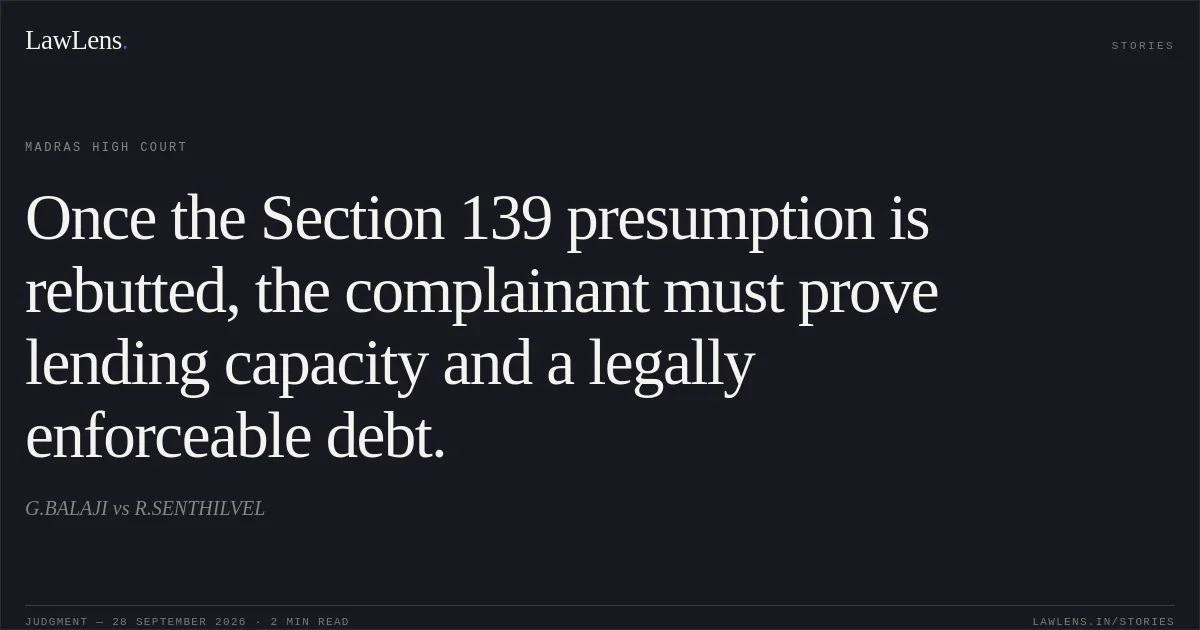
Whether the petitioner rebutted the statutory presumption that the cheque was issued towards a legally enforceable debt or liability.
Source reference: pp. 5–6Whether the respondent, after the presumption was rebutted, established his capacity to lend ₹9,00,000 in cash and that the cheque represented a legally enforceable debt.
Source reference: pp. 5–6Law Applied
The Court applied Section 138 of the Negotiable Instruments Act, under which a person may be convicted for dishonour of a cheque issued towards a legally enforceable debt or liability, and the statutory presumption applicable to a signed cheque.
Source reference: pp. 1, 5–6The Court proceeded on the principle that the accused may rebut that presumption by raising a probable defence; once rebutted, the evidential burden shifts to the complainant to establish the debt and, in the circumstances of this case, the capacity to advance the claimed amount.
Source reference: pp. 5–6The revision was considered under Sections 397 and 401 CrPC.
Source reference: p. 1No precedents were cited in the judgment.
Source reference: pp. 1, 5–6Reasoning
The Court found that the petitioner raised a probable defence through his bank statement, the Bank Manager’s evidence, and the sequence of cheque numbers: the cheque immediately before the disputed cheque had been used on 14 July 2014, and the cheque immediately after it on 17 July 2014.
Source reference: pp. 4–5Those facts supported the petitioner’s account that the disputed cheque was given as security for the July 2014 loan; the evidence that the parties’ transactions were conducted through banks and that the petitioner had stopped payment further supported that defence.
Source reference: pp. 4–5The Court therefore held that the statutory presumption had been rebutted, shifting the burden to the respondent.
Source reference: pp. 5–6Although the respondent said he had borrowed from his sister and sold property to obtain the money, he produced no documents substantiating those claims.
Source reference: pp. 5–6The Court concluded that he had not established his capacity to lend the sum or that the cheque was issued for a legally enforceable debt.
Source reference: pp. 5–6Holding
The Court held that the lower courts’ finding that the petitioner had failed to rebut the statutory presumption was contrary to the record and not in accordance with law.
It set aside the finding of guilt, acquitted the petitioner of the offence under Section 138 of the Negotiable Instruments Act, and allowed the criminal revision.
Source reference: p. 6Acts & Sections Cited
3 provisions across 2 statutes referred to in this judgment. Each provision opens on LawLens.
Code of Criminal Procedure, 19732
Negotiable Instruments Act, 18811
Original Court PDF
G.BALAJIvsR.SENTHILVEL
Click to open original judgment
Original judgment, available to read, download and summarize on LawLens.in