Facts
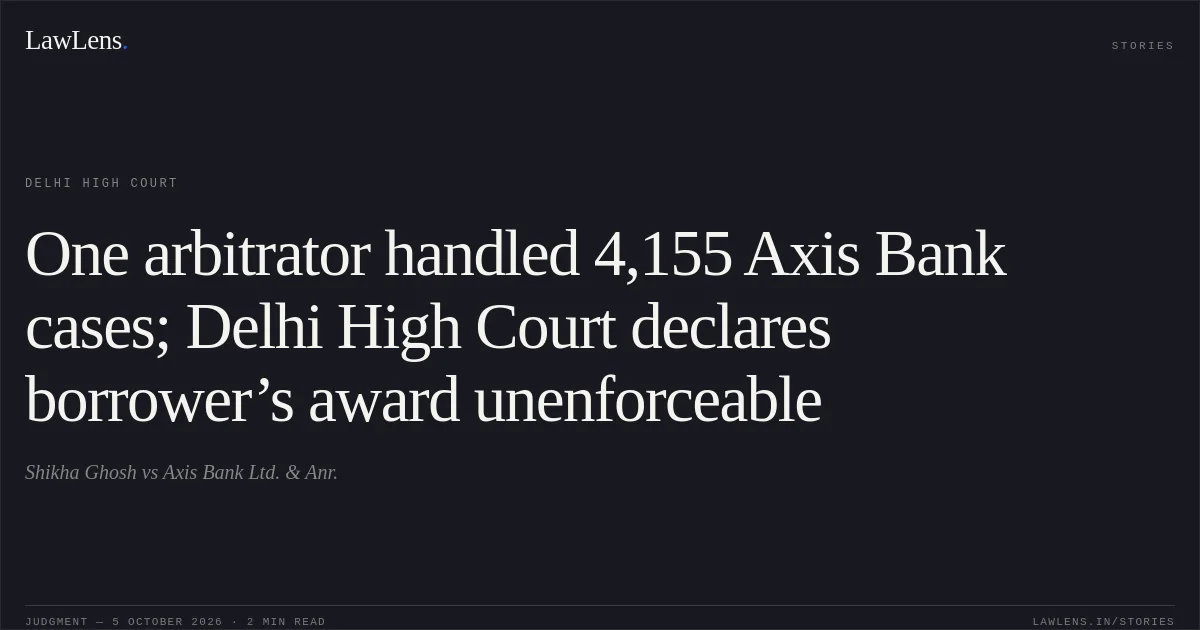
Axis Bank disbursed a loan of ₹16,66,795 to the appellant in January 2019 and later initiated arbitration.
Source reference: p. 1–2The appellant disputed receiving notice of the arbitration; the matter proceeded ex parte, and an award was made on 26 May 2023.
Source reference: p. 1–2After receiving the award on 2 June 2023, she filed a petition under Section 34 of the Arbitration and Conciliation Act, 1996 (“ACA”), which the Commercial Court dismissed as time-barred.
Source reference: p. 1–2In the appeal, the Bank stated that the sole arbitrator had handled 4,155 arbitrations for it over four to five years and that it had discontinued unilateral appointments from 2023
Source reference: p. 1–2, 4–5, 7–8Issues
1. Whether the award could be enforced where proof of service of the arbitral proceedings was disputed and the Bank identified no proof beyond the arbitrator’s recital in the award
Source reference: p. 3–52. Whether an award made by an arbitrator unilaterally appointed by the Bank, who had handled thousands of its cases, was unenforceable for want of independence and impartiality
Source reference: p. 5–83. Whether the appeal should succeed notwithstanding the Commercial Court’s dismissal of the Section 34 petition as time-barred
Source reference: p. 1–2, 9–10Law Applied
Section 12 of the ACA requires arbitrators to disclose circumstances likely to give rise to justifiable doubts about their independence or impartiality; the Fifth Schedule identifies circumstances relevant to such doubts, including an arbitrator’s appointment by a party on two or more occasions within the preceding three years (para. 22).
Source reference: p. 6–7The Court relied on the neutrality principle in Perkins Eastman Architects DPC v. HSCC (India) Ltd., (2020) 20 SCC 760, and Central Organisation for Railway Electrification v. ECI SPIC SMO MCML (JV), (2025) 4 SCC 641, as well as Delhi High Court decisions addressing unilateral appointments.
Source reference: p. 7The judgment treats awards made following unilateral appointments in these circumstances as void and unenforceable.
Source reference: p. 7–9Reasoning
The Bank’s affidavit established that the arbitrator had conducted 4,155 arbitrations for it, while the Bank also conceded that awards arising from its unilateral appointments were void ab initio.
Source reference: p. 5, 7–8The Court considered that scale of repeated appointments incompatible with the independence and neutrality required by Section 12, including when assessed against the Fifth Schedule’s indicators.
Source reference: p. 6–8As to service, the Bank relied on the arbitrator’s statement in the award and the appellant’s receipt of the award, but the Court found no independent proof of service of notices in the arbitral proceedings.
Source reference: p. 4–5In light of the Bank’s position on the invalidity of the appointment, the Court held the award unenforceable; it did not separately explain its treatment of the limitation ground on which the Section 34 petition had been dismissed.
Source reference: p. 1–2, 9Holding
The appeal succeeded, and the award dated 26 May 2023 was declared unenforceable against the appellant.
The Bank was left free to take fresh steps for recovery, if permissible in law.
Source reference: p. 10The Court also directed the Bank to file a further affidavit concerning the reasons for repeated appointments and its future course regarding affected awards, and directed the RBI to file an affidavit and caution banks and financial institutions on the issue.
Source reference: p. 9–10The matter was listed for further hearing.
Source reference: p. 10Acts & Sections Cited
5 provisions across 1 statute referred to in this judgment. Each provision opens on LawLens.
Arbitration and Conciliation Act, 19965
Original Court PDF
Shikha GhoshvsAxis Bank Ltd. & Anr.
Click to open original judgment
Original judgment, available to read, download and summarize on LawLens.in