Facts
The Petitioner, a member of the Revanta Multi State CGHS Ltd ("Society"), filed a writ petition under Article 226 of the Constitution challenging an election notice issued on January 19, 2026, by the Co-operative Election Authority.
Source reference: para. 2–3The Petitioner sought to reschedule the elections set for March 29, 2026, alleging that the electoral roll was published incorrectly and voter eligibility was not properly verified.
Source reference: para. 2This Society had been the subject of prior litigation (Mukesh Kumar v. Central Registrar of Cooperative Societies Ors.), where the Court observed that the Managing Committee had lost its mandate and directed fresh elections.
Source reference: para. 5In that previous proceeding, the Court specifically noted that any member aggrieved by the election process must seek remedies after the elections are concluded.
Source reference: para. 5–6Issues
1. Whether the Court should interdict or reschedule the scheduled elections of the Society based on allegations of an improper electoral roll and lack of voter verification.
Source reference: para. 2, 72. Whether a writ petition challenging the election process is maintainable while the election process is underway.
Source reference: para. 8, 10Law Applied
The Court considered Sections 28 and 29 of the Multi-State Cooperative Societies Act, 2002, which govern the preparation of the list of eligible members and the duties of the Returning Officer.
Source reference: para. 4It applied the established judicial principle that Courts should generally refrain from interfering in the election process once notified, particularly when an independent authority (such as the District Magistrate/Collector) is overseeing the process.
Source reference: para. 7The Court further relied on its own prior ruling in Mukesh Kumar v. Central Registrar of Cooperative Societies Ors., which established that grievances regarding the election process in this specific Society should be addressed through post-election remedies.
Source reference: para. 5–6, 15Reasoning
The Court reasoned that since the polling date (March 29, 2026) was imminent, staying the elections would be detrimental to the interests of the Society and its 4,000+ members.
Source reference: para. 7–8The Court emphasized that the Returning Officer—the District Magistrate/Collector of South-West Delhi—is an independent official, and it is presumed the provisional membership list was drawn according to eligibility criteria.
Source reference: para. 7The Court noted that entertaining individual writ petitions at this stage would effectively prevent the election from ever being completed.
Source reference: para. 8The Bench also highlighted a procedural impropriety: the Petitioner’s counsel was himself the petitioner in a related previous writ regarding the same Society, suggesting he should not have appeared as counsel in this matter.
Source reference: para. 9Ultimately, the Court found no reason to depart from its earlier directive that any election-related grievances must be pursued after the conclusion of the polls.
Source reference: para. 10Holding
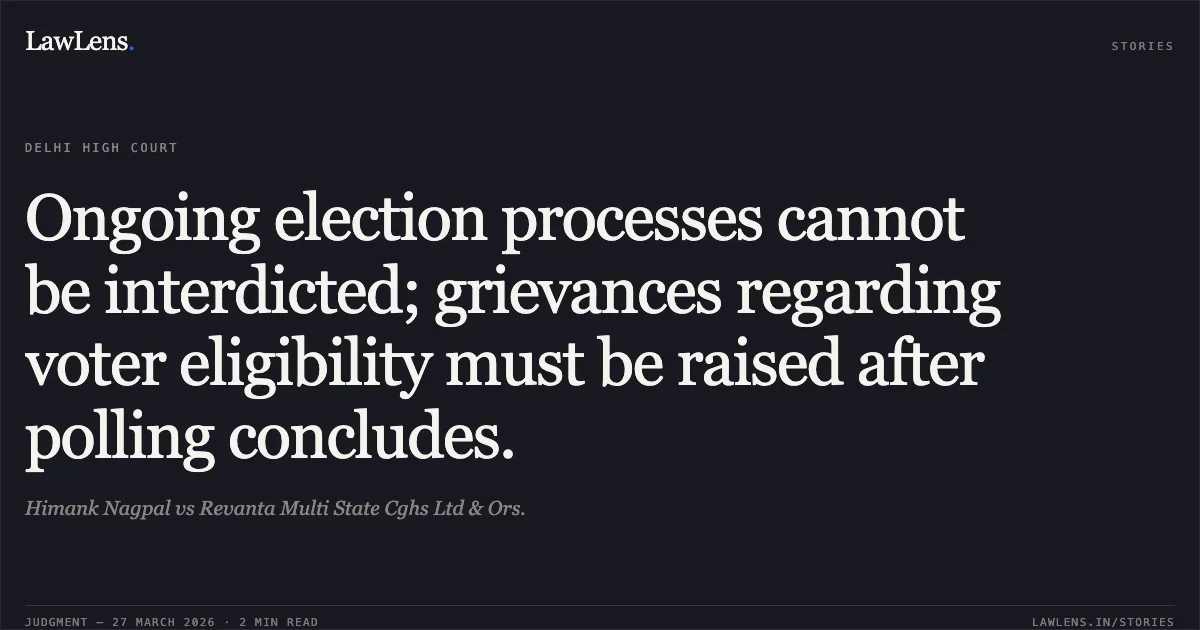
The Court declined to entertain the writ petition and refused to stay or reschedule the elections.
It held that the Petitioner is free to avail of legal remedies in accordance with the law only after the elections are concluded.
Source reference: para. 10The petition and all pending applications were disposed of without granting the requested relief.
Source reference: para. 11Acts & Sections Cited
2 provisions across 1 statute referred to in this judgment. Each provision opens on LawLens.
Multi-State Co-operative Societies Act, 20022
Original Court PDF
Himank NagpalvsRevanta Multi State Cghs Ltd & Ors.
Click to open original judgment
Original judgment, available to read, download and summarize on LawLens.in


![Subsequent exoneration does not retrospectively invalidate a finalized promotion select list.. UNNIKRISHNAN M vs M/o Environment And Forests. CAT - ['Ernakulam']. LawLens](/stories/thumbnails/subsequent-exoneration-does-not-retrospectively-invalidate-a-finalized-promotion-select-li-ce80a0e84f2f4887857271e8b4341c42.webp)