Facts
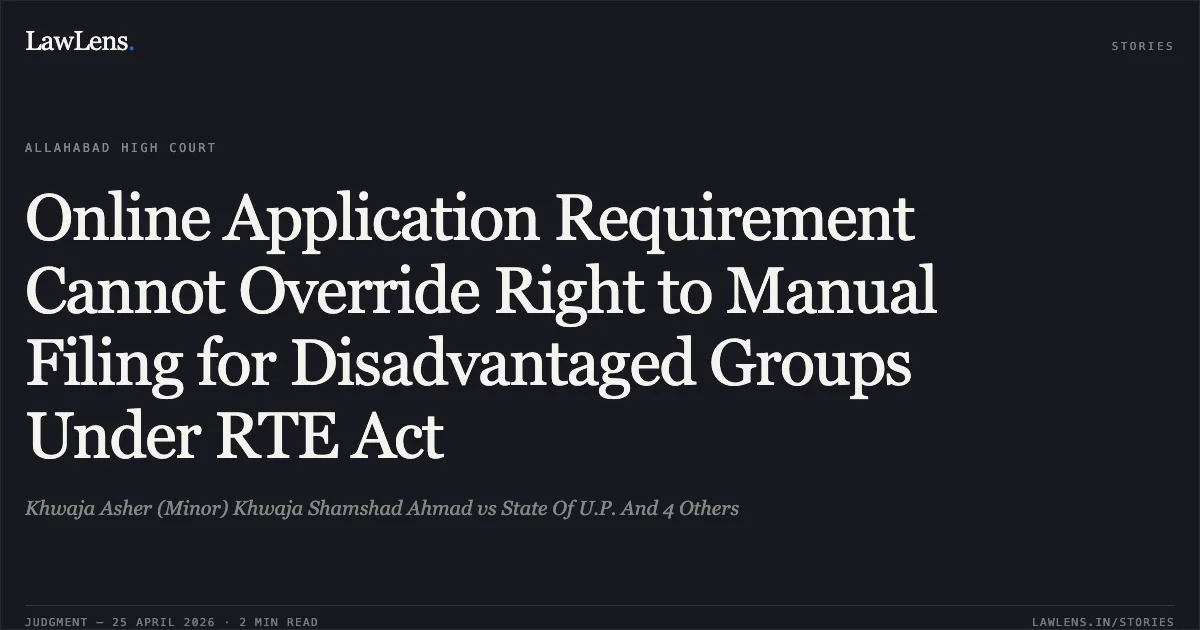
The petitioner, a minor represented by his father, sought a writ of mandamus to secure admission into Class Nursery under the 25% quota for weaker sections and disadvantaged groups.
Source reference: para 1-2The petitioner submitted a manual application to the District Basic Siksha Adhikari (BSA), Prayagraj, on April 5, 2023, citing an inability to upload the form online.
Source reference: para 3The State-respondents resisted the admission, contending that based on a series of Government Orders (G.O.) and notifications, the application process for the 2023-24 academic session had been transitioned exclusively to an online portal.
Source reference: para 5-7The petitioner relied on G.O. dated 03.03.2016 and a notification dated 06.02.2017, which mandated BSAs to facilitate manual applications for those unable to use the online system.
Source reference: para 3-4Issues
1. Whether the State can mandate an exclusively online application process for admissions under Section 12(1)(c) of the RTE Act, thereby rejecting manual applications.
Source reference: para 11-132. Whether the mandate of Section 12(1)(c) of the RTE Act and the underlying constitutional objectives are defeated by technical procedural requirements.
Source reference: para 11-15Law Applied
Section 12(1)(c) of the Right of Children to Free and Compulsory Education Act, 2009 (RTE Act), which requires private unaided schools to admit at least 25% of their strength from weaker sections and disadvantaged groups.
Source reference: para 2Article 21-A of the Constitution of India (inserted via the 86th Amendment Act, 2002), which makes free and compulsory education a fundamental right for children aged 6 to 14.
Source reference: para 8The court also invoked Directive Principles of State Policy regarding education.
Source reference: para 9The Government Order dated 03.03.2016, which cast a duty on the BSA to facilitate manual applications if parents are unable to apply online.
Source reference: para 3, 12Reasoning
The Court rejected the State's argument that online-only applications were mandatory. It observed that the communication dated 30.01.2023 did not expressly amend or rescind the 2016 G.O. allowing manual filings.
Source reference: para 7Critically, the Court reasoned that insisting on an online-only portal would defeat the "Statement of Objects and Reasons" of the 86th Constitutional Amendment and the RTE Act, as the intended beneficiaries are often underprivileged and lack the digital literacy or infrastructure to navigate online systems.
Source reference: para 11, 13The Court noted a significant shortfall in actual admissions vs. school allotments (approx. 1,300 vacant seats per session), identifying an "inherent defect" in implementation and school allotment.
Source reference: para 14-15While acknowledging that online systems improve transparency, the Court held that the State must bear the "onerous duty" of facilitating online filings through the BSA's office for those who cannot do so themselves.
Source reference: para 17-18Holding
The Court held that manual applications cannot be prohibited given the socio-economic status of the target group.
The Court allowed the writ petition and issued a mandamus directing Respondent No. 2 (BSA, Prayagraj) to process the petitioner’s application within one week.
Source reference: para 19, 22It directed the State (Respondent No. 1) to circulate the judgment to all BSAs in Uttar Pradesh and suggested the creation of a "Standard Operating Procedure" (SOP) to assist disadvantaged parents in filing applications through BSA offices to ensure no child is denied education due to technical barriers.
Source reference: para 21Acts & Sections Cited
2 provisions across 1 statute referred to in this judgment. Each provision opens on LawLens.
Right of Children to Free and Compulsory Education Act, 20092
Original Court PDF
Khwaja Asher (Minor) Khwaja Shamshad AhmadvsState Of U.P. And 4 Others
Click to open original judgment
Original judgment, available to read, download and summarize on LawLens.in