Facts
The Appellant/Plaintiff filed a suit for trademark and copyright infringement regarding the mark "RADHEY KRISHNA" used for incense sticks.
Source reference: para. 3The Plaintiff operates from Ajmer, Rajasthan, but filed the suit in Delhi, alleging that the Defendants (also based in Ajmer) were selling infringing goods in Delhi markets and through interactive e-commerce platforms like IndiaMart.
Source reference: paras. 8-9Initially, the Trial Court rejected the plaint for lack of jurisdiction, but the High Court restored it for trial.
Source reference: paras. 10-11After a full trial, the District Judge again directed the return of the plaint under Order VII Rule 10 CPC, holding that since both parties were from Ajmer and the Local Commissioner's seizure happened there, no substantial cause of action arose in Delhi.
Source reference: paras. 12, 21Issues
1. Whether the accessibility of interactive e-commerce websites and evidence of online sales within a forum’s territory are sufficient to establish territorial jurisdiction under Section 20(c) of the CPC and Section 134 of the Trade Marks Act.
Source reference: paras. 33, 452. Whether the rule laid down in IPRS v. Sanjay Dalia precludes a Plaintiff from suing in a forum where a part of the cause of action arises if both parties reside at a different common location.
Source reference: paras. 19, 48Law Applied
The Court applied Section 20(c) of the CPC, which allows suits where the cause of action arises "wholly or in part".
Source reference: para. 16It relied on Section 134 of the Trade Marks Act and Section 62 of the Copyright Act, which provide an additional forum based on the Plaintiff's residence/business.
Source reference: para. 46Regarding "purposeful availment" in the digital age, the Court followed the precedents of World Wrestling Entertainment (WWE), Inc. v. Reshma Collection, which held that interactive websites constitute "carrying on business" wherever they are accessible.
Source reference: paras. 10, 55Kohinoor Seed Fields India Pvt. Ltd. v. Veda Seed Sciences Pvt. Ltd., which established that online commercial targeting creates a jurisdictional nexus.
Source reference: para. 56It also clarified the limits of Indian Performing Rights Society (IPRS) v. Sanjay Dalia, stating it prevents forum shopping via branch offices but does not override Section 20(c).
Source reference: paras. 48-51Reasoning
The High Court found that the Trial Court adopted an "unduly narrow" interpretation of jurisdiction.
Source reference: para. 45It reasoned that the IPRS judgment only prohibits invoking a "wholly disconnected" forum; it does not bar a suit where a substantive part of the cause of action independently arises under Section 20(c) CPC.
Source reference: paras. 50-51The Court analyzed the evidence from the trial: (i) the Plaintiff proved actual commercial deliveries in Delhi via the "Instamojo" platform; and (ii) the Defendants admitted during cross-examination that their business particulars were listed on IndiaMart, a platform they used to target customers globally, including Delhi.
Source reference: paras. 52, 53, 63Applying the "bundle of facts" test from ABC Laminart and Om Prakash Srivastava, the Court held that purposeful commercial availment through interactive websites constitutes a material part of the cause of action.
Source reference: paras. 64-66, 70Thus, the territorial nexus was established not just by pleadings, but by proven evidentiary facts.
Source reference: para. 71Holding
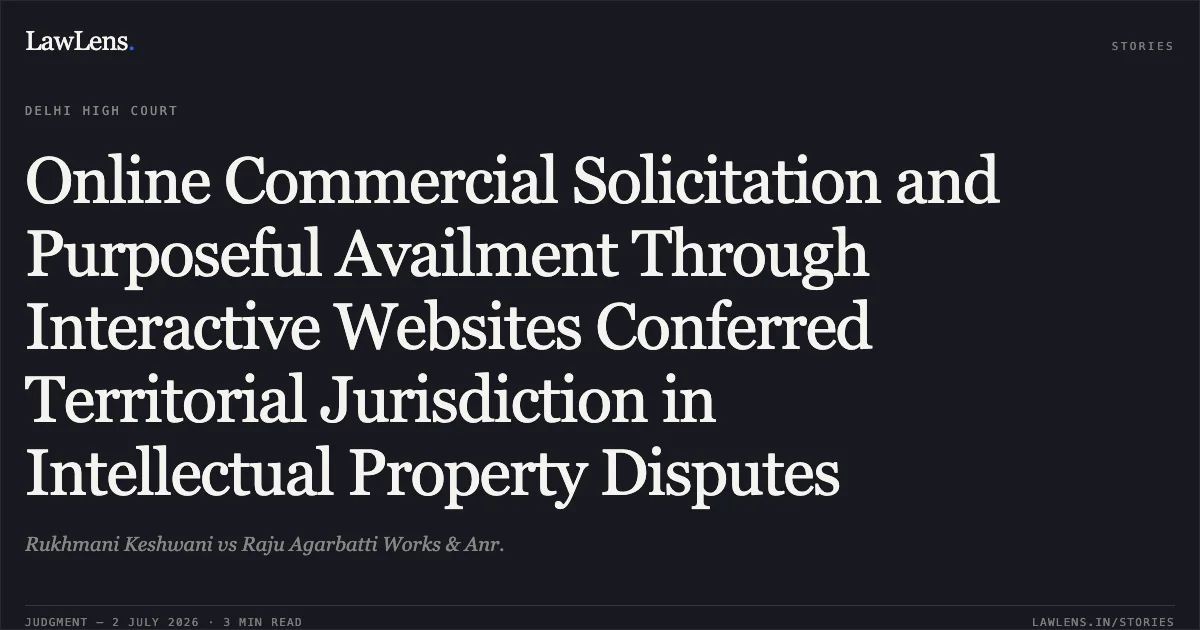
The High Court set aside the Trial Court's judgment, holding that the Delhi Courts possessed territorial jurisdiction.
The Court answered that online solicitation and proven deliveries within Delhi satisfy the requirements of Section 20(c) CPC and Section 134 of the Trade Marks Act.
Source reference: paras. 70, 74The suit was restored to its original number, and parties were directed to appear before the District Judge on July 10, 2026, for further proceedings on merits.
Source reference: paras. 78-79Acts & Sections Cited
10 provisions across 3 statutes referred to in this judgment. Each provision opens on LawLens.
Code of Civil Procedure, 19083
Trade Marks Act, 19994
Copyright Act, 19573
Original Court PDF
Rukhmani KeshwanivsRaju Agarbatti Works & Anr.
Click to open original judgment
Original judgment, available to read, download and summarize on LawLens.in