Facts
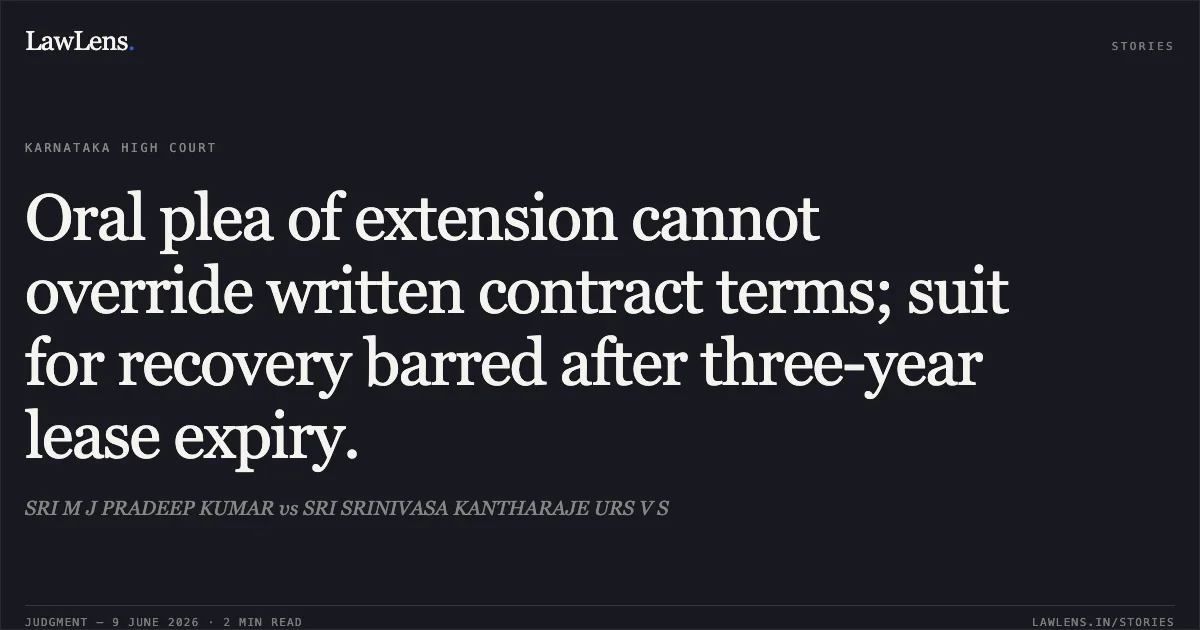
The Plaintiff (Respondent No. 1) entered into a lease deed dated 25.04.2009 with M/s. Raghavendra Enterprises (represented by the Appellant and deceased Defendant No. 2) to lease out his cable TV network business, including equipment and 574 subscribers.
Source reference: p. 4, 9-11The lease was for a three-year term from 01.05.2009 to 30.04.2012 at a monthly rent of ₹35,000/-.
Source reference: p. 9The Plaintiff alleged that after the lease expired, the Defendants orally agreed to extend the lease and failed to pay rent after April 2012.
Source reference: p. 5The Plaintiff issued a termination notice on 14.11.2016 and filed the suit in 2017.
Source reference: p. 5The Commercial Court ruled in favor of the Plaintiff, awarding arrears, damages, and ordering the return of the business.
Source reference: p. 3-4The Appellant challenged this on the grounds of limitation and lack of evidence regarding the lease extension.
Source reference: p. 6, 8Issues
1. Whether the suit filed by the Plaintiff in 2017 for claims arising out of a lease deed that expired in 2012 was barred by the law of limitation?
Source reference: p. 7, 162. Whether there was a valid oral agreement to extend the lease beyond the stipulated period of 30.04.2012?
Source reference: p. 6, 113. Whether the Plaintiff proved the entitlement to damages and the continued possession of the business by the Defendants?
Source reference: p. 7, 15Law Applied
Article 52 of the Limitation Act, 1963, which prescribes a three-year period for the recovery of arrears of rent from the date they become due.
Source reference: p. 16Article 55 of the Limitation Act regarding compensation for breach of contract (three years from the date of breach) and Article 113 for general suits where no period is provided (three years from when the right to sue accrues).
Source reference: p. 16Section 92 of the Indian Evidence Act, 1872, which stipulates that oral evidence cannot be admitted to contradict or vary the terms of a written contract.
Source reference: p. 15Reasoning
The Court found that the lease deed expressly expired on 30.04.2012.
Source reference: p. 11Under Section 92 of the Evidence Act, the Plaintiff's claim of an oral extension was legally unsustainable as it sought to modify a written agreement without documentary proof.
Source reference: p. 15Evidence indicated that the "control room" of the business had been shifted to the Plaintiff's own residence by 2013, suggesting the Defendants were no longer in exclusive control.
Source reference: p. 13-14Since the Defendants stopped paying rent after April 2012, the cause of action for recovery of rent and assets accrued on 01.05.2012.
Source reference: p. 16Consequently, the suit filed in 2017 (O.S. No. 93/2017) was significantly beyond the three-year limitation period prescribed under Articles 52 and 55 of the Limitation Act.
Source reference: p. 16The Court noted that the Commercial Court's award of ₹50,000/- per month in damages lacked any evidentiary basis or consideration of equipment depreciation.
Source reference: p. 15-16Holding
The High Court answered the issues in favor of the Appellant, holding that the suit was barred by limitation as the right to sue accrued upon the expiry of the lease in 2012.
The Court set aside the Commercial Court’s judgment and decree dated 04.09.2025. The appeal was allowed, effectively dismissing the Plaintiff’s suit for recovery of rent, damages, and business assets.
Source reference: p. 17Acts & Sections Cited
4 provisions across 2 statutes referred to in this judgment. Each provision opens on LawLens.
Commercial Courts Act, 20151
Limitation Act, 19633
Original Court PDF
SRI M J PRADEEP KUMARvsSRI SRINIVASA KANTHARAJE URS V S
Click to open original judgment
Original judgment, available to read, download and summarize on LawLens.in