Facts
The petitioner challenged the Foreigners Tribunal No. 1, Barpeta’s opinion dated 20 August 2018 declaring her a foreigner who entered Assam after 25 March 1971.
Source reference: para. 2–3She claimed Indian citizenship through her projected parents, Abdul Hakim and Sarifan Nessa, whose names appeared in electoral rolls of 1966 and 1970.
Source reference: para. 12, 14–20To establish linkage, she relied on her own testimony, testimony from a projected brother and a Gaonburah, electoral records, and a Gaonburah certificate.
Source reference: para. 12, 14–20The Tribunal answered the reference against her, and she sought judicial review under Article 226.
Source reference: para. 2, 5Issues
1. Whether the petitioner established, by sufficient evidence, her linkage to her projected parents and thereby discharged the burden under Section 9 of the Foreigners Act, 1946
Source reference: para. 13–21, 232. Whether the Tribunal’s opinion declaring the petitioner a foreigner disclosed an infirmity warranting interference under Article 226
Source reference: para. 28–30Law Applied
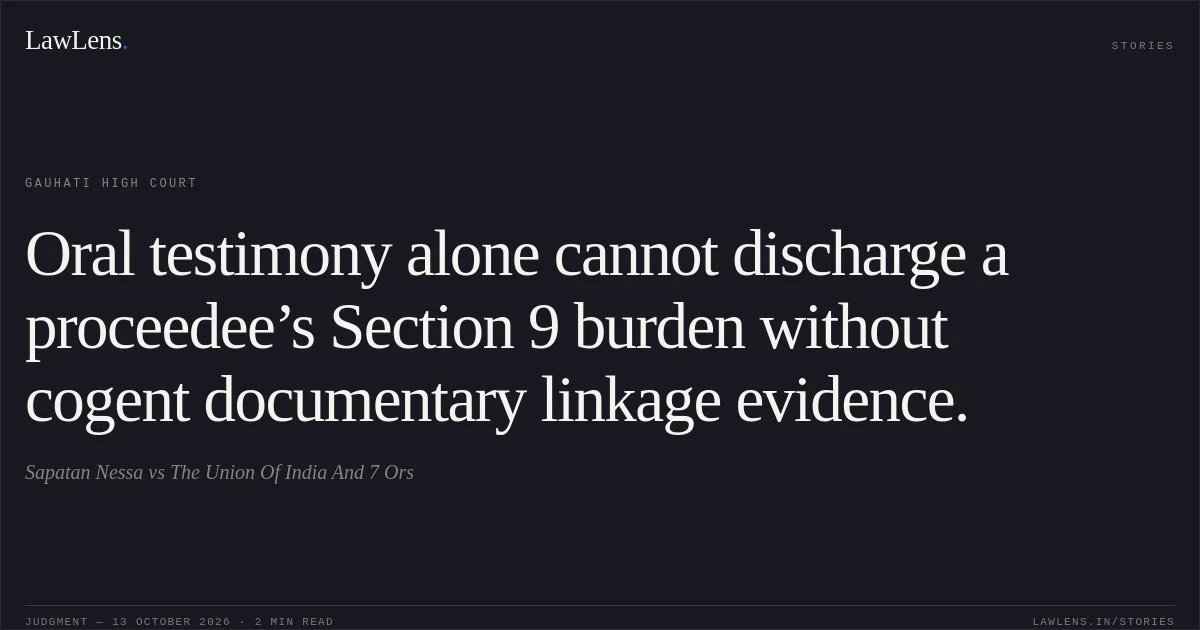
Section 9 of the Foreigners Act, 1946 places on the proceedee the burden of proving that she is not a foreigner; the Court stated that this burden may be discharged on a preponderance of probability.
Source reference: para. 23A proceedee must set out necessary particulars, including relevant family details, in her written statement; material variance between pleadings and evidence, or omission of important particulars, weakens the discharge of that burden.
Source reference: para. 13Sarbananda Sonowal v. Union of India, 2005 (5) SCC 665, was cited in support of the requirement to provide particulars within the proceedee’s knowledge.
Source reference: para. 13A reference must rest on reasonable grounds; applying Rahim Ali @ Rahim v. Union of India, 2014 0 Supreme (SC) 575, the Court found that the field verification and inability to furnish documents supplied such grounds in this case.
Source reference: para. 22–23Reasoning
The 1966 and 1970 electoral rolls showed the presence of the petitioner’s projected parents in India before the cut-off date, but did not establish her relationship to them.
Source reference: para. 14The petitioner’s written statement did not mention the projected brother who later testified, and her own evidence did not name him.
Source reference: para. 13, 15The brother’s voter identification record named his father as Hakibar Ali, not Abdul Hakim; the Gaonburah certificate likewise named Hakibar Ali, and the Gaonburah’s testimony was not supported by contemporaneous records establishing its basis.
Source reference: para. 17, 19–21The Court therefore found the oral evidence and certificate insufficient to establish linkage, and held that the petitioner had not discharged her Section 9 burden.
Source reference: para. 28–29Holding
The Court held that the petitioner failed to prove linkage to her projected parents and that no infirmity in the Tribunal’s opinion justified interference.
The writ petition was dismissed, any interim order was vacated, and the original record was directed to be returned to the Tribunal.
Source reference: para. 30–32Acts & Sections Cited
1 provisions across 1 statute referred to in this judgment. Linked provisions open on LawLens.
Foreigners Act, 19461
Original Court PDF
Sapatan NessavsThe Union Of India And 7 Ors
Click to open original judgment
Original judgment, available to read, download and summarize on LawLens.in