Facts
The petitioner was the subject of a reference made by the Superintendent of Police (B), Nagaon, questioning her citizenship (F.T. Case No. 1184/2011)
Source reference: p. 3Before the Foreigners Tribunal No. 2, Nagaon, the petitioner filed a written statement claiming her father, Radha Charan Paul, migrated from East Pakistan and registered in India in 1960
Source reference: p. 4She produced ten documents, including a 1960 Registration Certificate, 1971 Voter List (naming her projected brother), and a Gaonburah certificate
Source reference: p. 4the petitioner did not depose herself, relying on her projected brother (DW-2) and a Gaonburah (DW-1)
Source reference: p. 3, 12The Tribunal declared her a foreigner post-25.03.1971, finding she failed to discharge her burden of proof
Source reference: p. 3The petitioner challenged this opinion via a Writ Petition under Article 226
Source reference: p. 2Issues
1. Whether the petitioner discharged the burden of proof under Section 9 of the Foreigners Act, 1946, to establish her Indian citizenship through cogent evidence
Source reference: p. 3, 92. Whether the petitioner is entitled to benefits under the Immigrants (Expulsion From Assam) Act, 1950, or the Citizenship (Amendment) Act, 2019
Source reference: p. 5, 14Law Applied
The court applied Section 9 of the Foreigners Act, 1946, which mandates that the burden of proving that a person is not a foreigner lies solely upon the proceedee, notwithstanding the Evidence Act
Source reference: p. 9This was supported by the "Sarbananda Sonowal v. Union of India" (2005) principle, requiring disclosure of specific personal facts like date/place of birth and parental details
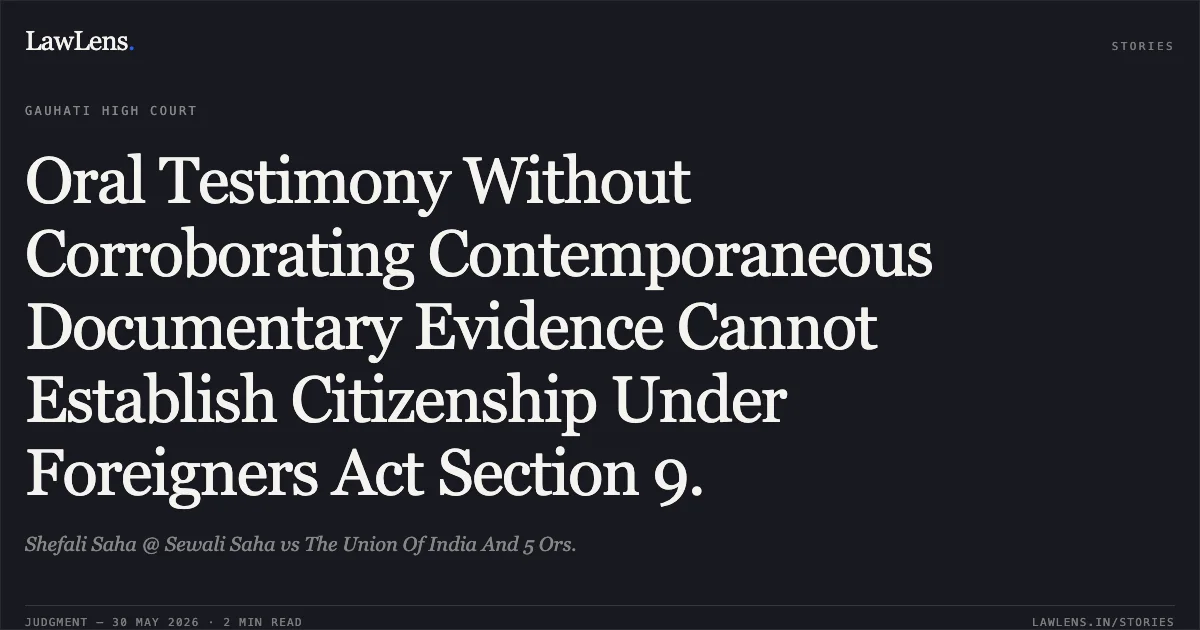
Source reference: p. 6Per "Nur Begum v. Union of India" (2020), oral testimony without corroborating documentary evidence of a contemporaneous period is insufficient to prove citizenship
Source reference: p. 12Regarding local certificates, "Khudeja Khatoon v. Union of India" (2018) and "State of Assam v. Ohab Ali" (2018) establish that Gaonburah certificates lack probative value if not backed by contemporaneous records or if they use the National Emblem without authorization
Source reference: p. 7, 13Reasoning
The Court found the petitioner’s written statement "vague" and lacking essential details required by the Sonowal precedent, such as her exact date of birth or comprehensive family details
Source reference: p. 6, 11While the 1960 Registration Certificate of the father and the 1971 Voter List of the brother were noted, the Court observed a total "lack of linkage" between those individuals and the petitioner
Source reference: p. 11The oral testimony of the projected brother (DW-2) could not substitute for documentary linkage
Source reference: p. 11-12The Gaonburah certificate (Ext-3) was rejected because the issuer (DW-1) admitted he became Gaonburah only in 2013 (long after the facts certified), lacked contemporaneous records to support the contents, and unauthorizedly used the National Emblem
Source reference: p. 12-13Consequently, the Court held that the petitioner failed to satisfy the "summary" but rigorous requirements of Section 9
Source reference: p. 14Holding
The Court answered that the petitioner failed to discharge her burden of proof and affirmed the Tribunal's decision
The Writ Petition was dismissed. However, regarding the alternative plea, the Court held that while the petitioner did not meet the standards for existing citizenship, she remains at liberty to apply for benefit under the Citizenship (Amendment) Act, 2019, provided she can establish she belongs to the specific class of persons entitled to relief under that Act. The Tribunal's records were ordered to be returned for further legal action
Source reference: p. 14Acts & Sections Cited
4 provisions across 3 statutes referred to in this judgment. Linked provisions open on LawLens.
Foreigners Act, 19462
Immigrants (Expulsion From Assam) Act, 19501
Citizenship Act, 19551
Original Court PDF
Shefali Saha @ Sewali SahavsThe Union Of India And 5 Ors.
Click to open original judgment
Original judgment, available to read, download and summarize on LawLens.in