Facts
The petitioner, Saken Ali, was proceeded against for determination of his citizenship after a reference was made by the Superintendent of Police (Border), Goalpara.
Source reference: no citationInitially, an ex parte opinion was passed against him in 2009, which was later set aside by the High Court in 2017, granting him a fresh opportunity to prove his citizenship.
Source reference: p. 9-10In his written statement, the petitioner claimed he was born in Katlamari, Assam, to one Babur Ali whose name appeared in the 1966 and 1970 voter lists.
Source reference: p. 3During the hearing, he produced several voter lists (1966, 1970, 1989, 1997) and examined himself and his projected father (DW-2).
Source reference: p. 4-5The Foreigners Tribunal No. 1, Goalpara, by opinion dated 17.07.2017, declared him a foreigner of the post-25.03.1971 stream due to material contradictions in testimony and lack of admissible linkage documents.
Source reference: p. 3, 6Issues
1. Whether the petitioner discharged his burden of proof under Section 9 of the Foreigners Act, 1946 to establish his Indian citizenship.
Source reference: p. 7 / para. 182. Whether the discrepancies in oral testimony and the lack of pleadings regarding specific voter lists vitiated the petitioner’s claim of linkage to his projected father.
Source reference: p. 8 / para. 163. Whether the perfunctory nature of the initial inquiry report or the wording of the reference notice invalidated the Tribunal's proceedings.
Source reference: p. 13-14 / para. 27-31Law Applied
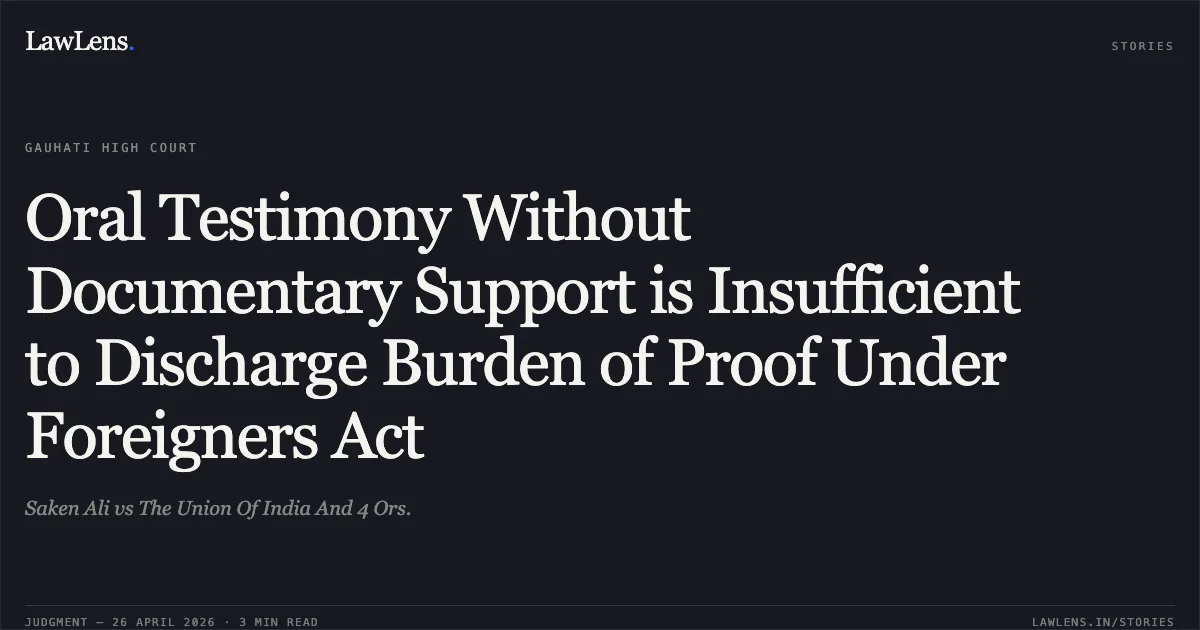
The court primarily applied Section 9 of the Foreigners Act, 1946, which mandates that the burden of proving that a person is not a foreigner lies upon such person.
Source reference: p. 7, 15It relied on Section 6-A of the Citizenship Act, 1955, which defines the cut-off dates for citizenship in Assam.
Source reference: p. 19-20Precedents such as Sarbananda Sonowal v. Union of India (2005) established that the burden of proof remains on the proceedee regardless of the nature of the initial inquiry.
Source reference: p. 14-15The court also applied the principle that evidence beyond pleadings is inadmissible, as held in Rashminara Begum v. Union of India.
Source reference: p. 11Oral testimony regarding lineage must be supported by cogent documentary evidence as per Nur Begum v. Union of India.
Source reference: p. 12Reasoning
The Court observed that the petitioner’s evidence was largely beyond his pleadings; he referred only to the 1966 voter list in his written statement but attempted to rely on subsequent lists (1989, 1997) during evidence without seeking a valid amendment.
Source reference: p. 10-11Upon analyzing the oral testimony, the Court found fatal contradictions: the petitioner (DW-1) claimed his father had one wife, while the projected father (DW-2) testified to having two wives. Furthermore, DW-2 could not identify the petitioner's father-in-law or the daughter-in-law’s village.
Source reference: p. 6Applying the 'preponderance of probability' standard, the Court held that these inconsistencies, coupled with the absence of any document (such as a birth certificate or school certificate) linking the petitioner to the person named in the 1966 voter list, meant the petitioner failed to prove his linkage.
Source reference: p. 10, 12Regarding procedural lapses, the Court held that under Section 9, a perfunctory police inquiry does not exempt the suspect from proving their citizenship before the Tribunal.
Source reference: p. 15Holding
The Court answered the issues in the negative, holding that the petitioner failed to discharge the burden of proof required to establish his citizenship.
The Court upheld the Tribunal's opinion that the petitioner is a foreigner who entered Assam on or after 25.03.1971; the writ petition was dismissed, and the court affirmed that under certiorari jurisdiction, it cannot act as an appellate court to re-weigh facts unless there is manifest perversity.
Source reference: p. 22 / para. 39The Registry was directed to return the Tribunal records for relevant consequential actions.
Source reference: p. 23Acts & Sections Cited
3 provisions across 2 statutes referred to in this judgment. Linked provisions open on LawLens.
Foreigners Act, 19462
Citizenship Act, 19551
Original Court PDF
Saken AlivsThe Union Of India And 4 Ors.
Click to open original judgment
Original judgment, available to read, download and summarize on LawLens.in


