Facts
The appellant/plaintiff filed a civil suit seeking a declaration that a sale deed dated 13.04.1977 was void and not binding, alongside reliefs for possession and permanent injunction
Source reference: para 2The plaintiff alleged that his deceased father intended only to execute a 20-year lease in favor of Defendant No. 1, but the defendants fraudulently executed an outright sale deed
Source reference: para 2Defendant No. 1 filed an application under Order 7 Rule 11 of the Code of Civil Procedure (CPC), contending the suit was barred by limitation and lacked a valid cause of action
Source reference: para 5The Trial Court rejected the plaint, holding the suit was filed decades after the statutory period prescribed under the Limitation Act
Source reference: para 7This was affirmed by the First Appellate Court
Source reference: para 8The plaintiff then approached the High Court in a Second Appeal under Section 100 of the CPC
Source reference: para 1Issues
Whether a plaint can be rejected under Order 7 Rule 11(d) of the CPC on the ground of limitation based solely on the averments made within the plaint.
Source reference: para 14-15Whether the concurrent findings of the lower courts regarding the bar of limitation and lack of cause of action involve a substantial question of law warranting interference under Section 100 of the CPC.
Source reference: para 16-18Law Applied
The Court primarily applied Order 7 Rule 11(d) of the CPC, which mandates the rejection of a plaint where the suit appears from the statements in the plaint to be barred by any law
Source reference: para 13It relied on Hardesh Ores (P) Ltd. vs. Hede and Company (2007) 5 SCC 614, establishing that "law" under Order 7 Rule 11(d) includes the law of limitation
Source reference: para 15the Court applied Section 100 of the CPC, which restricts the scope of a Second Appeal to "substantial questions of law" and prohibits interference with concurrent findings of fact unless they are perverse or recorded de hors the pleadings
Source reference: para 16, 20The Court also referenced State of Rajasthan vs. Shiv Dayal (2019) 8 SCC 637 regarding the limited grounds for challenging concurrent findings in a Second Appeal
Source reference: para 20Reasoning
The Court observed that the power under Order 7 Rule 11(d) is a procedural tool to filter out "sham litigation" at the threshold by looking strictly at the averments in the plaint
Source reference: para 14In this case, the plaintiff challenged a sale deed from 1977 in a suit instituted in 2018, nearly four decades later
Source reference: para 11The Court found that the plaintiff failed to specify when he obtained knowledge of the alleged fraud or irregularities to justify such a delay
Source reference: para 12Applying the principle that the law of limitation bars the remedy after the prescribed period, the Court held that the Trial Court was correct in rejecting the plaint as the statements therein clearly demonstrated the claim was time-barred
Source reference: para 15, 22Regarding the Second Appeal, the Court noted that the appellant sought a re-appreciation of evidence, which does not constitute a substantial question of law
Source reference: para 18The Court found no perversity or legal infirmity in the concurrent findings of the lower courts
Source reference: para 21-22Holding
The High Court dismissed the Second Appeal, upholding the judgments of the Trial Court and the First Appellate Court
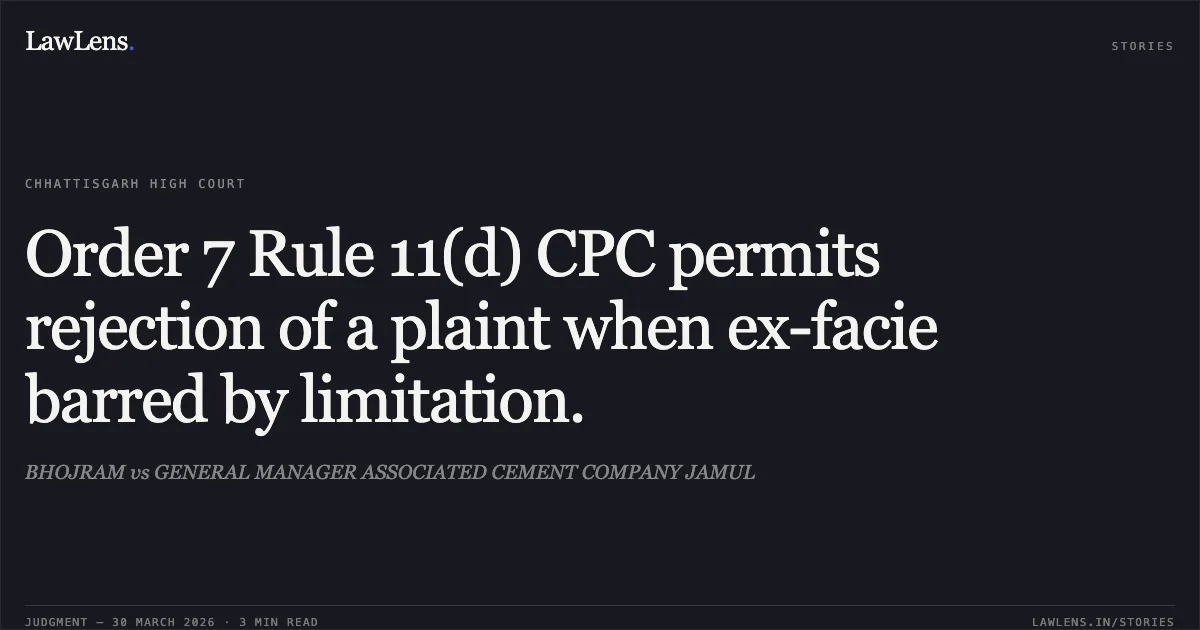
It held that the suit was clearly barred by limitation based on the plaintiff’s own pleadings, and therefore, the rejection of the plaint under Order 7 Rule 11(d) of the CPC was just and legal
Source reference: para 22The Court concluded that no substantial question of law arose for consideration
Source reference: para 21Acts & Sections Cited
4 provisions across 2 statutes referred to in this judgment. Each provision opens on LawLens.
Code of Civil Procedure, 19083
Limitation Act, 19631
Original Court PDF
BHOJRAMvsGENERAL MANAGER ASSOCIATED CEMENT COMPANY JAMUL
Click to open original judgment
Original judgment, available to read, download and summarize on LawLens.in