01Facts
The respondent-Trust, owner of a shop at Bazaar Nadrai Gate, Kasganj, instituted S.C.C. Suit No. 2 of 2019 seeking the petitioner’s eviction.
¶ 3–5The petitioner claimed that the tenancy had devolved from his grandfather to his father and thereafter to him in 2005, and that he had been paying rent at Rs.1,000 per month.
¶ 3–5He contended that rent had been tendered but was not accepted, and that rent for part of the disputed period had been deposited under Section 30(1) of the U.P. Act No. 13 of 1972.
¶ 6–8He also challenged the maintainability of the suit under Order VII Rule 11 CPC, asserting that the plaint disclosed no cause of action and lacked material particulars concerning the Trust, its Secretary’s authority, the notices, and the alleged arrears.
¶ 8The trial court framed an issue on rejection of the plaint under Order VII Rule 11 CPC and rejected the objection on 29 May 2024.
¶ 9–10The District Judge dismissed the petitioner’s revision on 27 August 2025.
¶ 11The petitioner consequently invoked the High Court’s supervisory jurisdiction under Article 227 of the Constitution.
¶ 1102Issues
i.1. Whether the plaint, on a meaningful reading and taking its averments at face value, disclosed a cause of action for eviction so as to avoid rejection under Order VII Rule 11(a) CPC?
¶ 14–18ii.2. Whether the petitioner’s objections concerning payment or deposit of rent, validity and service of notices, authority of the Trust and its Secretary, applicability of the U.P. Act No. 13 of 1972, and the effect of the earlier injunction decree warranted interference under Article 227?
¶ 23–3003Law Applied
The Court applied Order VII Rule 11(a) CPC, under which a plaint may be rejected where it does not disclose a cause of action.
¶ 15–19The plaint must be read meaningfully and as a whole, and the enquiry is confined to whether its material averments, assumed to be correct for that limited purpose, disclose a right to sue; the Court cannot conduct a mini-trial or test the truth of the allegations.
¶ 15–19The Court relied on T. Arivandandam v. T.V. Satyapal, (1977) 4 SCC 467, concerning the distinction between a real cause of action and an illusion created by clever drafting.
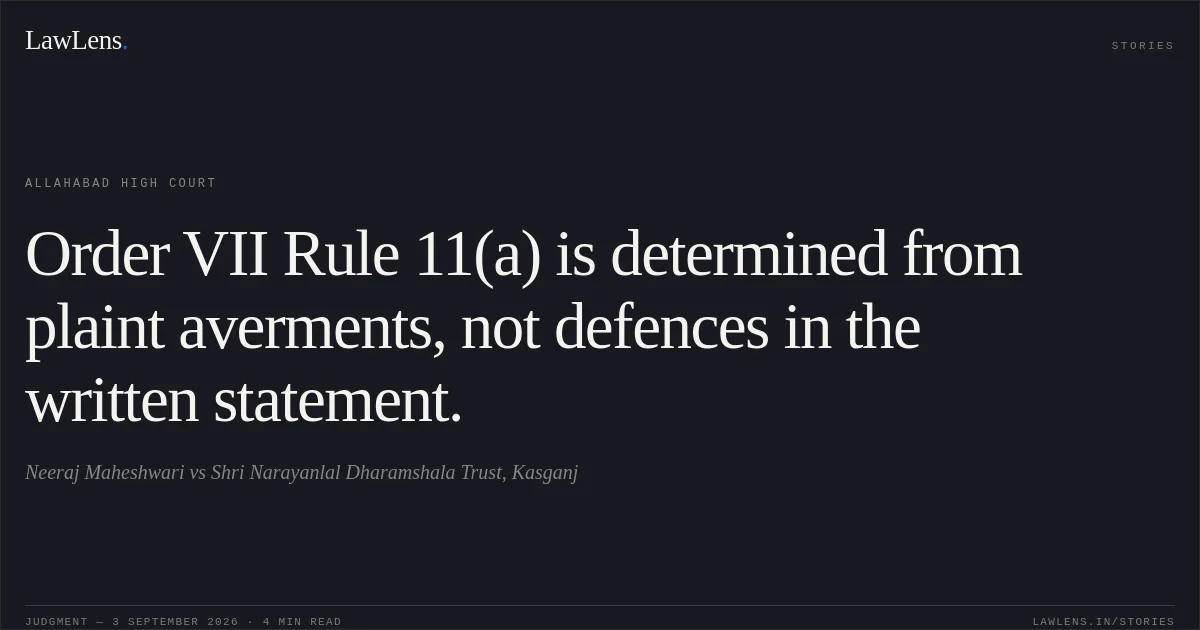
¶ 15The Court relied on Saleem Bhai v. State of Maharashtra, (2003) 1 SCC 557, holding that the averments in the plaint govern an application under Order VII Rule 11 and that the written statement is irrelevant for that enquiry.
¶ 16The Court relied on Dahiben v. Arvindbhai Kalyanji Bhanusali, (2020) 7 SCC 366, reiterating that the plaint must be read in its entirety without undertaking a mini-trial.
¶ 17The Court also applied the limited scope of supervisory jurisdiction under Article 227, which does not permit reappreciation of disputed factual and legal defences absent jurisdictional error, perversity, or manifest illegality.
¶ 27–28Provisions in the judgment · 1
U.P. Act No. 13 of 1972 (alias, unresolved) Section 30
04Reasoning
The plaint specifically pleaded the landlord–tenant relationship, the petitioner’s continued occupation, non-payment of rent from 1 October 2016, resulting arrears, demands for payment, issuance of notices dated 21 September 2017, 7 October 2017 and 1 November 2017, and failure to comply with those notices.
¶ 20–22These averments constituted the foundational facts supporting a claim for eviction and therefore disclosed a cause of action under Order VII Rule 11(a) CPC.
¶ 20–22The petitioner’s contentions that rent had been tendered or deposited, that the notices were not served or were invalid, that the Trust or its Secretary lacked authority, that the U.P. Act applied, and that the earlier injunction decree affected the suit concerned the merits of the claim or available defences, not the existence of a cause of action on the face of the plaint.
¶ 23–26Although the revisional court referred to admissions in the written statement, such admissions were not germane; the plaint independently satisfied the statutory test.
¶ 28No patent jurisdictional error, perversity, or manifest illegality was established to justify interference under Article 227.
¶ 27–3105Holding
The High Court held that the plaint disclosed a real and subsisting cause of action for eviction and was not liable to be rejected under Order VII Rule 11(a) CPC.
¶ 25, 28It declined to adjudicate at this stage the petitioner’s defences relating to rent, notices, the Trust’s authority, applicability of the U.P. Act No. 13 of 1972, rent deposits, or the earlier injunction decree, leaving them open for determination by the trial court on the pleadings and evidence.
¶ 29–30The petition under Article 227 was accordingly disposed of, and the orders dated 29 May 2024 and 27 August 2025 were left undisturbed.
¶ 31Original Court PDF
Neeraj MaheshwarivsShri Narayanlal Dharamshala Trust, Kasganj
Click to open original judgment
Original judgment, available to read, download and summarize on LawLens.in