01Facts
The plaintiffs (Respondents 1-5) are the daughters of Amarsang Bhojrajji, who held the suit land under a Mamlatdar's order dated 09/12/1973 in Inam Abolition Case Nos. 138-141 of 1973.
¶ 4Amarsang and his wife died about 18 and 27 years before the suit, respectively.
¶ 4Defendant Nos. 1 and 2 (Respondents 6-7), the plaintiffs' brothers, were mutated in the revenue records as sole heirs under Entry No. 427.
¶ 4.2On 16/12/2005 Defendant Nos. 1 and 2 executed a registered sale deed of the suit land in favour of the petitioners (Defendant Nos. 3-4).
¶ 4.2The plaintiffs alleged they learned of the sale deed around 15/09/2014 and filed Regular Civil Suit No. 44 of 2014 on 20/11/2014.
¶ 4.2, 14The plaintiffs sought a declaration that the sale deed is null and void qua them, a declaration of a 71.43% share, partition by metes and bounds, possession, and a permanent injunction.
¶ 4.4The petitioners filed an application under Order VII Rule 11(a) and (d) CPC (Exh. 88) on 19/07/2023, which the trial court rejected on 16/02/2026.
¶ 2, 4.5By the time of the rejection application's decision, the plaintiffs' examination-in-chief affidavit had been filed and cross-examination was pending.
¶ 5, 702Issues
i.1. Whether an application under Order VII Rule 11 CPC can be entertained after the plaintiff's evidence has commenced, in light of Bhagya Estate Ventures.
¶ 8ii.2. Whether, on the averments of the plaint alone, the suit is ex facie barred by limitation under Articles 58 and 59 of the Limitation Act, 1963.
¶ 6.1-6.2, 13-14iii.3. Whether the plaint discloses a cause of action, given the sale deed predates the suit by about nine years.
¶ 6.3iv.4. Whether Article 110 of the Limitation Act, 1963 is applicable and whether the cited decisions warrant rejection of the plaint.
¶ 18-1903Law Applied
Order VII Rule 11 CPC permits only the plaint averments to be examined, and the plaint is rejected only if it ex facie discloses no cause of action or is barred by law.
¶ 10, 15Bhagya Estate Ventures Pvt. Ltd. v. Narne Estates Pvt. Ltd. (SC, 2024) holds that a rejection application cannot be entertained once the trial has advanced to evidence or final stages.
¶ 8Under P. Kishore Kumar v. Vittal K. Patkar (2024) 13 SCC 553 and the authorities cited therein, revenue records are not documents of title, and mutation neither creates nor extinguishes title.
¶ 11-12Under Article 59 of the Limitation Act, 1963, a suit to cancel an instrument must be filed within three years of knowledge, and under Section 3 of the Transfer of Property Act, 1882, deemed notice of a registered instrument is confined to persons acquiring the property or an interest in it.
¶ 14, 16-17The Court followed Daliben Valjibhai v. Prajapati Kodarbhai Kachrabhai (SC, 2025), P.V. Guru Raj Reddy v. P. Neeradha Reddy, Chhotanben v. Kirtibhai Jalkrushnabhai Thakkar (2018) 6 SCC 422, Smt. Dilboo v. Smt. Dhanraji (2000) 7 SCC 702, and Bahadurbhai Laljibhai Malhotra v. Ambalal Joitaram (Guj., 2015).
¶ 15-17Under Article 110 of the Limitation Act, 1963, a person excluded from joint family property may sue to enforce a share within twelve years from when the exclusion becomes known.
¶ 18Provisions in the judgment · 8 · Linked ones open on LawLens
Code of Civil Procedure, 1908 Section 115
Limitation Act, 1963 Section 58Section 59Section 110
Transfer of Property Act, 1882 Section 3
Registration Act, 1908 Section 34Section 35Section 49
04Reasoning
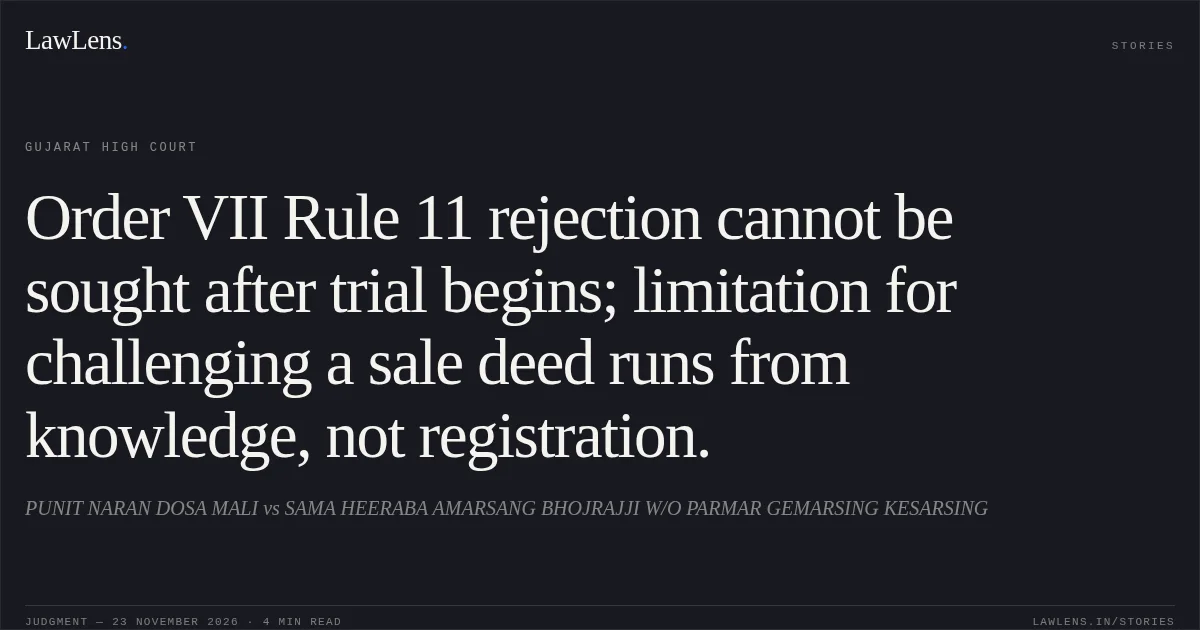
Since evidence had begun, the Court held that the Order VII Rule 11 application was impermissible under Bhagya Estate.
¶ 8Because the trial court had decided the matter on merits, the Court nonetheless tested the petitioners' contentions on merits.
¶ 9Reading the plaint as a whole, the Court held that the plaintiffs, as Class-I heirs, were co-owners entitled to equal shares, and that the non-mutation of their names did not extinguish that title absent a registered relinquishment.
¶ 11-13On limitation, the Court held that registration does not automatically fix the start of limitation against non-transferees, and that whether the plaintiffs had knowledge in 2005 or 2014 is a question of fact for trial, so the plaint could not be rejected at the threshold.
¶ 14-17Even assuming deemed knowledge from 2005, Article 110 provides twelve years from knowledge of exclusion; the suit filed in November 2014 was therefore within time and was not hopelessly barred.
¶ 18, 18.1The petitioners' authorities were distinguished: Umadevi involved a partition and sale with full known mutation and a suit filed decades later; Masrur Fatema involved a co-signatory with knowledge and suppression of facts; and Whiteswan Buildcon was distinguished on its facts, the Court noting it was under challenge before the Supreme Court.
¶ 19(i)-(iii)05Holding
The Order VII Rule 11 application, filed at the stage of the plaintiff's evidence, was misconceived. The suit is not ex facie and hopelessly time-barred, and the plaint does not fail to disclose a cause of action.
¶ 18.1, 21The trial court's rejection, though based on merits, involved no jurisdictional error. The Civil Revision Application under Section 115 CPC was dismissed in limine with no order as to costs, and the trial court was directed to expedite the suit.
¶ 21-23Original Court PDF
PUNIT NARAN DOSA MALIvsSAMA HEERABA AMARSANG BHOJRAJJI W/O PARMAR GEMARSING KESARSING
Click to open original judgment
Original judgment, available to read, download and summarize on LawLens.in