Facts
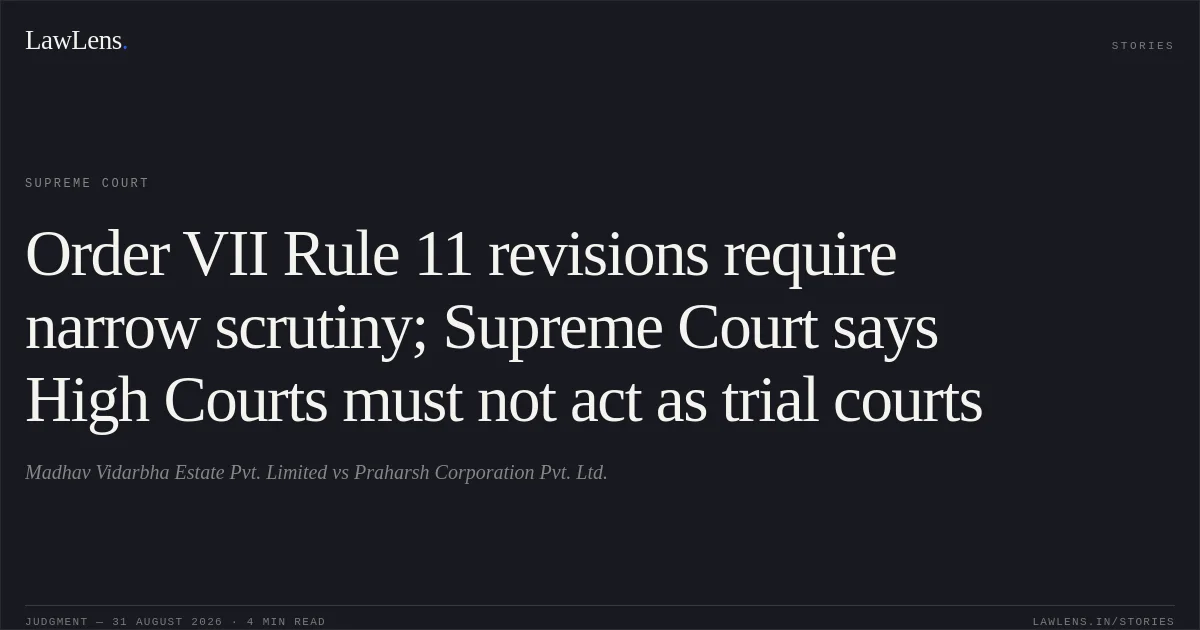
IARCPL and Madhav Vidarbha instituted Special Civil Suit No. 408 of 2017 seeking, inter alia, declarations that certain sale deeds were null and non-binding, declarations of illegal possession, recovery of possession, alternative monetary relief, and damages.
Source reference: para. 3–7The defendants, Praharsh Corporation and Sawan Bhatewara, applied under Order VII Rule 11 CPC for rejection of the plaint, contending that it disclosed no cause of action and was barred by Sections 11 and 47 CPC.
Source reference: para. 3–7The Trial Court rejected the applications, holding that the plaint disclosed triable issues and that matters such as res judicata and limitation required adjudication at trial; it also held that documents relied upon by the defendants but not forming part of the plaint could not be considered at that stage.
Source reference: para. 3–7In revision under Section 115 CPC, the Bombay High Court reversed the Trial Court and rejected the plaint qua Praharsh and Sawan, without identifying any jurisdictional error or material irregularity in the Trial Court’s orders.
Source reference: para. 8–11Issues
1. Whether the High Court exceeded the limited scope of its revisional jurisdiction under Section 115 CPC by interfering with the Trial Court’s reasoned orders rejecting the applications under Order VII Rule 11 CPC, without identifying any jurisdictional error, illegality, or material irregularity?
Source reference: para. 12–13, 20–212. Whether, while considering an application under Order VII Rule 11 CPC, the court may rely upon documents and factual matters not forming part of the plaint and its annexures, or undertake an extensive merits-based examination of the dispute?
Source reference: para. 19–20Law Applied
Section 115 CPC confers a limited supervisory revisional jurisdiction upon the High Court, exercisable only where the subordinate court has exercised jurisdiction not vested in it, failed to exercise jurisdiction vested in it, or acted illegally or with material irregularity.
Source reference: para. 12As explained in Shiv Shakti Coop. Housing Society v. Swaraj Developers, revision is distinct from appeal and does not permit a rehearing on facts or correction of every erroneous conclusion; the jurisdiction is confined principally to jurisdictional errors.
Source reference: para. 13Under Order VII Rule 11 CPC, rejection of a plaint at the threshold is permissible only when the statutory grounds, including absence of a cause of action or a bar created by law, are clearly attracted.
Source reference: para. 19–20The court must undertake a meaningful reading of the plaint, but must examine only the averments in the plaint and the documents annexed to it, not the defence or external documents.
Source reference: para. 19–20The principle in T. Arivandandam v. T.V. Satyapal permits rejection of a manifestly vexatious or meritless plaint, but only where the requirements of Order VII Rule 11 are actually fulfilled.
Source reference: para. 19The Court also reiterated that stay of trial in revision should not be routine and is warranted only where continuation of the trial would seriously and irreparably prejudice the revision or adversely affect the parties.
Source reference: para. 23–24Reasoning
The Trial Court had jurisdiction to decide the Order VII Rule 11 applications and passed reasoned orders holding that the plaint raised triable questions, including limitation, res judicata, and the alleged statutory bar.
Source reference: para. 11–13, 21The High Court did not demonstrate that the Trial Court had exceeded, failed to exercise, or illegally exercised its jurisdiction, which was essential before interference under Section 115 CPC could be justified.
Source reference: para. 11–13, 21Instead, the High Court effectively assumed the role of the trial court, undertook an extensive examination of the factual and documentary merits, and relied upon documents that did not form part of the plaint.
Source reference: para. 20This approach violated the settled limits of an Order VII Rule 11 inquiry and the distinction between appellate and revisional jurisdiction.
Source reference: para. 20–21The Supreme Court therefore held that the High Court had illegally exercised its revisional jurisdiction.
Source reference: para. 20–21Holding
The Supreme Court answered the issues in favour of Madhav Vidarbha.
It set aside the Bombay High Court’s judgment and orders rejecting the plaint and restored Special Civil Suit No. 408 of 2017 to the file of the Trial Court.
Source reference: para. 25The defendants were granted eight weeks to file their written statements, followed by six weeks for framing of issues, subject to the Trial Court’s docket; the Trial Court was requested to proceed expeditiously without unnecessary adjournments.
Source reference: para. 26The Trial Court was directed to decide the suit uninfluenced by the observations of either the Supreme Court or the High Court, with all questions of fact and law left open for trial.
Source reference: para. 27The appeals were allowed, interim orders were vacated, and the parties were directed to bear their own costs.
Source reference: para. 28–29Acts & Sections Cited
7 provisions across 2 statutes referred to in this judgment. Each provision opens on LawLens.
Code of Civil Procedure, 19086
Commercial Courts Act, 20151
Original Court PDF
Madhav Vidarbha Estate Pvt. LimitedvsPraharsh Corporation Pvt. Ltd.
Click to open original judgment
Original judgment, available to read, download and summarize on LawLens.in