Facts
The parties married on 09.09.2015 and had a daughter born on 01.09.2016.
Source reference: para. 4, 7–8The husband was employed in India and later proceeded to Germany for employment, while the wife remained at her parental home with the child.
Source reference: para. 4, 7–8The husband alleged that the wife subjected him to cruelty through quarrels concerning household work, travel, communication with his parents, the child’s naming ceremony, and refusal to return to the matrimonial home.
Source reference: para. 2, 5–9He sought dissolution of marriage under Sections 13(1)(ia) and 13(1)(ib) of the Hindu Marriage Act, 1955, in H.M.O.P. No.166 of 2019.
Source reference: para. 2, 5–9The wife denied the allegations, contending that the husband and his family had subjected her to unpleasant treatment and that the husband had failed to take her and the child with him when he went abroad.
Source reference: para. 10–11She maintained that she was willing to resume matrimonial life and had approached the police and relatives for reunion.
Source reference: para. 10–11She filed H.M.O.P. No.31 of 2021 under Section 9 of the Hindu Marriage Act for restitution of conjugal rights.
Source reference: para. 2The Family Court, Tirunelveli, dismissed the husband’s divorce petition and allowed the wife’s petition for restitution of conjugal rights by a common order dated 08.08.2022.
Source reference: para. 1–2, 17–19The husband preferred the present appeals under Section 19 of the Family Courts Act, 1984.
Source reference: para. 1–2, 17–19Issues
Whether the conduct attributed to the wife amounted to cruelty under Section 13(1)(ia) of the Hindu Marriage Act, 1955?
Source reference: para. 20(i)Whether the husband established the statutory ingredients of desertion under Section 13(1)(ib) of the Hindu Marriage Act, 1955?
Source reference: para. 20(ii)Whether the decree granting restitution of conjugal rights in favour of the wife called for appellate interference?
Source reference: para. 20(iii)Law Applied
The Court applied Sections 13(1)(ia) and 13(1)(ib) of the Hindu Marriage Act, 1955, concerning cruelty and desertion, and Section 9 concerning restitution of conjugal rights.
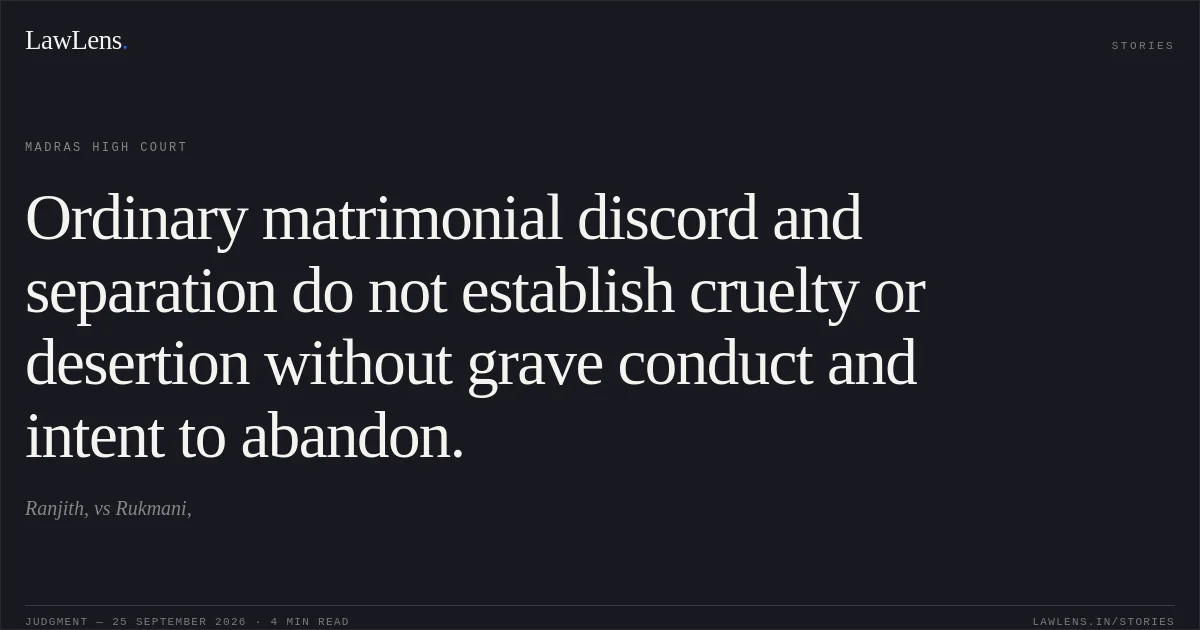
Source reference: para. 2, 20Cruelty must be established through grave and weighty conduct assessed in the context of the entire matrimonial relationship; trivial disagreements, isolated incidents, and the ordinary wear and tear of married life do not constitute mental cruelty.
Source reference: paras. 22–25This principle was drawn from Dr. N.G. Dastane v. S. Dastane , AIR 1975 SC 1534; J.L. Nanda v. Smt. Veena Nanda , AIR 1988 SC 407; Samar Ghosh v. Jaya Ghosh , (2007) 4 SCC 511; and Vishwanath Agrawal v. Sarla Vishwanath Agrawal , (2012) 7 SCC 288.
Source reference: paras. 22–25Desertion requires both physical separation and the intention to permanently bring cohabitation to an end, without reasonable cause.
Source reference: para. 33A decree for restitution of conjugal rights may be granted where one spouse has withdrawn from the society of the other without reasonable excuse and the applicant establishes willingness to resume matrimonial life.
Source reference: para. 19, 36–37Reasoning
The Court held that the allegations concerning washing clothes, travelling by car or bus, telephone communication with the husband’s parents, the child’s name, and participation in family functions were ordinary matrimonial disagreements and did not constitute grave or sustained cruelty.
Source reference: paras. 17, 27, 39The parties had lived together at Bangalore for approximately seven months and their relationship during that period was substantially peaceful, which weakened the husband’s claim of continuous matrimonial hostility.
Source reference: paras. 15, 28The more serious allegations concerning the wife’s alleged mistreatment of the husband’s parents and exclusion of the paternal grandparents were not supported by direct evidence; the alleged victims were not examined and the husband’s cousin was not an eyewitness.
Source reference: para. 30On desertion, the Court found that the husband had himself left for Germany for employment shortly after the child’s birth, that communication and reconciliation efforts continued, and that the wife consistently asserted her willingness to resume cohabitation.
Source reference: paras. 33–36Her residence at her parental home while caring for the minor child, particularly when the husband was abroad, did not by itself establish a settled intention to permanently abandon the marriage.
Source reference: para. 34The wife’s approach to the police for reunion was consistent with her claim that she desired restoration of the matrimonial relationship.
Source reference: para. 36The husband therefore failed to prove either cruelty or the statutory ingredients of desertion, and no perversity or material illegality was shown in the Family Court’s decree for restitution of conjugal rights.
Source reference: para. 37Holding
The Court answered all issues against the husband.
It held that the alleged conduct did not amount to cruelty under Section 13(1)(ia), that desertion under Section 13(1)(ib) was not established, and that the decree for restitution of conjugal rights was justified.
Source reference: paras. 32–37Accordingly, C.M.A.(MD) Nos. 993 and 994 of 2022 were dismissed, the common order dated 08.08.2022 of the Family Court, Tirunelveli, was confirmed, and the decree granting restitution of conjugal rights in favour of the wife was maintained.
Source reference: para. 41No costs were awarded, and the connected miscellaneous petitions were closed.
Source reference: para. 41Acts & Sections Cited
3 provisions across 2 statutes referred to in this judgment. Each provision opens on LawLens.
Family Courts Act, 19841
Hindu Marriage Act, 19552
Original Court PDF
Ranjith,vsRukmani,
Click to open original judgment
Original judgment, available to read, download and summarize on LawLens.in