Facts
The appellant-informant and the first respondent-accused were neighbours. The accused and her father-in-law had undertaken construction under a municipal licence, allegedly relying on an interpolated and forged copy of the original approved building plan. The appellant lodged a complaint, pursuant to which an FIR was registered for offences under Sections 468, 471 and 420 read with Section 34 of the IPC.
Source reference: paras. 1–2, pp. 1–2After investigation, a chargesheet was filed alleging that the accused had forged the plan and used it as genuine before the authorities.
Source reference: paras. 3–4, pp. 2–3The Magistrate found prima facie material and directed framing of charges. The accused’s revision was dismissed by the Sessions Court.
Source reference: paras. 4–5, pp. 3–4In an earlier petition under Section 482 CrPC, the High Court declined to interfere, holding that the material in the chargesheet was sufficient to frame charges; that order was not challenged further.
Source reference: paras. 10–12, pp. 9–12The accused subsequently filed another writ petition raising the same objection that the original plan had not been produced. The High Court accepted the objection, set aside the orders framing charge, and discharged the accused. The informant appealed to the Supreme Court.
Source reference: para. 13, pp. 12–13Issues
Whether the High Court could entertain a subsequent challenge under Section 482 CrPC and discharge the accused on the same ground that had already been considered and rejected in an earlier proceeding.
Source reference: paras. 12–15, pp. 12–17Whether the non-production of the original document allegedly forged was, by itself, sufficient to prevent framing of charges or to quash the prosecution for offences under Sections 468, 471 and 420 IPC.
Source reference: paras. 16–19, pp. 18–22Whether the High Court exceeded the permissible scope of jurisdiction at the stage of framing of charge by re-appreciating and sifting the prosecution material.
Source reference: para. 20, pp. 22–23Law Applied
The Court applied Sections 227 and 482 of the CrPC, holding that at the stage of framing charge the court examines only the record and documents accompanying the chargesheet and must determine whether the material raises a prima facie case or grave suspicion; it must not conduct a meticulous evaluation of evidence as though deciding guilt or innocence.
Source reference: para. 20, pp. 22–23The Court relied on Piara Singh v. State of Punjab, which recognises the doctrine of issue estoppel: an issue directly raised and decided between the same parties cannot ordinarily be re-agitated in subsequent proceedings.
Source reference: para. 15, pp. 16–17Under Rama Shanker Lal v. State of U.P., non-production of the original forged document is not automatically fatal; the prosecution may establish forgery through other evidence, though the evidence must ultimately exclude reasonable doubt.
Source reference: paras. 16–17, pp. 18–20Under CBI v. R.S. Pai, omission to file relevant documents with the chargesheet does not necessarily bar their subsequent production with the court’s permission, and Section 173(5) CrPC is directory in that respect.
Source reference: para. 18, pp. 20–21Reasoning
The Supreme Court held that the accused’s later writ petition substantially re-agitated the same objection—absence of the original plan—which had already been considered when the Division Bench previously refused to interfere with the order framing charge.
Source reference: paras. 12–15, pp. 12–17The earlier order had attained finality, and the accused could not circumvent it by filing a fresh challenge to the Magistrate’s and Sessions Court’s orders. The principle of issue estoppel independently barred reconsideration of the same ground.
Source reference: para. 15, pp. 16–17On merits, the Court held that the absence of the original plan did not conclusively establish that the prosecution must fail. Whether the plan was forged and whether the accused knowingly used it as genuine were matters for trial, capable of being proved through witness testimony, surrounding circumstances, and other documentary evidence.
Source reference: paras. 16–19, pp. 18–22The High Court had therefore impermissibly evaluated the sufficiency and probative value of the chargesheet material instead of asking whether it disclosed grave suspicion warranting trial.
Source reference: para. 20, pp. 22–23Holding
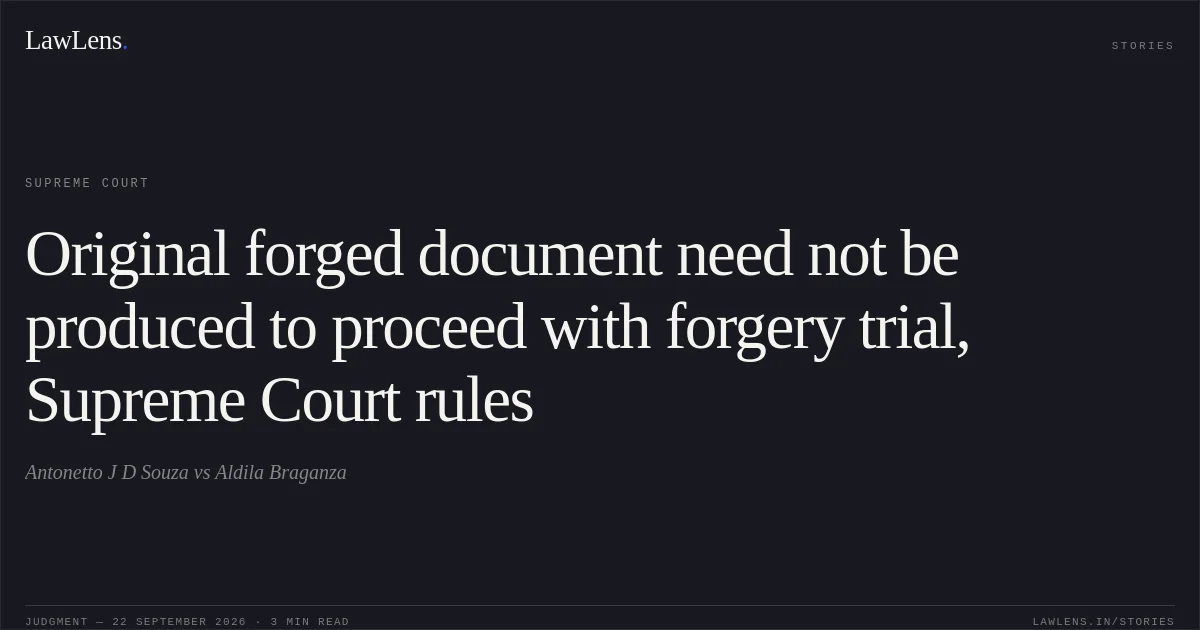
The Supreme Court held that the accused was barred from re-agitating the previously rejected objection and that the non-production of the original allegedly forged document, by itself, was not a valid ground for quashing the prosecution or refusing to proceed with trial.
The Supreme Court allowed the appeal and set aside the High Court’s order dated 28 August 2024 discharging the accused. It restored the criminal proceedings before the Magistrate and directed that the trial proceed in accordance with law.
Source reference: para. 21, pp. 23–24All contentions were left open for consideration at trial, and the Magistrate was directed to expedite the proceedings.
Source reference: para. 21, p. 24Acts & Sections Cited
8 provisions across 2 statutes referred to in this judgment. Each provision opens on LawLens.
Indian Penal Code, 18604
Code of Criminal Procedure, 19734
Original Court PDF
Antonetto J D SouzavsAldila Braganza
Click to open original judgment
Original judgment, available to read, download and summarize on LawLens.in