Facts
The Appellant was convicted by the Trial Court on May 23, 2008, for offences under Sections 363, 366, and 376 of the Indian Penal Code (IPC)
Source reference: p. 2, 4The prosecution alleged that on May 16, 2004, the Appellant enticed the prosecutrix (the complainant’s daughter) and took her away
Source reference: p. 3-4The prosecutrix and Appellant traveled from Delhi to West Bengal, where they registered their marriage under the Special Marriage Act, 1954, on July 9, 2004
Source reference: p. 2, 10They lived together for approximately two months before being located by the police
Source reference: p. 2While the prosecutrix initially supported the Appellant in her statements under Sections 161 and 164 of the Cr.P.C., she turned hostile during the trial, alleging she was kidnapped and raped under pressure
Source reference: p. 2, 10-11The Appellant challenged the conviction, asserting that the prosecutrix was a consenting major
Source reference: p. 2, 9Issues
1. Whether the prosecutrix was a minor at the time of the incident, thereby vitiating her consent for the purposes of Sections 363, 366, and 376 IPC
Source reference: p. 4, 62. Whether the sexual relationship between the Appellant and the prosecutrix constituted rape under Section 376 IPC, given their subsequent marriage and the prosecutrix’s alleged consent
Source reference: p. 4, 13Law Applied
Section 94 of the Juvenile Justice Act, 2015, and Rule 12 of the Juvenile Justice Rules, 2007 (as interpreted in Jarnail Singh v. State of Haryana and K.P. Kiran Kumar v. State), which establish a hierarchy of evidence for age determination: first, the matriculation certificate; second, the municipal birth certificate; and third, the ossification test
Source reference: p. 4-6Birad Mal Singhvi v. Anand Purohit, which states school registers lack evidentiary value unless the person providing the information is examined
Source reference: p. 7-8Exception 2 to Section 375 of the IPC (pre-amendment), which stipulates that sexual intercourse by a man with his own wife, the wife not being under fifteen years of age, is not rape
Source reference: no citationReasoning
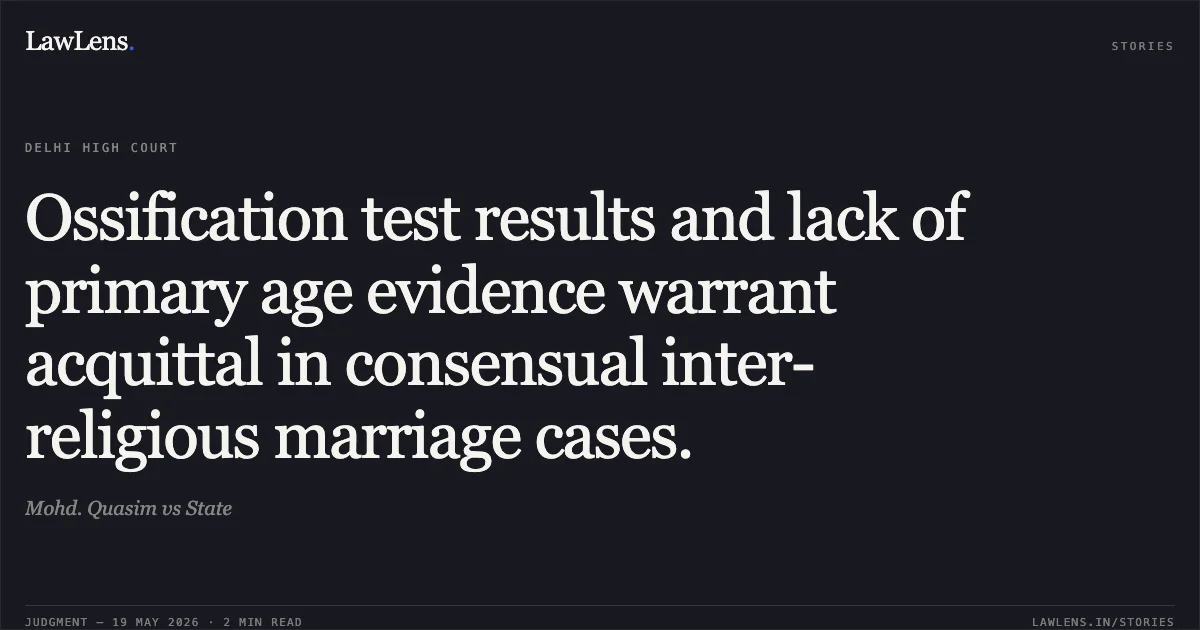
The court examined the hierarchy of evidence for age determination, noting the absence of a matriculation or municipal birth certificate. It found the school records unreliable as the person who entered the date of birth was not examined.
Source reference: p. 6, 8The court prioritized the ossification test, which placed the prosecutrix's age between 17 and 18 years. Applying the principle of margin of error (+/- 2 years), the court determined she could be treated as a major at the time of the incident.
Source reference: p. 9The court analyzed the prosecutrix's conduct, noting she lived with the Appellant for two months without protest and had registered a marriage under the Special Marriage Act, suggesting her subsequent hostile testimony was likely due to parental pressure.
Source reference: p. 10, 12Holding
The court held that the prosecutrix was a major at the relevant time and that the encounter was consensual.
The conviction of the Appellant under Sections 363, 366, and 376 IPC was set aside, and the Appellant was acquitted of all charges.
Source reference: no citationActs & Sections Cited
2 provisions across 2 statutes referred to in this judgment. Each provision opens on LawLens.
Protection of Children from Sexual Offences Act, 20121
Prohibition of Child Marriage Act, 20061
Original Court PDF
Mohd. QuasimvsState
Click to open original judgment
Original judgment, available to read, download and summarize on LawLens.in