Facts
The State of Rajasthan implemented the Keer Kheda Gadia Lohar Yojana around 2005 to rehabilitate members of the Gadia Lohar community.
Source reference: paras. 6, 9.4; pp. 10, 13–14Approximately 184 residential plots, measuring 18 feet × 25 feet, were allotted free of cost on 99-year leasehold terms, subject to conditions including non-alienation, the absence of any other plot or house in Rajasthan, and construction of a house within two years; breach could result in the plot reverting to the municipal authority.
Source reference: paras. 6, 9.4; pp. 10, 13–14The petitioners alleged that, pursuant to a State order dated 21 April 2022 relaxing restrictions on the transfer and mutation of certain non-transferable plots, plots allotted under the welfare scheme were transferred to persons outside the beneficiary community, including relatives of respondent No. 7, the Chairman of Nagar Parishad, Bhilwara.
Source reference: paras. 9–9.5; pp. 11–15A departmental inquiry report prima facie recorded that the 2022 order had been wrongly interpreted and that mutations were effected despite the original allotment conditions prohibiting sale, gift or transfer.
Source reference: para. 9.4; pp. 13–14The State expressed willingness to investigate the alleged irregularities, including the conduct of respondent No. 7 in relation to all 184 plots.
Source reference: paras. 10, 12; p. 15During the proceedings, the Court also noted a fresh State initiative to identify and rehabilitate homeless nomadic and semi-nomadic families by providing residential pattas.
Source reference: para. 13; pp. 16–17Issues
1. Whether the alleged sale, purchase and mutation of plots allotted under the Keer Kheda Gadia Lohar Yojana in favour of persons outside the Gadia Lohar community required an independent fact-finding inquiry and consequential action in accordance with law?
Source reference: paras. 9–14; pp. 11–192. Whether administrative relaxation under the order dated 21 April 2022 could validly permit transfer of welfare-scheme plots to persons who were not members of the beneficiary Gadia Lohar community?
Source reference: paras. 9.1–9.4, 15–18; pp. 11–14, 19–243. Whether future transfers of plots allotted under the Scheme could be permitted only in favour of bona fide members of the Gadia Lohar community so as to preserve the Scheme’s rehabilitation objective?
Source reference: paras. 17–18.1; pp. 21–24Law Applied
The Court applied Articles 14 and 21, read with Articles 38, 39(b) and 46 of the Constitution, holding that substantive equality, dignity, shelter and rehabilitation of historically disadvantaged communities require affirmative State protection and not merely formal non-discrimination.
Source reference: paras. 3–3.3, 15; pp. 6–8, 19–20It treated the Keer Kheda Gadia Lohar Yojana as a constitutional welfare and rehabilitation measure whose non-alienation condition was intended to prevent exploitation and diversion of public resources.
Source reference: paras. 6–7, 15–17; pp. 10–11, 19–22Section 42 of the Rajasthan Tenancy Act, 1955, although held not directly applicable to the Scheme, was relied upon for its protective legislative philosophy prohibiting transfer of protected land by members of Scheduled Castes and Scheduled Tribes to persons outside those communities.
Source reference: paras. 13.1–13.2, 17; pp. 17–18, 21–22The Court also referred to international human-rights principles concerning adequate housing, social security, equality and dignity under the UDHR, ICCPR and ICESCR.
Source reference: para. 4; p. 8Accordingly, any transfer of Scheme plots to a non-member of the Gadia Lohar community, contrary to the Scheme’s object, was held void and incapable of conferring title or supporting mutation.
Source reference: paras. 18–18.1; pp. 22–24Reasoning
The Court found that the original allotments were not ordinary transfers of public land but affirmative measures intended to provide permanent habitation and eradicate nomadism and semi-nomadism among the Gadia Lohar community.
Source reference: paras. 6–7, 15–17; pp. 10–11, 19–22The 21 April 2022 relaxation could not be interpreted in isolation or used to override the original allotment conditions and constitutional purpose of the Scheme.
Source reference: no citationThe departmental material indicated that the authorities had relied on a misinterpretation of the relaxation order to effect mutations in favour of purchasers, even though the governing allotment documents prohibited alienation and provided for reversion upon breach.
Source reference: para. 9.4; pp. 13–14Applying the principles of substantive equality, protection against exploitation and preservation of welfare benefits for the intended class, the Court held that permitting transfer to economically stronger outsiders would convert a rehabilitation measure into an ordinary commercial land transaction and defeat its constitutional object.
Source reference: paras. 16–18.2; pp. 20–24Since allegations concerning the 184 plots and the involvement of respondent No. 7 required factual verification, the Court directed a comprehensive independent inquiry rather than determining individual culpability in the writ proceedings.
Source reference: para. 14; p. 19Holding
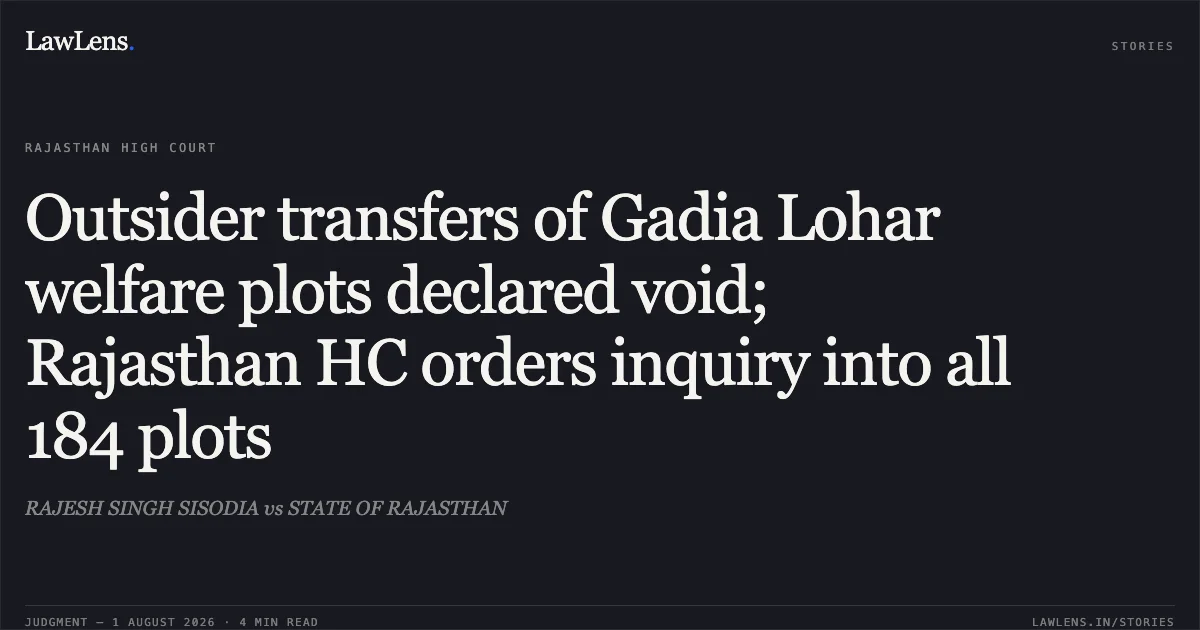
The Public Interest Litigation was allowed.
Respondents Nos. 3 and 4 were directed to conduct, through the competent authority, a comprehensive fact-finding inquiry into the alleged illegal purchase and transfer of plots under the Scheme, including the alleged involvement of the family members of respondents Nos. 8 to 10, and to take action in accordance with law.
Source reference: para. 14; p. 19The inquiry report was directed to be placed before the Court within six months.
Source reference: para. 14; p. 19The Court further held that the 184 plots allotted under the Keer Kheda Gadia Lohar Yojana must remain within the beneficiary community.
Source reference: para. 18; pp. 22–23Transfers, sales, gifts, exchanges, assignments, bequests or third-party interests created in favour of non-members were declared liable to be cancelled, quashed and set aside, irrespective of any administrative order or policy purporting to legalise them.
Source reference: para. 18; pp. 22–23Any such transfer would confer no right, title or interest, and no authority could recognise it or effect mutation.
Source reference: para. 18.1; pp. 23–24On cancellation, the plot would revest in the State or local authority for fresh allotment to an eligible Gadia Lohar beneficiary.
Source reference: para. 18.1; pp. 23–24Any permissible transfer after twenty years could be made only in favour of a bona fide member of the Gadia Lohar community.
Source reference: para. 18.1; p. 23Compliance with the judgment was directed within thirty days of receipt of its certified copy.
Source reference: para. 20; p. 26Acts & Sections Cited
2 provisions across 1 statute referred to in this judgment. Linked provisions open on LawLens.
Criminal Tribes Act, 18712
Original Court PDF
RAJESH SINGH SISODIAvsSTATE OF RAJASTHAN
Click to open original judgment
Original judgment, available to read, download and summarize on LawLens.in


