01Facts
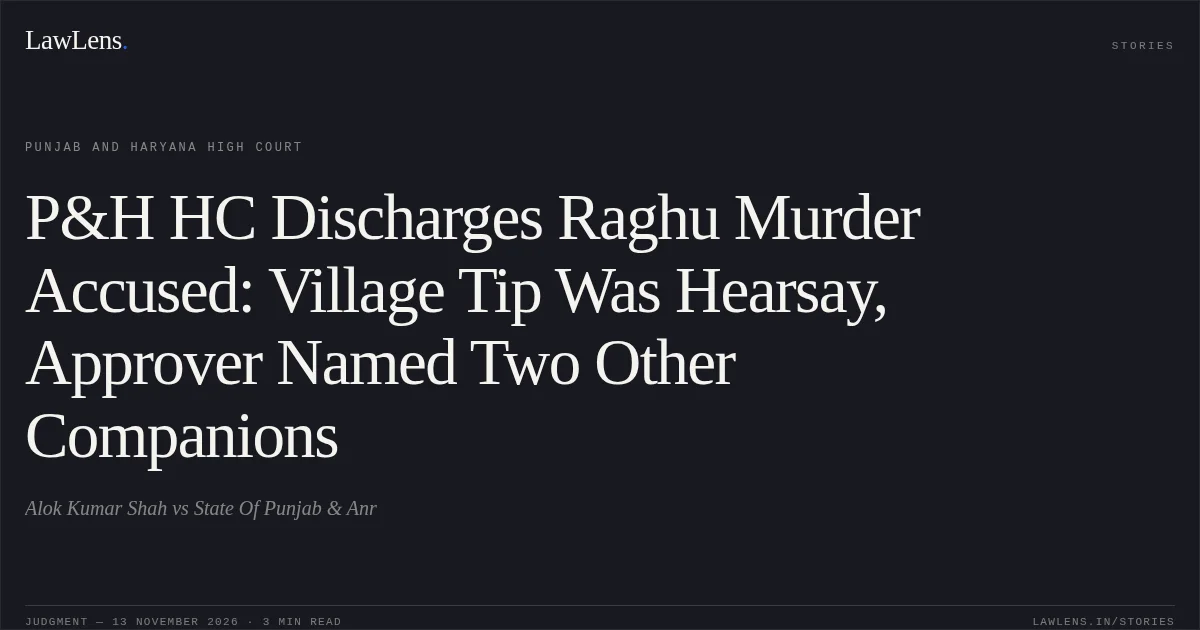
Raghu was murdered in June 2012.
pp. 2–7, 14–17The complainant’s initial statement identified Rajiv Dass and two unnamed companions; a later supplementary statement named Alok Kumar Shah, stating only that he had learned Shah’s name “at his own level and from his village.”
pp. 2–7, 14–17Shah was charged under Sections 302 and 120-B IPC.
pp. 2–7, 14–17The prosecution’s approver, Yogesh Kumar, named Rajiv and Bharat Jha as the other persons present but did not name Shah.
pp. 2–7, 14–17The Sessions Court framed charges against Shah, and he challenged that order in revision.
pp. 2–7, 14–17During the revision proceedings, the Court also considered testimony recorded before the trial had been stayed as to Shah.
pp. 2–7, 14–1702Issues
i.1. Whether the material before the Sessions Court disclosed sufficient ground, including grave suspicion founded on material capable of being proved at trial, to frame charges against Shah under Sections 302 and 120-B IPC.
pp. 8–14, 23ii.2. Whether the Sessions Court’s failure to consider the approver’s statement and the nature of the complainant’s information warranted interference in revision.
pp. 14–1903Law Applied
Under Sections 227 and 228 CrPC, the court must apply its judicial mind and sift the prosecution material to determine whether it discloses a prima facie case or grave suspicion; it must not conduct a trial or assess the material as though deciding guilt.
pp. 8–10Union of India v. Prafulla Kumar Samal and Sajjan Kumar v. CBI establish that the court is not a mere post office for the prosecution and may discharge where the material gives rise only to suspicion, rather than grave suspicion.
pp. 8–10Under Dipakbhai Jagdishchandra Patel v. State of Gujarat, strong suspicion must rest on material capable of being translated into evidence at trial.
p. 10Section 60 of the Evidence Act requires oral evidence to be direct; hearsay is generally inadmissible, as explained in Kalyan Kumar Gogoi v. Ashutosh Agnihotri.
pp. 12–14Revisional jurisdiction under Section 397 CrPC may be exercised where, among other grounds, material evidence has been ignored or the decision is grossly erroneous, as stated in Amit Kapoor v. Ramesh Chander.
pp. 7–8The Court noted that, because the revision was instituted in 2016, the matter remained governed by the CrPC under Section 531 BNSS.
p. 7Provisions in the judgment · 11 · Linked ones open on LawLens
Code of Criminal Procedure, 1973 Section 173Section 307Section 164Section 397Section 227Section 228
Indian Penal Code, 1860 Section 302Section 364Section 379Section 34
Bharatiya Nagarik Suraksha Sanhita, 2023 Section 531
04Reasoning
The only investigative material naming Shah was the complainant’s supplementary statement, which did not identify him from personal knowledge and attributed the information to an unnamed source.
pp. 11–16, 17–19The Court held that this hearsay could not provide a sound basis for grave suspicion.
pp. 11–16, 17–19The complainant had not identified Shah during investigation and later acknowledged that he first saw Shah after the occurrence when Shah was produced in court.
pp. 11–16, 17–19The approver’s statement, available when charges were framed, named Rajiv and Bharat Jha and did not mention Shah; the Court found that the trial court had failed to consider this material.
pp. 14–20The subsequent testimony also disclosed no independent source for the allegation against Shah.
pp. 14–20The trial court’s general reference to the police record and supplementary statement, without evaluating these matters, amounted to non-application of mind and justified revisional intervention.
pp. 14–2005Holding
The High Court held that the material did not raise grave suspicion against Shah or support his alleged presence, participation in the murder, or involvement in a conspiracy.
pp. 23–25It allowed the revision, set aside the order framing charges against Shah under Sections 302 and 120-B IPC, and discharged him; his bail and surety bonds, if any, were discharged.
pp. 23–25Original Court PDF
Alok Kumar ShahvsState Of Punjab & Anr
Click to open original judgment
Original judgment, available to read, download and summarize on LawLens.in