01Facts
Atul Arora, aged 20 and a B.Com. student who earned income by giving tuitions, was injured in a motor accident on 24 December 1999.
pp. 1–4He sustained, among other injuries, fractures and a bladder tear, underwent multiple operations, and was assessed as having 30% permanent disability, including shortening of one leg.
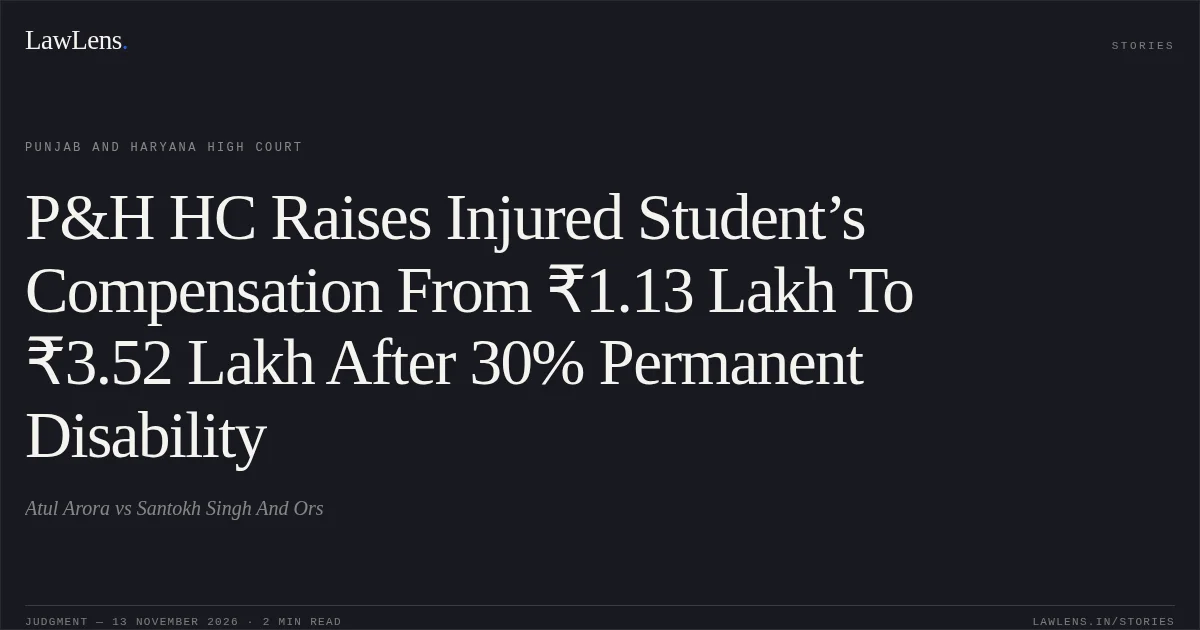
pp. 1–4The Motor Accident Claims Tribunal, Patiala, awarded him ₹1,13,865, including ₹13,865 for damage and ₹1,00,000 as lump-sum compensation for disability and no-fault liability.
pp. 1–4He appealed seeking enhancement; the respondents did not challenge the findings on negligence.
pp. 1–4The High Court considered the nature of his injuries and treatment, his income and disability, and the other heads of compensation claimed.
pp. 3–602Issues
i.Whether the Tribunal’s award should be enhanced by assessing functional disability and loss of earning capacity, including future prospects and an age-based multiplier.
pp. 2–5ii.Whether additional compensation was payable for pain and suffering, loss of future amenities and prospects, medical and related expenses, loss of income during treatment, future medical expenses, and damage to the vehicle.
pp. 2–3, 5–603Law Applied
The Court relied on National Insurance Company Ltd. v. Pranay Sethi, 2017 (16) SCC 680, for adding future prospects when determining loss of earning capacity, and Smt. Sarla Verma v. Delhi Transport Corporation, 2009 (6) SCC 121, for selecting the multiplier by reference to the injured person’s age.
p. 4In assessing injury compensation, the Court treated functional disability as a question requiring consideration of both the extent of permanent disability and its effect on the claimant’s earning capacity in light of his circumstances and occupation.
p. 4It also required evidence to support claimed expenses and future medical costs; expenses admitted to have been reimbursed were not recoverable absent proof of any unpaid amount.
p. 504Reasoning
The claimant’s 30% permanent disability, leg shortening, young age, and resulting effect on his future earning capacity supported assessing functional disability at 30%.
pp. 4–5Because reliable evidence of his asserted income of ₹2,500 per month was lacking, the Court used the 1999 minimum wage of ₹1,900 per month, added 40% for future prospects, and applied a multiplier of 18. This produced ₹1,72,368 for loss of earning capacity.
p. 5The Court also awarded ₹11,400 for six months’ lost income, ₹30,000 for medical and related expenses, ₹50,000 for pain and suffering, and ₹75,000 for loss of future prospects and amenities, including marriage prospects.
pp. 5–6It declined to increase the vehicle-damage amount already accepted by the Tribunal, award reimbursed medical expenses without proof of an unpaid balance, or allow future medical expenses without supporting evidence.
p. 605Holding
The appeal was allowed.
pp. 6–7The Court recalculated total compensation at ₹3,52,633, including the Tribunal’s ₹13,865 award for damage, resulting in an enhancement of ₹2,38,768.
pp. 6–7The claimant was also granted interest at 7.5% per annum on the enhanced amount from the date of filing the claim petition until realization; liability remained as determined in the Tribunal’s award.
pp. 6–7Original Court PDF
Atul AroravsSantokh Singh And Ors
Click to open original judgment
Original judgment, available to read, download and summarize on LawLens.in