Facts
The petitioners, two entrepreneurs, sought to establish a modern "Hotmix Plant" (batch mix plant) in Nellanad Grama Panchayat.
Source reference: p. 8Petitioner No. 1 originally applied for a proprietary unit in 2017, obtaining a No Objection Certificate (NOC) from the District Medical Officer (DMO) and consent from the Pollution Control Board (PCB).
Source reference: p. 8, 28The Panchayat initially rejected the application due to public protest.
Source reference: p. 9In 2022, petitioners 1 and 2 formed a partnership, purchased machinery worth over ₹5 crore, and filed a fresh application under Section 233 of the Kerala Panchayat Raj Act, 1994 ("Act").
Source reference: p. 13Despite a prior High Court judgment (Ext.P1) directing the Panchayat to reconsider the application in light of the 2018 amendment to the Act, the Panchayat issued a fresh rejection (Ext.P3).
Source reference: p. 18, 24The Panchayat reasoned that the 2018 amendment did not apply because the machinery was allegedly installed in 2017 without permission and that local residents feared health hazards.
Source reference: p. 24The petitioners challenged this rejection, asserting all statutory clearances were obtained.
Source reference: p. 17Issues
1. Whether the Grama Panchayat has the power to reject an application for establishing an industrial unit under Section 233 of the Act following the amendment by Act 14 of 2018.
Source reference: para 372. Whether the 2018 amendment applies to an application filed in 2025, notwithstanding the Panchayat's claim that machinery was installed prior to the amendment.
Source reference: para 24-253. Whether public protest or apprehension of health hazards, absent scientific backing or statutory non-compliance, is a valid ground for refusing a trade license.
Source reference: para 60-62Law Applied
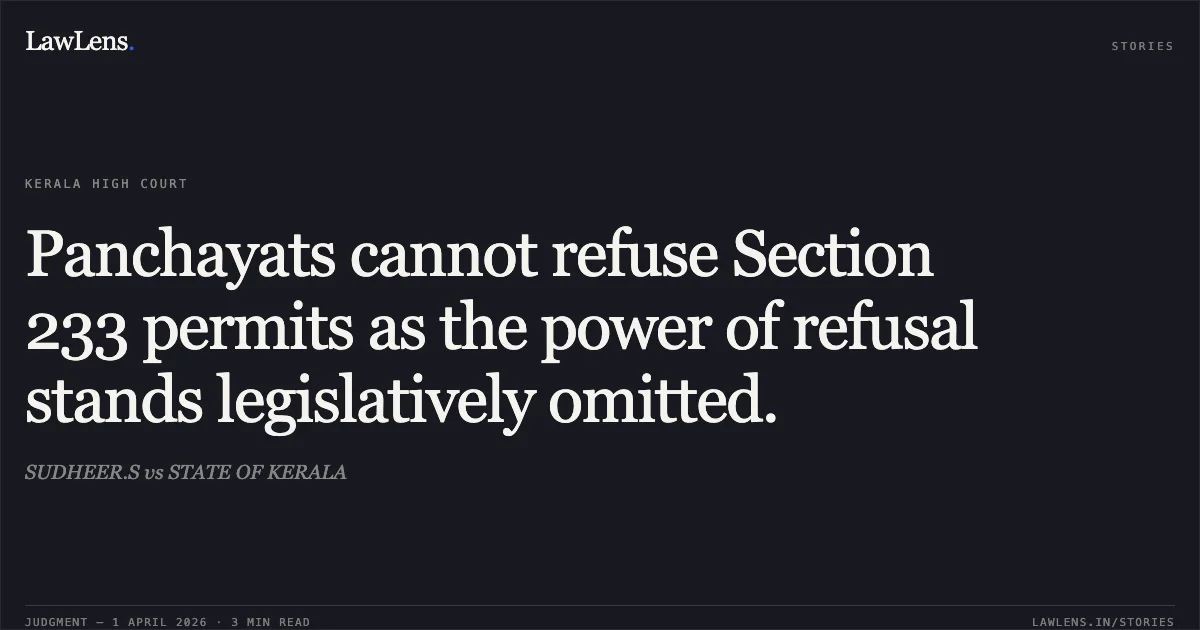
The court primarily applied Section 233 of the Kerala Panchayat Raj Act, 1994, as amended by Act 14 of 2018.
Source reference: para 37The amendment specifically omitted the words "or refusing" from Section 233(4), signifying that the Panchayat must either grant permission absolutely or impose conditions, but cannot reject an application if statutory clearances are met.
Source reference: para 38, 62The court also relied on the principle of "deemed license" under Section 236 of the Act, supported by Sudhakaran V. v. Pallichal Grama Panchayat [2016 (2) KHC 481] and Abdul Shafeek v. Asamannoor Grama Panchayath [2018 (3) KHC 170], which established that failure to communicate a decision within the statutory period results in a deemed grant of permission.
Source reference: para 30-31Reasoning
The Court found the Panchayat’s rejection (Ext.P3) factually and legally flawed.
Source reference: para 26Factually, the Court noted that the partnership was registered in 2022 and the specific batch mix machinery was purchased in March 2022; thus, the Panchayat’s claim that the unit was installed in 2017 was unsustainable.
Source reference: para 26Legally, the Court held that since the current application was filed in 2025, it must be governed by the law in force at that time, which includes the 2018 amendment.
Source reference: para 24By omitting the power to "refuse" in Section 233(4), the legislature intended to promote industrial growth by ensuring that units meeting health and environmental standards (as certified by the DMO and PCB) are not stifled by local authorities.
Source reference: para 37-38The Court observed that the DMO’s report explicitly ruled out health hazards, noting that the nearest houses were 150 meters away, and the PCB had granted consent.
Source reference: para 44, 51Consequently, the Court determined that the Panchayat’s decision was an "extra-legal" reaction to public protest, which undermined the rule of law and discouraged investment.
Source reference: para 55, 61Holding
The Court allowed the writ petition and set aside the Panchayat's rejection order (Ext.P3).
It held that under the amended Section 233, the Panchayat lacks the authority to reject an application when statutory clearances from the DMO and PCB are in place.
Source reference: para 62The Court directed Respondents 4 and 5 (the Panchayat and its Secretary) to allow the petitioners' application (Ext.P26) within two weeks, permitting them to impose appropriate conditions in accordance with Section 233, but explicitly prohibiting rejection.
Source reference: para 63Acts & Sections Cited
3 provisions across 1 statute referred to in this judgment. Linked provisions open on LawLens.
Kerala Panchayat Raj Act, 19943
Original Court PDF
SUDHEER.SvsSTATE OF KERALA
Click to open original judgment
Original judgment, available to read, download and summarize on LawLens.in

![Authorities must decide pensionary and retiral-benefit claims through a reasoned order within eight weeks.. Habibullah khan vs HOME DEPARTMENT. CAT - ['Srinagar']. LawLens](/stories/thumbnails/authorities-must-decide-pensionary-and-retiral-benefit-claims-through-a-reasoned-order-wit-d0cbe8a8119c48fbabe7df9f2d353488.webp)
![Continuous temporary-status service entitles dependants to family pension despite absence of formal regularisation.. SMT SUSHILA DEVI vs DEPARTMENT OF POSTS. CAT - ['Allahabad']. LawLens](/stories/thumbnails/continuous-temporary-status-service-entitles-dependants-to-family-pension-despite-absence-0006d1f107144299ac3b945914aae9ff.webp)