01Facts
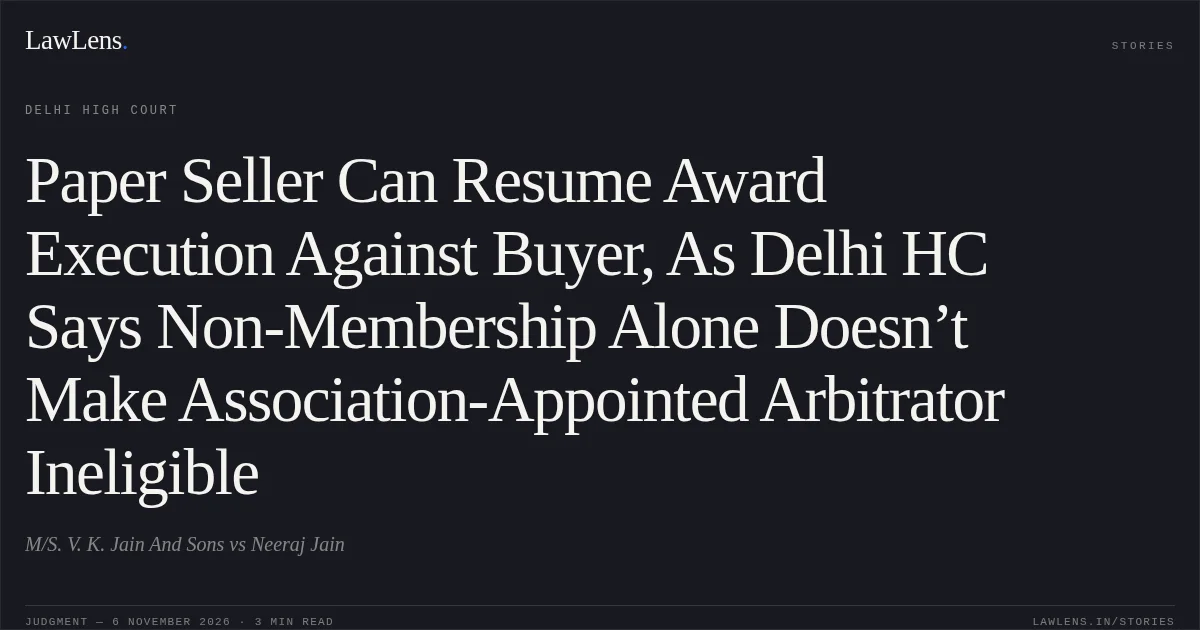
The Appellant, a paper wholesaler, sought to enforce an arbitral award for an outstanding commercial debt.
Invoices issued during the parties’ dealings contained a clause referring disputes to the Paper Merchants Association (Regd.), Delhi, for sole arbitration, with the arbitrator to be appointed by its Executive Committee.
¶ 4–7 · pp. 2–3The Association’s Executive Committee appointed the sole arbitrator; the Respondent did not participate, and the arbitrator awarded the claimed principal, interest, and further interest.
¶ 7 · p. 3In execution, the Respondent objected that the arbitrator had been unilaterally appointed, that he was not an Association member, and that he had not consented in writing to the appointment after the disputes arose.
¶ 9–10 · pp. 3–4The Commercial Court allowed the objections and dismissed execution.
The Appellant appealed under Section 13 of the Commercial Courts Act, 2015, read with Order XXI Rule 58 CPC.
¶ 1, 11 · p. 1, 402Issues
i.1. Whether the invoice clause and the parties’ commercial dealings established an arbitration agreement under Section 7 of the Arbitration and Conciliation Act, 1996.
¶ 17–30 · pp. 9–13ii.2. Whether appointment of the sole arbitrator by the Association’s Executive Committee violated Section 12(5), given that the Respondent was not shown to be an Association member and had not executed a post-dispute written waiver.
¶ 31–50 · pp. 13–18iii.3. Whether the executing court could examine the award’s validity for a jurisdictional defect despite the Respondent’s failure to challenge it under Section 34.
¶ 51–59 · pp. 19–2103Law Applied
Section 7 of the Arbitration and Conciliation Act, 1996 permits an arbitration agreement to be established through written contractual terms or recorded communications; a separately signed agreement is not invariably required, but the material must establish consensus to arbitrate.
¶ 18–19 · p. 9Section 12(5) renders an arbitrator ineligible where the arbitrator’s relationship falls within the Seventh Schedule; waiver is possible only by an express written agreement made after disputes arise.
¶ 32–33 · p. 13Perkins Eastman Architects DPC v. HSCC (India) Ltd. concerns appointment control by an ineligible party; Bhadra International (India) Pvt. Ltd. v. Airports Authority of India addresses statutory ineligibility and the requirement of express written waiver.
¶ 35–37 · pp. 14–15, and para. 49 · p. 18Under Sections 35 and 36, an award is binding and enforceable, and an executing court ordinarily cannot go behind it, but may examine a jurisdictional objection that, if established, would make the award a nullity.
¶ 52–54 · p. 19 · ¶ 57–58 · pp. 20–21The Court also considered SRF Limited v. Jonson Rubber Industries Limited , Taipack Limited v. Ram Kishore Nagar Mal , Rajesh Jain v. M/s Shiv Shakti Impex , Punjab State Civil Supplies Corporation Ltd. v. M/s Atwal Rice & General Mills , M.V. Omni Projects (India) Ltd. , and Kotak Mahindra Bank Ltd. v. Narendra Kumar Prajapat .
¶ 22, 26, 28, 45–46, 53 · pp. 10–12, 17, 19Provisions in the judgment · 9 · Linked ones open on LawLens
Commercial Courts Act, 2015 Section 13
Arbitration and Conciliation Act, 1996 Section 7Section 11Section 12Section 14Section 18Section 34Section 35Section 36
04Reasoning
The Court considered the invoice clause sufficiently clear in its reference to “sole arbitration” and its identification of the Executive Committee as appointing authority; acceptance of invoices and the parties’ course of dealings were relevant to determining consensus, while the cheque supported the existence of the underlying debt but did not itself establish consent to arbitrate.
¶ 20–25 · pp. 9–11The Respondent’s non-membership did not, by itself, negate an independently agreed contractual reference to the Association.
¶ 28–30 · pp. 12–13The Commercial Court had not identified any relationship between the arbitrator and a party falling within the Seventh Schedule, nor material showing that the Association’s Committee was controlled by or acting in the interest of the Appellant.
¶ 38–48 · pp. 15–18It therefore erred in treating the appointment as necessarily unilateral merely because the Respondent was not an Association member.
¶ 38–48 · pp. 15–18The executing court could examine a genuine jurisdictional objection, notwithstanding the absence of a Section 34 challenge, but the alleged Section 12(5) disqualification was not established on the record.
¶ 55–59 · pp. 20–2105Holding
The Court held that the Respondent had not established a violation of Section 12(5) merely by showing that he was not an Association member, and that the award could not be declared a nullity on that ground alone.
¶ 60 · p. 21It set aside the Commercial Court’s order, rejected the objections insofar as they challenged enforceability on the alleged unilateral appointment, and restored and remitted the execution petition for further proceedings.
¶ 61–65 · pp. 21–22The Commercial Court was directed not to reopen the appointment issue decided in the appeal, while remaining permissible execution objections could be considered within the executing court’s limited jurisdiction.
¶ 61–65 · pp. 21–22Original Court PDF
M/S. V. K. Jain And SonsvsNeeraj Jain
Click to open original judgment
Original judgment, available to read, download and summarize on LawLens.in