Facts
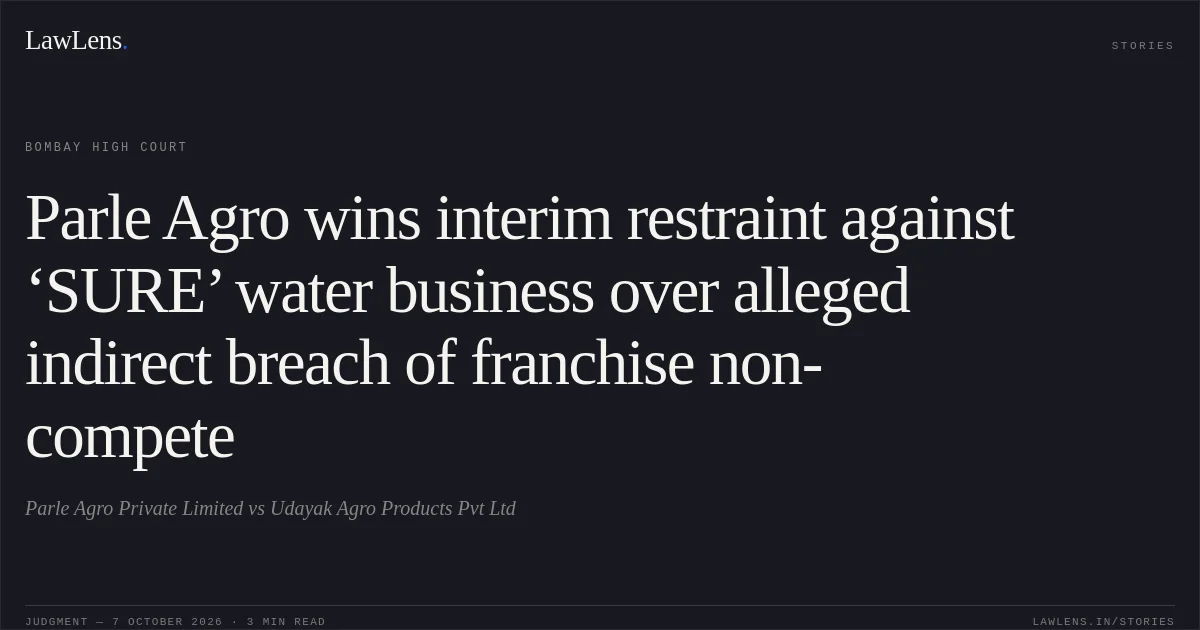
Parle Agro Private Limited (“PAPL”) had a subsisting 2014 franchise agreement with Udayak Agro Products Pvt. Ltd. (“Udayak”) for packaged drinking water, containing restrictions on competing activity carried on directly or indirectly through associates or sister concerns.
Source reference: paras. 1–4, 13–21; pp. 1–5, 10–16A separate 2018 franchise agreement with KL Beverages LLP (“KL Beverages”) covered other beverages.
Source reference: paras. 1–4, 13–21; pp. 1–5, 10–16Following a March 2026 audit at the respondents’ shared industrial compound, PAPL alleged that KL Beverages was manufacturing competing packaged drinking water under the “SURE” brand while Udayak’s agreement remained in force.
Source reference: paras. 1–4, 13–21, 96–101; pp. 1–5, 10–16, 61–67PAPL relied on the contractual covenants, the entities’ alleged operational and management links, and audit and invoice material.
Source reference: paras. 1–4, 13–21, 96–101; pp. 1–5, 10–16, 61–67It sought interim relief under Section 9 of the Arbitration and Conciliation Act, 1996, pending arbitration.
Source reference: paras. 1–4, 13–21, 96–101; pp. 1–5, 10–16, 61–67Issues
1. Whether the 2014 agreement’s restrictions on indirect competition could prima facie reach competing packaged-water activity carried on through KL Beverages, a separate entity and non-signatory to that agreement
Source reference: paras. 69–81, 85–95; pp. 39–49, 50–602. Whether the Court could grant Section 9 interim protection affecting a non-signatory where the alleged activity was carried on through a concern connected with a party to the arbitration agreement
Source reference: paras. 110–118; pp. 74–803. Whether the evidence and balance of convenience justified interim restraint and disclosure, notwithstanding the respondents’ objections concerning post-termination restraint, damages, and business hardship
Source reference: paras. 119–139; pp. 80–101Law Applied
Section 9 of the Arbitration and Conciliation Act, 1996 empowers the Court to grant interim measures to protect the subject matter and efficacy of arbitration; an order may affect a non-signatory where justified by the circumstances, but must not interfere with a third party’s independent rights.
Source reference: paras. 112–118; pp. 75–80The Court applied the ordinary interim-relief considerations of a prima facie case, balance of convenience, and irreparable prejudice.
Source reference: paras. 125–130; pp. 86–92In construing the contractual restrictions, it considered Clauses 5, 14(a), and 16 of the 2014 agreement, including their references to indirect activity through associates or sister concerns and to use of franchise facilities and know-how.
Source reference: paras. 73–84; pp. 41–49It relied on *Elster Instromet B.V. v. Mrunal Gandhi* for the principle that express words addressing indirect competition and affiliates should not be construed so as to make that protection ineffective, while distinguishing the case’s different facts.
Source reference: paras. 89–93, 131–133; pp. 54–58, 92–94The Court did not decide whether a post-termination non-compete restraint would be enforceable under Section 27 of the Contract Act, 1872; it proceeded on the subsisting obligation under the 2014 agreement.
Source reference: paras. 119–120; pp. 80–81Reasoning
The Court read the 2014 agreement as prohibiting not only Udayak’s direct competition but also specified competing activity carried on indirectly through connected entities.
Source reference: paras. 86–88, 96–103; pp. 50–54, 61–69It did not treat common ownership or group membership alone as sufficient to disregard separate legal identity.
Source reference: paras. 86–88, 96–103; pp. 50–54, 61–69Rather, it considered those links together with evidence of shared premises, personnel and business functions, the audit’s record of water-production arrangements at KL Beverages’ premises, and material indicating that the competing activity had begun.
Source reference: paras. 86–88, 96–103; pp. 50–54, 61–69That evidence was sufficient for interim purposes to connect the alleged activity to the restriction, without finally deciding that KL Beverages was a party to the 2014 agreement or that confidential information had been misused.
Source reference: paras. 109, 118, 137; pp. 74, 79–80, 97–99The Court found that continued competing activity could develop customer and market relationships and make restoration more difficult; it therefore favoured limited protection, while preserving the respondents’ ability to conduct independent lawful business outside the disputed field.
Source reference: paras. 121–130, 138; pp. 81–92, 99–100Holding
The Petition was partly allowed.
Pending adjudication before the Sole Arbitrator, the respondents and specified related entities were restrained from directly or indirectly manufacturing, packaging, distributing, marketing, selling, or otherwise dealing in “SURE” water or competing packaged drinking water in a manner contrary to the franchise obligations.
Source reference: para. 140; pp. 102–106They were also restrained from using PAPL’s protected confidential information, know-how, processes, manuals, and business networks in connection with that activity.
Source reference: para. 140; pp. 102–106The restraint does not prohibit KL Beverages from carrying on independent lawful business outside the competing packaged-water field.
Source reference: para. 140; pp. 102–106The respondents were directed to disclose on affidavit, within four weeks, available particulars of competing packaged-water activity from 5 February 2014 onward.
Source reference: para. 140; pp. 102–106All findings were expressly prima facie, with the agreements’ effect, the entities’ relationship, liability, misuse, and damages left to the Arbitrator; no order as to costs was made.
Source reference: para. 140; pp. 102–106Acts & Sections Cited
3 provisions across 2 statutes referred to in this judgment. Each provision opens on LawLens.
Arbitration and Conciliation Act, 19962
Indian Contract Act, 18721
Original Court PDF
Parle Agro Private LimitedvsUdayak Agro Products Pvt Ltd
Click to open original judgment
Original judgment, available to read, download and summarize on LawLens.in