Facts
The petitioner, Tanveer Ahmad Mir, was detained under Section 8(a) of the Jammu Kashmir Public Safety Act, 1978 (PSA) via Order No. 09/DMB/PSA/2025 dated 29.04.2025.
Source reference: p.1The detention was based on allegations that he was an active Over Ground Worker (OGW) for Lashkar-e-Toiba, providing logistical support and maintaining contact with Pakistan-based handlers.
Source reference: p.2The petitioner challenged the detention on multiple grounds: that the grounds were a verbatim copy of the police dossier; that the material was not fully supplied; that the "Security of the State" could not be substituted with "Security of the Union Territory" post-2019; and that procedural rules (Rule 33 of Transaction of Business Rules) were violated.
Source reference: p.2-4Issues
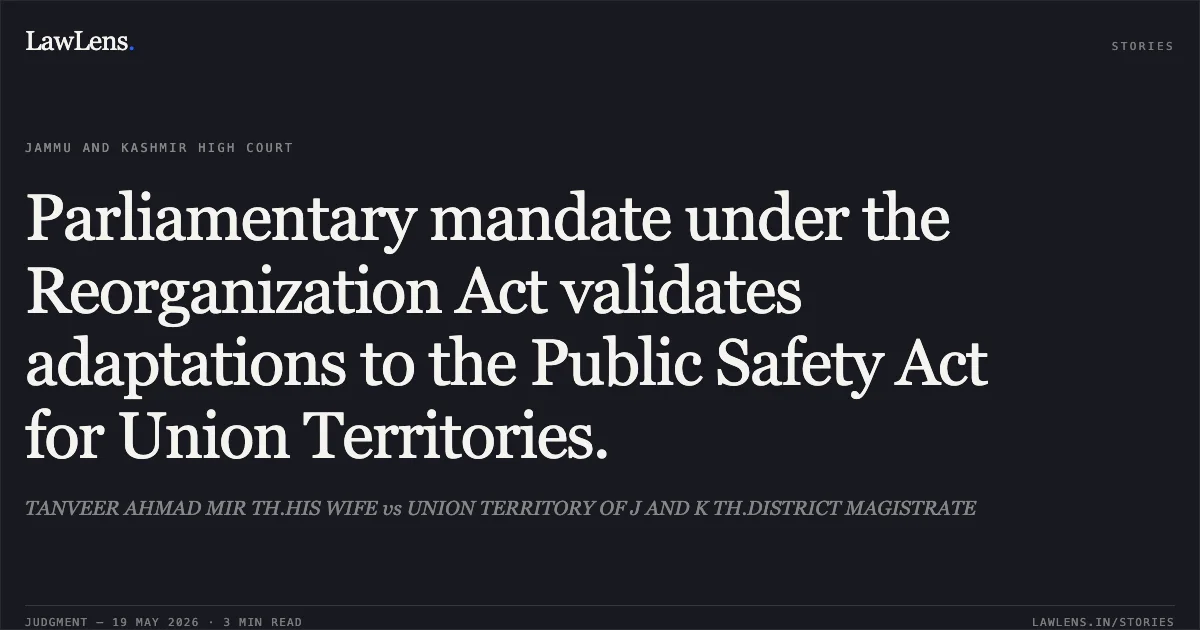
1. Whether the adaptation of the JK Public Safety Act, 1978, substituting "State" with "Union Territory," is constitutionally valid under the JK Reorganization Act, 2019.
Source reference: p.9 / para. 352. Whether the substitution of the police dossier into the grounds of detention constitutes a total non-application of mind.
Source reference: p.14 / para. 533. Whether the failure to strictly follow Rule 33 of the Transaction of Government Business Rules in granting government approval vitiates the detention.
Source reference: p.12 / para. 444. Whether the non-supply of all investigation material resulted in a violation of the constitutional right under Article 22(5).
Source reference: p.18 / para. 65Law Applied
The court applied Section 95 and 96 of the JK Reorganization Act, 2019, which empowers the Central Government to adapt and modify existing laws to facilitate their application to successor Union Territories.
Source reference: p.10-11It relied on Article 22(5) of the Constitution regarding the right to effective representation and Article 21 regarding personal liberty.
Source reference: p.8Procedurally, it applied Section 8(4) of the PSA concerning government approval of detention orders.
Source reference: p.12Precedents included Jai Singh v. State of JK regarding non-application of mind, and Haradhan Saha v. State of West Bengal, which establishes that preventive detention is a precautionary power distinct from punitive prosecution and can be invoked even during the pendency of criminal trials.
Source reference: p.14, p.20Reasoning
The court reasoned that the substitution of "Union Territory" for "State" in the PSA was a valid exercise of delegated legislation expressly sanctioned by Parliament under Section 96 of the Reorganization Act.
Source reference: p.11Regarding the "verbatim reproduction" claim, the court found that while similarities existed, the detaining authority had independently evaluated the detenue’s antecedents, bail status, and recent security threats (e.g., the Pahalgam attack), demonstrating a "conscious" subjective satisfaction.
Source reference: p.16-17The court noted that the detaining authority considered material beyond the FIR, including intelligence inputs and proxy network usage.
Source reference: p.16On procedural grounds, the court held that Rule 33 of Business Rules is an internal regulatory mechanism; since the order was issued "By order of the Government" and the detenue actually submitted a representation, no prejudice was caused.
Source reference: p.13, 18-19The court further observed that all relevant documents (25 leaves) were served and explained to the detenue in his local language.
Source reference: p.18Holding
The court answered all issues in the negative.
It held that the adaptation of the PSA is constitutionally sound and that the subjective satisfaction of the detaining authority was based on relevant, live material.
Source reference: p.12, p.21, p.23The court concluded that the procedural safeguards under Article 22(5) and the PSA were fully complied with, and the detention was necessary to prevent activities prejudicial to the security of the Union Territory; the petition was dismissed and Registry was directed to return the detention records to the respondents.
Source reference: p.24-25Acts & Sections Cited
9 provisions across 4 statutes referred to in this judgment. Each provision opens on LawLens.
Bharatiya Nagarik Suraksha Sanhita, 20232
Code of Criminal Procedure, 19732
Jammu and Kashmir Reorganisation Act, 20193
Unlawful Activities (Prevention) Act, 19672
Original Court PDF
TANVEER AHMAD MIR TH.HIS WIFEvsUNION TERRITORY OF J AND K TH.DISTRICT MAGISTRATE
Click to open original judgment
Original judgment, available to read, download and summarize on LawLens.in