Facts
The applicant, a Senior Social Security Assistant (SSA) at the Employees’ Provident Fund Organisation (EPFO), challenged the application of reservation in the Limited Departmental Competitive Examination (LDCE) 2019 for promotion to the post of Section Supervisor.
Source reference: para. 3.1The notification for the LDCE was issued on June 21, 2018, specifying that nine vacancies were reserved for SC (05) and ST (04) categories
Source reference: para. 3.1The examination was conducted on July 27, 2019, and the results were declared on January 25, 2022
Source reference: para. 5.5The applicant participated in the process but failed to secure a position in the merit list
Source reference: para. 5.5He subsequently challenged the promotion orders dated August 5, 2022, and the rejection of his representation on September 19, 2022, arguing that the respondents failed to collect cadre-wise quantifiable data regarding the inadequacy of representation of SC/ST and the impact on administrative efficiency before implementing reservation
Source reference: para. 2.3, 2.4During the pendency of the litigation, the applicant was promoted to the post, which he accepted
Source reference: para. 5.6Issues
1. Whether the grant of reservation in promotion via the LDCE-2019 was illegal due to non-compliance with the constitutional mandate of collecting quantifiable data as per Jarnail Singh-II
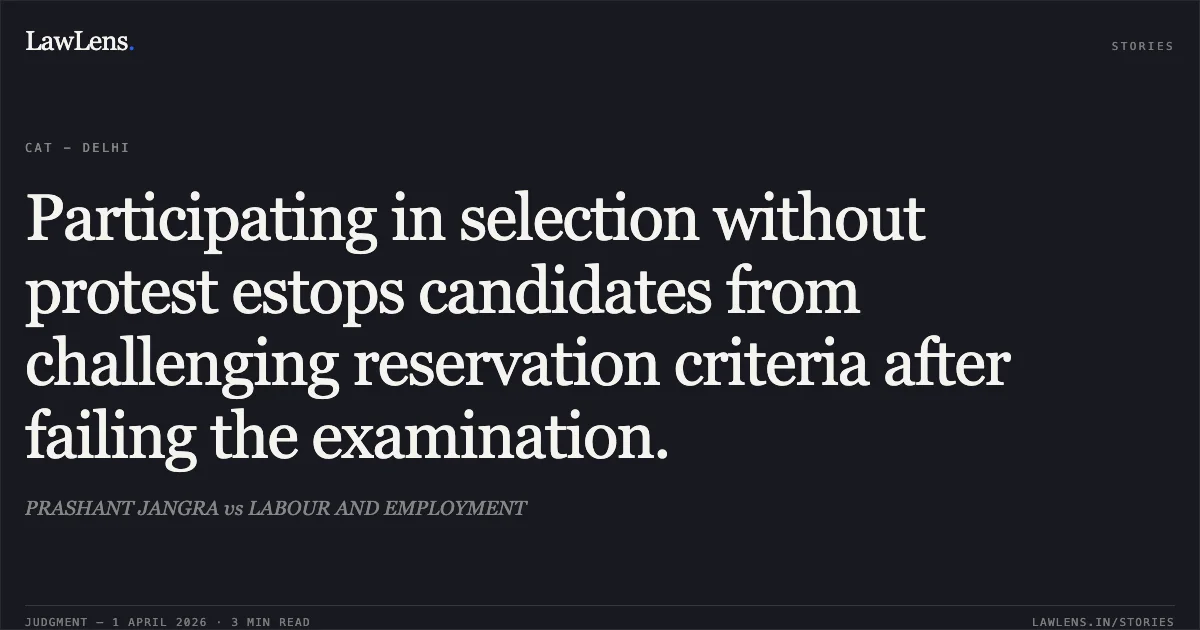
Source reference: para. 5.12. Whether an applicant, having participated in a selection process with full knowledge of the reservation criteria, is estopped from challenging said criteria after failing to secure a promotion
Source reference: para. 3.1, 5.4Law Applied
The court relied on the constitutional requirements for reservation in promotion established in M. Nagaraj v. Union of India (2006) and clarified in Jarnail Singh v. Lachhmi Narain Gupta (2018) and Jarnail Singh-II (2022), which mandate the collection of quantifiable data on inadequacy of representation and the maintenance of administrative efficiency under Article 335
Source reference: para. 5.1, 5.2The court also applied the principle of prospective application of judicial precedents regarding administrative policies
Source reference: para. 5.6the doctrine of estoppel as applied in Dinesh Chandra Yadav v. Union of India, which prevents candidates from challenging selection norms after participating in the process and failing
Source reference: para. 5.7Reasoning
The Tribunal found that the applicant was fully aware of the reserved vacancies stipulated in the 2018 notification and Clause 8, which made candidatures subject to the outcome of various court cases
Source reference: para. 5.4By participating in the LDCE without protest, the applicant took a "calculated chance" and could not challenge the rules of the game after the result was adverse to him
Source reference: para. 3.1Regarding the legal mandate for quantifiable data, the Tribunal noted that the LDCE process began in 2018 and the examination concluded in 2019, whereas the specific directions in Jarnail Singh-II attained finality only on January 28, 2022
Source reference: para. 5.6The Tribunal held that Jarnail Singh-II operates prospectively for future exercises and cannot be used to invalidate a process that was already near completion
Source reference: para. 5.6the Tribunal observed that the applicant had already accepted a subsequent promotion without seeking an amendment to the O.A. for ante-dating or consequential benefits, thereby weakening his claim of prejudice
Source reference: para. 5.6Holding
The Tribunal dismissed the Original Application, holding that there was no merit in the challenge to the reservation policy applied to the LDCE-2019
The court held that the respondents followed extant DoPT OMs and that the judicial requirements of Jarnail Singh-II did not apply retrospectively to nullify an ongoing selection process
Source reference: para. 5.6All pending miscellaneous applications were disposed of with no order as to costs
Source reference: para. 6.2Original Court PDF
PRASHANT JANGRAvsLABOUR AND EMPLOYMENT
Click to open original judgment
Original judgment, available to read, download and summarize on LawLens.in


![Subsequent exoneration does not retrospectively invalidate a finalized promotion select list.. UNNIKRISHNAN M vs M/o Environment And Forests. CAT - ['Ernakulam']. LawLens](/stories/thumbnails/subsequent-exoneration-does-not-retrospectively-invalidate-a-finalized-promotion-select-li-ce80a0e84f2f4887857271e8b4341c42.webp)