Facts
The applicant, a Telephone Mechanic at BSNL, was issued a letter on 19.05.2014 seeking clarification for unauthorized absence since 16.11.2013
Source reference: p. 2The applicant’s written response dated 24.05.2014 used the Hindi proverb “थूक कर चाटना” (to describe inconsistency) and the word “नालायक” (useless/incompetent) in reference to his superior officer
Source reference: p. 2, 4Consequently, he was charged with misconduct under Rule 4(1)(C) of the BSNL (Conduct, Discipline & Appeal) Rules, 2006 for conduct unbecoming of a public servant
Source reference: p. 3On 14.07.2014, the Disciplinary Authority (DA) imposed a minor penalty of stoppage of two annual increments without cumulative effect
Source reference: p. 3The applicant appealed to the Principal General Manager (PGM), who rejected the appeal on 01.10.2015
Source reference: p. 3-4The applicant challenged these orders, contending that the language was colloquial, the letter was drafted by someone else, and the PGM was not the competent Appellate Authority (AA)
Source reference: p. 4-5Issues
1. Whether the use of derogatory language and proverbs against a superior officer in official correspondence constitutes misconduct under the BSNL (CDA) Rules, 2006
Source reference: p. 11-122. Whether an employee can disclaim liability for the contents of an official representation on the grounds that it was drafted by another person, despite having signed it
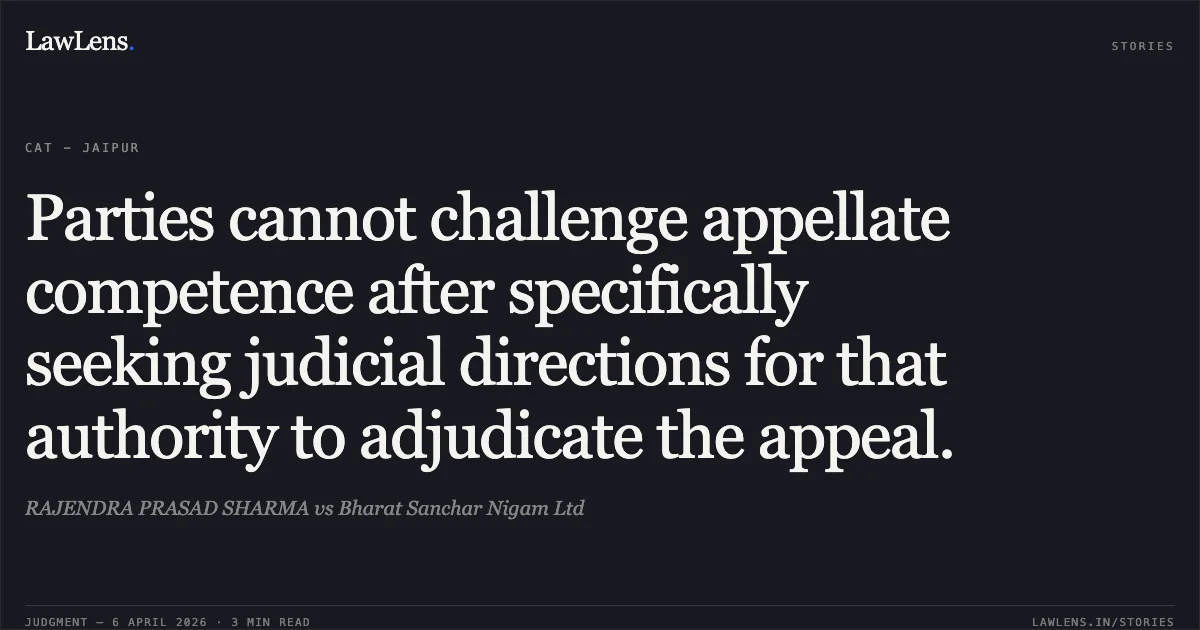
Source reference: p. 133. Whether the appellate order was void for lack of jurisdiction when the applicant himself had previously moved the Tribunal to direct the PGM to decide said appeal
Source reference: p. 15-164. Whether the applicant's failure to disclose previous litigation warranted the imposition of costs
Source reference: p. 19-20Law Applied
Rule 4(1)(C) of the BSNL (CDA) Rules, 2006, which mandates maintaining conduct becoming of a public servant
Source reference: p. 3The doctrine of judicial review as established in Union of India & Ors. v. Subrata Nath, B.C. Chaturvedi v. Union of India, and Union of India v. P. Gunasekaran, which restricts Tribunals from reappreciating evidence or substituting findings of fact unless they are patently perverse or violate natural justice
Source reference: p. 8-11The principle of "approbation and reprobation," preventing a party from challenging an authority's jurisdiction after specifically seeking its exercise
Source reference: p. 16Reasoning
The Tribunal held that the determination of whether specific language is "indecent" falls within the competence of the DA; the use of terms like "useless" for a superior in official records is not an arbitrary ground for punishment
Source reference: p. 12Regarding the drafting of the letter, the Tribunal found the applicant's plea specious, ruling that by appending his signature, he adopted the entire content and could not selectively disclaim offensive portions
Source reference: p. 13On the issue of jurisdiction, the Tribunal noted that while the PGM was not the designated AA under the Rules, the applicant had specifically obtained a direction from the Tribunal in a previous OA (No. 491/2015) for the PGM to decide the appeal
Source reference: p. 15Thus, the applicant was estopped from challenging the PGM's competence
Source reference: p. 16The Tribunal observed that the applicant made a false declaration regarding the absence of prior litigation, which constituted an abuse of the legal process
Source reference: p. 19Holding
The Tribunal dismissed the Original Application, upholding the penalty and the appellate order
It held that the disciplinary proceedings were conducted in accordance with the law and the punishment was not disproportionate
Source reference: p. 12, 17Due to the applicant’s "patent false declaration" regarding previous litigation (OA No. 491/2015) and his attempt to mislead the court, the Tribunal imposed a cost of ₹5,000 to be deposited in the Prime Minister National Relief Fund
Source reference: p. 20Original Court PDF
RAJENDRA PRASAD SHARMAvsBharat Sanchar Nigam Ltd
Click to open original judgment
Original judgment, available to read, download and summarize on LawLens.in


![Subsequent exoneration does not retrospectively invalidate a finalized promotion select list.. UNNIKRISHNAN M vs M/o Environment And Forests. CAT - ['Ernakulam']. LawLens](/stories/thumbnails/subsequent-exoneration-does-not-retrospectively-invalidate-a-finalized-promotion-select-li-ce80a0e84f2f4887857271e8b4341c42.webp)