01Facts
The parties were involved in two suits concerning rights in properties. In Special Civil Suit No. 211 of 2022, the plaintiffs sought enforcement of a release deed executed by the petitioners’ deceased relative; petitioner No. 1 separately sued, claiming a share and challenging that deed.
¶ 6.1–6.4 · pp. 4–5At counsel’s request, both suits were referred to a National Lok Adalat.
¶ 7 · p. 6On 9 September 2023, the parties filed compromise terms in the first suit, and petitioner No. 1 withdrew the second suit. The terms recorded that registered instruments had already been executed and that respondent No. 6 had paid petitioner No. 1 ₹1 crore.
¶ 8, 27–30 · pp. 6, 15–17The petitioners later sought to set aside the compromise, Lok Adalat awards, consequential orders and decree, alleging fraud, coercion, lack of valid consent to referral, and procedural defects, including missing signatures on the award in the withdrawn suit.
¶ 3–5, 11–13 · pp. 2–3, 7–802Issues
i.1. Whether the suits were validly referred to the Lok Adalat under the Legal Services Authorities Act, 1987, despite the petitioners’ assertion that they had not consented to the referral.
¶ 11, 24–26 · pp. 7, 13–14ii.2. Whether the awards and consequential orders should be set aside for want of verification of the parties’ voluntary consent, alleged fraud or coercion, or defects in the awards’ signatures.
¶ 12–13, 27–30 · pp. 7–8, 15–17iii.3. Whether the petitioners had established grounds for interference with the Lok Adalat awards under Articles 226 and 227 of the Constitution.
¶ 20–23 · pp. 11–1303Law Applied
Under Sections 19(5)(i) and 20 of the Legal Services Authorities Act, 1987, a court may refer a pending matter to a Lok Adalat where the parties agree, or one party applies and the court is prima facie satisfied that settlement is possible.
¶ 24 · p. 13Section 21 provides that a Lok Adalat award is deemed to be a decree or order, is final and binding on the parties, and is not appealable.
¶ 19 · p. 11Relying on State of Punjab v. Jalour Singh, (2008) 2 SCC 660, the Court stated that a settlement-based award may be challenged under Articles 226 or 227 only on limited grounds; writ review is not appellate review and may be warranted in cases such as apparent and egregious fraud, irretrievable injustice, an ex facie unlawful award, or a flagrant breach of the judicial process or the Act and its Regulations.
¶ 20–23 · pp. 11–13Provisions in the judgment · 3 · Linked ones open on LawLens
Legal Services Authorities Act, 1987 Section 20Section 21Section 19
04Reasoning
The Court rejected the challenge to the referral because the parties’ advocates had requested it, more than two months passed before the Lok Adalat hearing without objection, and the parties then appeared and executed the compromise or withdrawal pursis.
¶ 25–26 · p. 14It also found the settlement sufficiently demonstrated: the Panel Head recorded that the parties were present and admitted the compromise, while the terms and previously executed registered instruments and payment of ₹1 crore supported the conclusion that the settlement had been acted upon.
¶ 27–29 · pp. 15–16Although the award in the withdrawn suit bore only the Panel Head’s and petitioner No. 1’s signatures, the Court held that this did not materially undermine the settlement because that suit had been withdrawn as a consequence of the settlement in the other suit; petitioner No. 1 had also obtained a court-fee refund certificate.
¶ 30 · p. 17In the circumstances, the petitioners’ prior conduct and receipt of benefits did not establish a basis for writ interference.
¶ 31 · p. 1705Holding
The Court held that the referral and settlement were not shown to be invalid and that the petitioners had not established grounds for setting aside the Lok Adalat awards or consequential orders.
¶ 31–33 · pp. 17–18The writ petition was dismissed, the Rule discharged, and no costs were awarded.
¶ 31–33 · pp. 17–18Original Court PDF
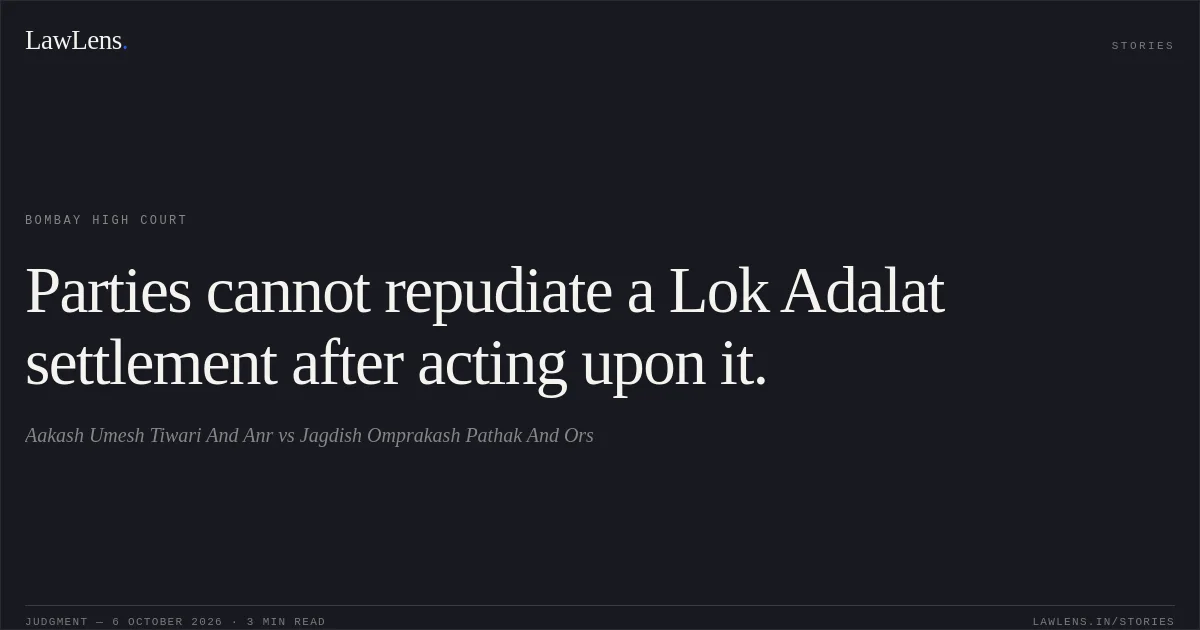
Aakash Umesh Tiwari And AnrvsJagdish Omprakash Pathak And Ors
Click to open original judgment
Original judgment, available to read, download and summarize on LawLens.in