Facts
The respondent had sued for possession of four acres in Survey No. 47/1A at Sirnoor, alleging entitlement to the property.
Source reference: p. 3The trial court dismissed the suit; the first appellate court partly allowed the respondent’s appeal and decreed recovery of three acres, prompting the defendants’ second appeal.
Source reference: pp. 5–6During the second appeal, the parties entered into a mediated compromise. The appellants agreed to pay the respondent ₹1.70 crore in instalments in full and final settlement of his claims concerning the land.
Source reference: pp. 6–9The parties were present before the High Court; the Court accepted the daughter’s special power of attorney in favour of her brother, and the appellants handed over a demand draft for ₹25 lakh, which the respondent acknowledged receiving.
Source reference: pp. 3–4, 9Issues
1. Whether the parties’ compromise could be accepted and the second appeal disposed of in its terms.
Source reference: pp. 4–5, 92. Whether the decree should provide for recovery of the agreed settlement amount in the event of non-compliance with the payment schedule.
Source reference: p. 7Law Applied
Order XXIII Rule 3 of the Code of Civil Procedure, 1908, provides for recording a lawful compromise in writing and signed by the parties, and for passing a decree in accordance with it.
Source reference: no citationThe appeal was brought under Section 100 read with Order XLII Rule 1 CPC.
Source reference: p. 2The Court cited no precedents and did not independently decide the underlying title or limitation questions; those matters were addressed through the parties’ agreed terms.
Source reference: pp. 7–8Reasoning
The Court found it just and reasonable to dispose of the appeal in accordance with the parties’ compromise, noting their presence and the respondent’s receipt of the first instalment of ₹25 lakh.
Source reference: pp. 3–5, 9The compromise specified the remaining instalments and provided that the respondent could execute the decree to recover the agreed amounts in the event of default.
Source reference: pp. 6–7The Court accepted the settlement and directed the Registry to draw the decree accordingly.
Source reference: p. 10Holding
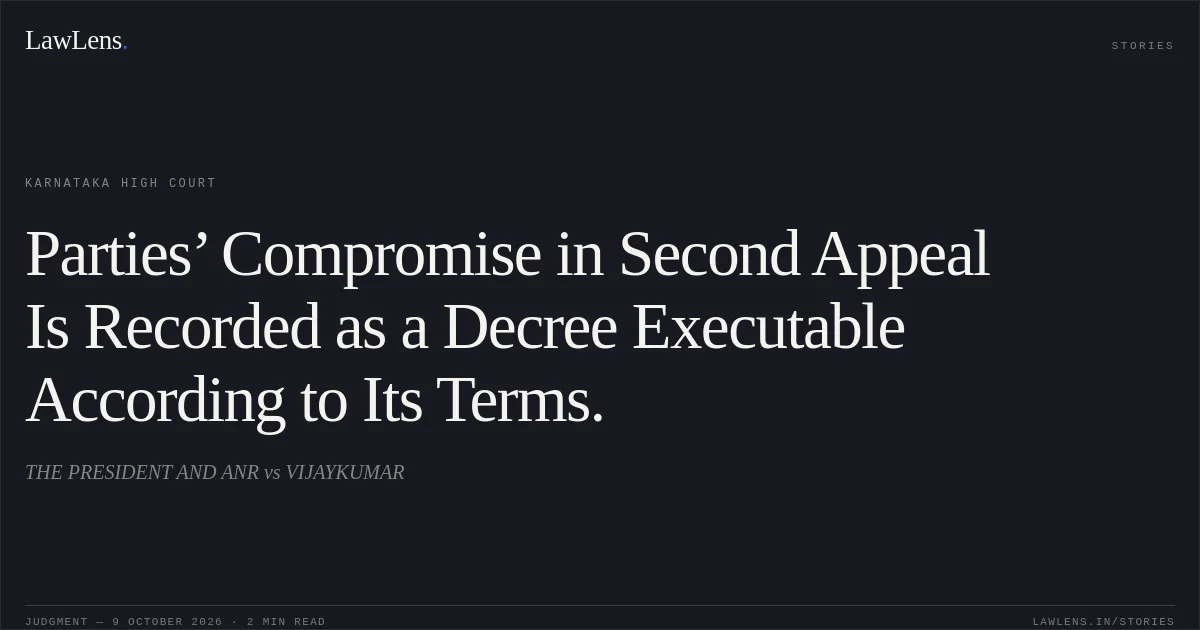
The High Court disposed of the second appeal on the terms of the compromise petition and directed the Registry to draw the decree in those terms.
The compromise provides for payment of ₹1.70 crore in instalments, with execution available to recover amounts in the event of non-compliance; the parties were to bear their own costs.
Source reference: pp. 6–9Acts & Sections Cited
1 provisions across 1 statute referred to in this judgment. Each provision opens on LawLens.
Code of Civil Procedure, 19081
Original Court PDF
THE PRESIDENT AND ANRvsVIJAYKUMAR
Click to open original judgment
Original judgment, available to read, download and summarize on LawLens.in