Facts
Airports Authority of India (AAI) awarded a works contract to M/s Ahluwalia Contracts (India) Limited (ACIL) on 21 January 2009, followed by execution of the Contract Agreement on 2 February 2009. Disputes arose concerning the levy of compensation. After the dispute-resolution process failed, ACIL invoked arbitration under Clause 57(b) of the Contract Agreement on 16 April 2019.
Source reference: pp. 3–4, paras. 5–7AAI unilaterally appointed Shri S.C. Gupta, Chief Engineer (Retd.), CPWD, as the Sole Arbitrator under Clause 57(c), and the Arbitrator furnished the requisite declaration under Section 12(1)(b) of the Arbitration and Conciliation Act, 1996 (“A&C Act”).
Source reference: p. 4, para. 8Both parties participated in the arbitral proceedings from 2019 to 2023 without objecting to the constitution of the Tribunal. The Sole Arbitrator passed an Award dated 10 August 2023 allowing certain claims of ACIL and rejecting AAI’s counter-claims.
Source reference: pp. 4–5, paras. 9–11AAI challenged the Award under Section 34 of the A&C Act, but did not plead any objection concerning the unilateral appointment or Section 12(5) read with the Seventh Schedule.
Source reference: p. 5, para. 12During the Section 34 hearing, the learned Single Judge raised the issue suo motu, relied upon Bhadra International (India) Pvt. Ltd. v. Airports Authority of India and related decisions, and set aside the Award on the ground that the Sole Arbitrator had been invalidly appointed.
Source reference: pp. 5–6, paras. 13–15ACIL preferred the present appeal under Section 37.
Source reference: p. 2, para. 1Issues
1. Whether AAI’s unilateral appointment of the Sole Arbitrator, after disputes had arisen and without a subsequent express written agreement waiving Section 12(5) of the A&C Act, was invalid under Section 12(5) read with the Seventh Schedule?
Source reference: pp. 9–10, paras. 21–242. Whether AAI, having itself appointed the Sole Arbitrator and participated in the arbitral proceedings without objection, was precluded from challenging the appointment after the Award was rendered?
Source reference: pp. 6–9, paras. 17–18; pp. 14–18, paras. 32–403. Whether the learned Single Judge could examine the validity of the Tribunal’s constitution under Section 34 despite AAI not having raised the objection in its Section 34 petition or before the Arbitral Tribunal?
Source reference: pp. 18–19, paras. 41–43Law Applied
The Court applied Section 12(5) of the A&C Act, which renders a person falling within the Seventh Schedule categories ineligible to act as an arbitrator, notwithstanding any prior agreement to the contrary; waiver is permissible only through an express agreement in writing made after the disputes have arisen.
Source reference: pp. 10–11, paras. 23–24Relying on Bharat Broadband Network Ltd. v. United Telecoms Ltd., (2019) 5 SCC 755, and Bhadra International (India) Pvt. Ltd. v. Airports Authority of India, 2026 INSC 6, the Court held that appointment, acquiescence, participation, or other conduct cannot constitute the statutorily required waiver.
Source reference: pp. 11–17, paras. 25–27, 35–39It also relied on Railways Board, Ministry of Railways v. Titagarh Rail Systems Ltd., 2026:DHC:1720, holding that following a contractual appointment procedure cannot itself waive Section 12(5), and Mahavir Prasad Gupta and Sons v. Govt. of NCT of Delhi, 2025 SCC OnLine Del 4241, holding that unilateral appointment is not an express written waiver.
Source reference: pp. 13–15, paras. 28–34The Court further held that an objection concerning the inherent jurisdiction and statutory eligibility of the Tribunal may be examined at the Section 34 stage notwithstanding the absence of an earlier objection.
Source reference: p. 19, para. 41Reasoning
The Court held that AAI’s unilateral appointment of the Sole Arbitrator was made after disputes had arisen and that no subsequent express written agreement existed by which both parties consciously waived Section 12(5).
Source reference: p. 18, para. 40AAI’s own appointment of the Arbitrator did not amount to such waiver because the act of appointment and the statutory waiver contemplated by the proviso operate in distinct fields.
Source reference: pp. 14–15, paras. 32–33Similarly, AAI’s participation in the arbitration for nearly four years, submission of pleadings, involvement in the reference of claims and counter-claims, and failure to object could not replace the mandatory requirement of an express written agreement.
Source reference: pp. 17–18, paras. 38–40The Court rejected ACIL’s attempt to confine Bhadra International to cases where the non-appointing party raises the challenge, observing that the requirement of written waiver does not depend on which party made the appointment.
Source reference: p. 18, para. 38Since the defect concerned the Tribunal’s statutory eligibility and inherent jurisdiction, the absence of an objection in AAI’s Section 34 petition did not validate the appointment or prevent the Court from examining it.
Source reference: p. 19, para. 41Holding
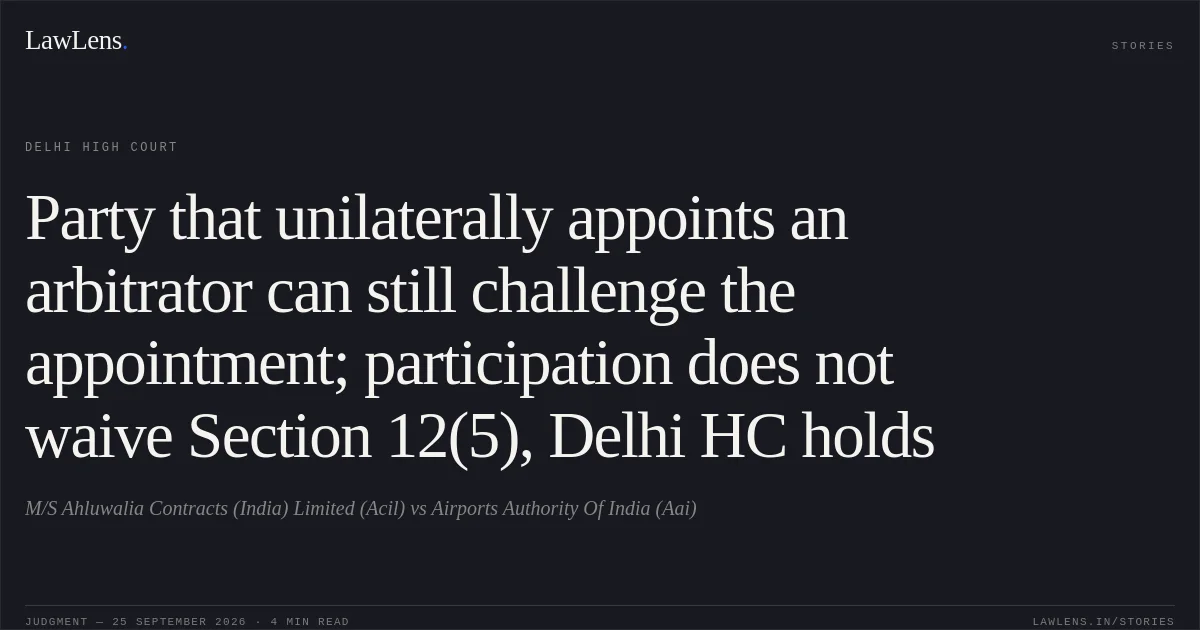
The Court answered the issues against ACIL. It held that AAI’s unilateral appointment of the Sole Arbitrator was contrary to Section 12(5) read with the Seventh Schedule, and that neither AAI’s appointment of the Arbitrator nor its subsequent participation in the proceedings constituted a valid waiver in the absence of an express written agreement made after the disputes arose.
The learned Single Judge was therefore justified in setting aside the Award on the ground of invalid constitution of the Arbitral Tribunal.
Source reference: p. 19, paras. 42–45The appeal was dismissed, and the pending applications were closed.
Source reference: p. 20, para. 46Acts & Sections Cited
10 provisions across 2 statutes referred to in this judgment. Each provision opens on LawLens.
Arbitration and Conciliation Act, 1996
Indian Contract Act, 18721
Original Court PDF
M/S Ahluwalia Contracts (India) Limited (Acil)vsAirports Authority Of India (Aai)
Click to open original judgment
Original judgment, available to read, download and summarize on LawLens.in