Facts
The petitioners applied to the Regional Passport Officer (RPO), Ahmedabad, for the re-issuance/renewal of their passports to reflect a change in residential address and to visit their children abroad
Source reference: p. 1-2The RPO refused to renew the passports for the full 10-year validity period on the grounds that a criminal FIR was pending against the petitioners
Source reference: p. 2The petitioners noted that the High Court had already stayed the FIR proceedings in a separate quashing petition and had deleted the bail condition requiring the surrender of their passports
Source reference: p. 2The respondent authorities argued that under GSR Notification 570(E) dated 25.08.1993, since the Trial Court order did not specify a renewal period, the passport could only be issued for one year
Source reference: p. 3Issues
1. Whether the passport authorities are required to renew a passport for the full statutory period of 10 years despite pending criminal proceedings when the court has not specified a shorter duration
Source reference: p. 4 / para. 92. Whether the guidelines established by the Bombay High Court regarding the interpretation of GSR Notification 570(E) and the Passport Rules, 1980, should be applied to ensure the petitioners' right to a full-term passport
Source reference: p. 5-6 / para. 10-12Law Applied
Section 6(2)(f) of the Passports Act, 1967, which allows for the refusal of a passport if criminal proceedings are pending, read with Section 22, which allows for exemptions
Source reference: p. 4GSR Notification 570(E) dated 25.08.1993, which provides specific durations for passport issuance (one year vs. court-specified periods) for persons with pending cases
Source reference: p. 4, para. 8Precedent of Narendra K. Ambwani v. Union of India & Ors. (2014 SCC Online Bom 356), which established that if a Magistrate directs renewal "as per Rules," the Passport Rules, 1980 apply, necessitating a 10-year renewal for qualifying adults
Source reference: p. 5-6Reasoning
The court reasoned that while GSR Notification 570(E) provides a default one-year renewal period when a court order is silent on duration, this must be balanced against the Passport Rules, 1980, which generally mandate a 10-year tenure
Source reference: para. 9-10The court observed that passport authorities do not possess the judicial power to determine an individual's right to travel; that authority rests solely with the Trial Court
Source reference: para. 12By adopting the logic in Narendra K. Ambwani, the court resolved the ambiguity between the restricted timeline in the 1993 Notification and the standard 10-year rule, concluding that the RPO is bound to renew the passport for 10 years unless a court specifically orders otherwise
Source reference: para. 12The court noted the petitioners were well-settled and the FIR proceedings were already stayed, diminishing the risk of absconding
Source reference: para. 5Holding
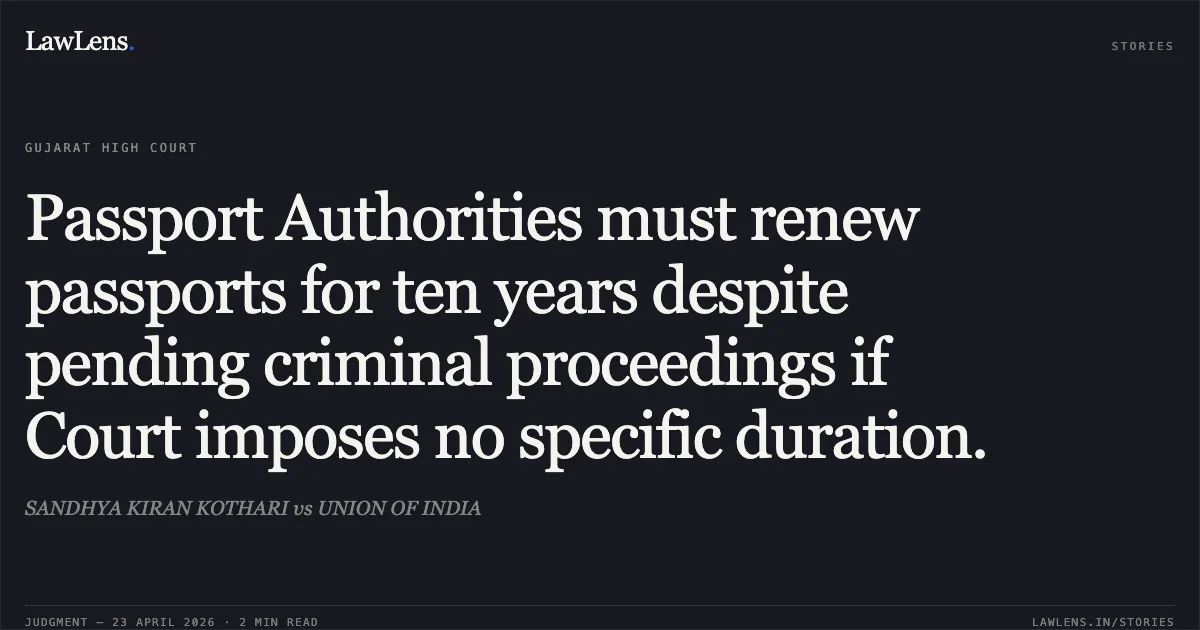
The Court allowed the petition and issued a writ of mandamus directing the respondent authority to re-issue/renew the petitioners' passports for a full validity period of 10 years
The court held that the application must be processed within four weeks
Source reference: para. 13The petitioners must still obtain specific permission from the concerned Trial Court before undertaking any actual travel abroad, at which point the Trial Court may impose necessary conditions
Source reference: para. 13Rule made absolute
Source reference: para. 14Acts & Sections Cited
2 provisions across 1 statute referred to in this judgment. Each provision opens on LawLens.
Passports Act, 19672
Original Court PDF
SANDHYA KIRAN KOTHARIvsUNION OF INDIA
Click to open original judgment
Original judgment, available to read, download and summarize on LawLens.in