Facts
The petitioner’s passport had expired, and he applied to the respondent passport authority for a renewal for a period of 10 years
Source reference: para. 3, 5The petitioner has pending criminal proceedings against him
Source reference: para. 8The passport authority, citing GSR Notification 570(E) dated 25.08.1993, processed the renewal for only 1 year because the Trial Court’s order permitting the petitioner to hold a passport did not specify a particular validity period
Source reference: para. 6, 9The petitioner approached the High Court seeking a direction for a 10-year renewal to facilitate international travel
Source reference: para. 3, 5Issues
1. Whether the passport authority is mandated to renew a passport for a full 10-year term when the Trial Court has not specified a specific validity period in its order for an applicant with pending criminal proceedings.
Source reference: para. 3, 92. Whether the guidelines issued by the Bombay High Court in Narendra K. Ambwani v. Union of India regarding the interpretation of the Passport Rules and GSR 570(E) should be applied to the present case.
Source reference: para. 5.1, 11Law Applied
The court primarily applied Section 6(2)(f) and Section 22 of the Passports Act, 1967
Source reference: para. 3, 8It relied on GSR Notification 570(E) dated 25.08.1993, which exempts citizens with pending criminal cases from certain restrictions provided they obtain a court order, but restricts passport validity to one year if the court order is silent on duration
Source reference: para. 8, 9Furthermore, the court adopted the persuasive ratio of the Bombay High Court in Narendra K. Ambwani v. Union of India & Ors. (2014 SCC Online Bom 356), which clarified that qualifying applicants are entitled to a 10-year renewal under the Passport Rules, 1980, unless the Magistrate specifically orders otherwise under the 1993 Notification
Source reference: para. 10, 11Reasoning
The court noted that while GSR Notification 570(E) provides a default 1-year renewal when a trial court order is silent, an ambiguity exists when read alongside the general Passport Rules, 1980, which provide for 10-year renewals
Source reference: para. 11Adopting the reasoning in Narendra K. Ambwani, the court determined that the passport authority does not possess the jurisdiction to decide an accused person's right to travel; that authority rests solely with the Trial Court
Source reference: para. 11The court reasoned that a 10-year renewal is the standard administrative procedure under the Rules, and any restrictions on actual travel (as opposed to mere possession of the document) must be governed by specific conditions imposed by the Trial Court when the petitioner seeks permission to depart from India
Source reference: para. 11, 12Holding
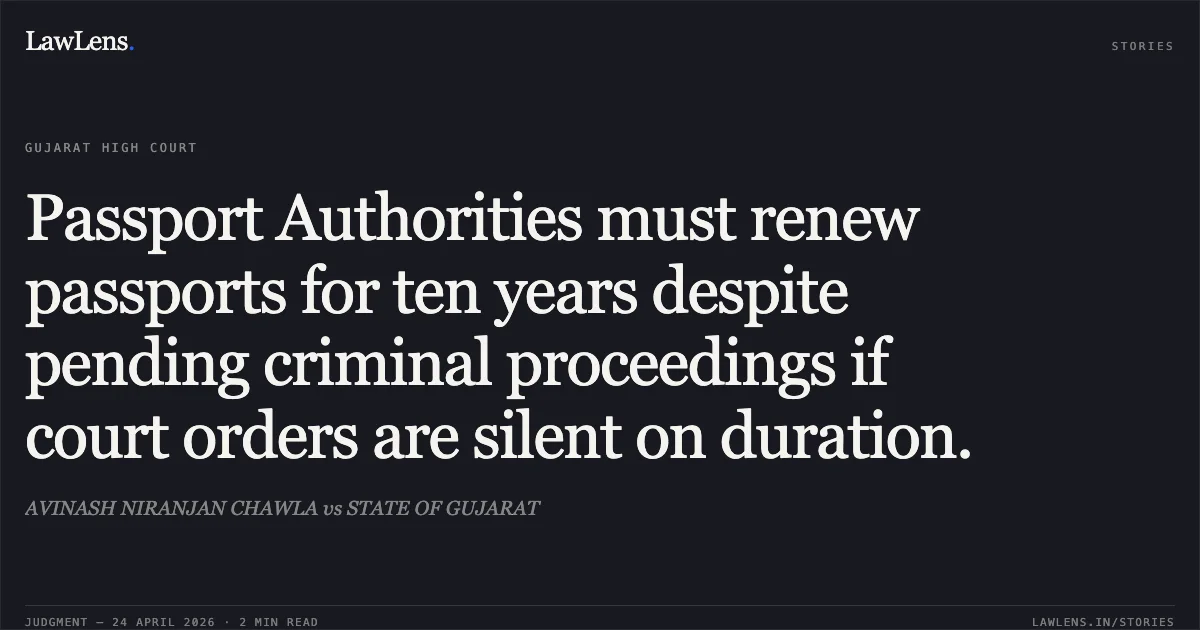
The Court allowed the petition and directed the respondent authority to renew the petitioner's passport for a period of 10 years
The holding clarifies that while the passport is to be renewed for the standard duration, the petitioner must still obtain express permission from the Trial Court before any specific international travel, at which point the Trial Court may impose necessary conditions
Source reference: para. 12The authority was ordered to decide the renewal application within four weeks
Source reference: para. 12Acts & Sections Cited
2 provisions across 1 statute referred to in this judgment. Each provision opens on LawLens.
Passports Act, 19672
Original Court PDF
AVINASH NIRANJAN CHAWLAvsSTATE OF GUJARAT
Click to open original judgment
Original judgment, available to read, download and summarize on LawLens.in


![Subsequent exoneration does not retrospectively invalidate a finalized promotion select list.. UNNIKRISHNAN M vs M/o Environment And Forests. CAT - ['Ernakulam']. LawLens](/stories/thumbnails/subsequent-exoneration-does-not-retrospectively-invalidate-a-finalized-promotion-select-li-ce80a0e84f2f4887857271e8b4341c42.webp)