Facts
The appellant, Chief Executive Officer of the Lal Saraiya Fisherman Refugee Cooperative Society, claimed that a 348.55-acre Jalkar had been allotted in 1956 to fifteen refugee fishermen families for rehabilitation and had thereafter been periodically settled with them on payment of the reserved jama.
Source reference: para. 3–9The Society challenged an increase in the reserved jama in an earlier writ petition; that petition was disposed of with a direction to consider its representation.
Source reference: para. 3–9After the Jalkar was transferred to the Animal and Fisheries Resource Department, the appellant sought its settlement in favour of the Society.
Source reference: para. 3–9The Single Judge dismissed the ensuing writ petition, holding that the appellant had established no enforceable legal or statutory right.
Source reference: para. 3–9The appellant appealed, relying, among other things, on the history of settlement, legitimate expectation, and Sections 15 and 27 of the Displaced Persons (Compensation and Rehabilitation) Act, 1954.
Source reference: para. 3–9Issues
1. Whether the Single Judge’s dismissal of the writ petition suffered from illegality, perversity or infirmity warranting appellate interference
Source reference: para. 122. Whether the appellant’s past settlement of the Jalkar, claimed legitimate expectation, or reliance on the Displaced Persons (Compensation and Rehabilitation) Act, 1954 established an enforceable right to settlement
Source reference: para. 14–16Law Applied
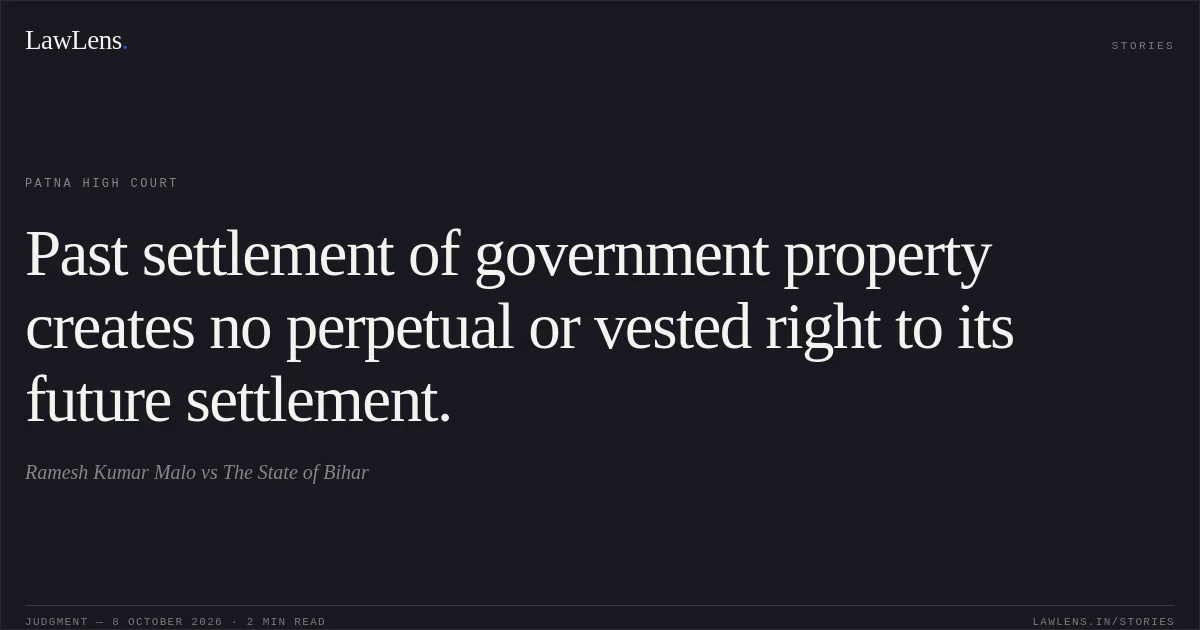
Settlement of Government property must comply with the applicable statutory framework and the constitutional requirements of fairness, equality and non-arbitrariness; past settlement or permission to use such property does not, by itself, create a perpetual or vested right to future settlement.
Source reference: para. 14Under Sant Ram Sharma v. State of Rajasthan, AIR 1967 SC 1910, executive instructions cannot override statutory rules and ordinarily do not create enforceable rights.
Source reference: para. 6Under Union of India v. Hindustan Development Corporation, (1993) 3 SCC 499, legitimate expectation may arise from an express promise or consistent practice, but does not by itself mature into an enforceable right.
Source reference: para. 15Relief under Article 226 requires an enforceable legal right; the earlier court orders required fair consideration in accordance with law but did not direct settlement in the appellant’s favour.
Source reference: para. 17, 19Reasoning
The Court accepted that the Jalkar had reportedly been allotted to refugee fishermen families and settled with them over time, but held that those circumstances could not confer a perpetual right over Government property.
Source reference: para. 14–19The appellant identified no statutory provision granting the Society an indefeasible right to settlement; the asserted executive practice and legitimate expectation were insufficient to establish one.
Source reference: para. 14–19Nor did the earlier orders or the transfer of the Jalkar between departments confer such a right.
Source reference: para. 14–19The appellant’s rehabilitation and livelihood claims could be considered by the competent authority, but could not justify a judicial direction to settle the property in the Society’s favour absent an enforceable legal right.
Source reference: para. 14–19Holding
The Court answered the issue against the appellant and found no illegality, perversity or infirmity in the Single Judge’s order warranting interference.
The appeal was disposed of without granting the requested settlement, but the appellant was given liberty to submit a representation concerning rehabilitation; the competent authority must consider and decide it in accordance with law.
Source reference: para. 20–22Acts & Sections Cited
2 provisions across 1 statute referred to in this judgment. Linked provisions open on LawLens.
Displaced Persons (Compensation and Rehabilitation) Act, 19542
Original Court PDF
Ramesh Kumar MalovsThe State of Bihar
Click to open original judgment
Original judgment, available to read, download and summarize on LawLens.in