Facts
The petition was initially brought by a breast-cancer patient seeking affordable access to Ribociclib, a patented medicine, and directions to the Union Government to act under Sections 92 or 100 of the Patents Act, 1970.
Source reference: pp. 4–7The petitioner died while the case was pending; the Court continued the matter in its own name and appointed an amicus curiae.
Source reference: pp. 4–7The Court later impleaded, among others, the relevant patent holders and cancer-treatment institutions.
Source reference: pp. 8, 21–22The Union relied on Palbociclib as an alternative, while the amicus and expert material maintained that it was not interchangeable with Ribociclib for early breast cancer.
Source reference: pp. 8, 21–22Issues
1. Whether “use of an invention for the purposes of Government” under Sections 99 and 100 of the Patents Act includes government-authorised manufacture of a patented medicine and its non-commercial sale to needy patients.
Source reference: pp. 26–302. Whether the Court should direct the Central Government to invoke Section 100 where a patented life-saving medicine is alleged to be unaffordable.
Source reference: pp. 45–483. Whether Palbociclib could be treated as an interchangeable substitute for Ribociclib in the circumstances considered.
Source reference: pp. 21–22Law Applied
Section 99 of the Patents Act defines use for government purposes to include an invention made, used, exercised or vended for the purposes of the Central Government, a State Government or a government undertaking; Section 100 authorises government use and permits an authorised person to make, use, exercise or vend a patented medicine, including its non-commercial sale.
Source reference: pp. 26–29Section 83 requires the patent system to promote public health and public interest, avoid impeding public-health measures, and make patented inventions available at reasonably affordable prices.
Source reference: pp. 44–45Article 21 imposes a State obligation to protect life, while Article 47 makes improvement of public health a primary duty of the State.
Source reference: pp. 33–43The Supreme Court’s decision in In Re: Distribution of Essential Supplies and Services During Pandemic recognised government-use powers under Section 100 as a public-health flexibility, but treated whether and to what extent to exercise those powers as a policy decision for the Central Government.
Source reference: pp. 34–36, 47–48Paschim Banga Khet Mazdoor Samity v. State of W.B. and Pt. Parmanand Katara v. Union of India affirm the State’s duty to preserve life and provide medical assistance.
Source reference: pp. 36–39Government policy is generally for the executive, subject to constitutional and statutory limits; the Court also relied on State of Punjab v. Ram Lubhaya Bagga and Siddharth Dalmia v. Union of India concerning judicial restraint in policy matters.
Source reference: pp. 48–54Reasoning
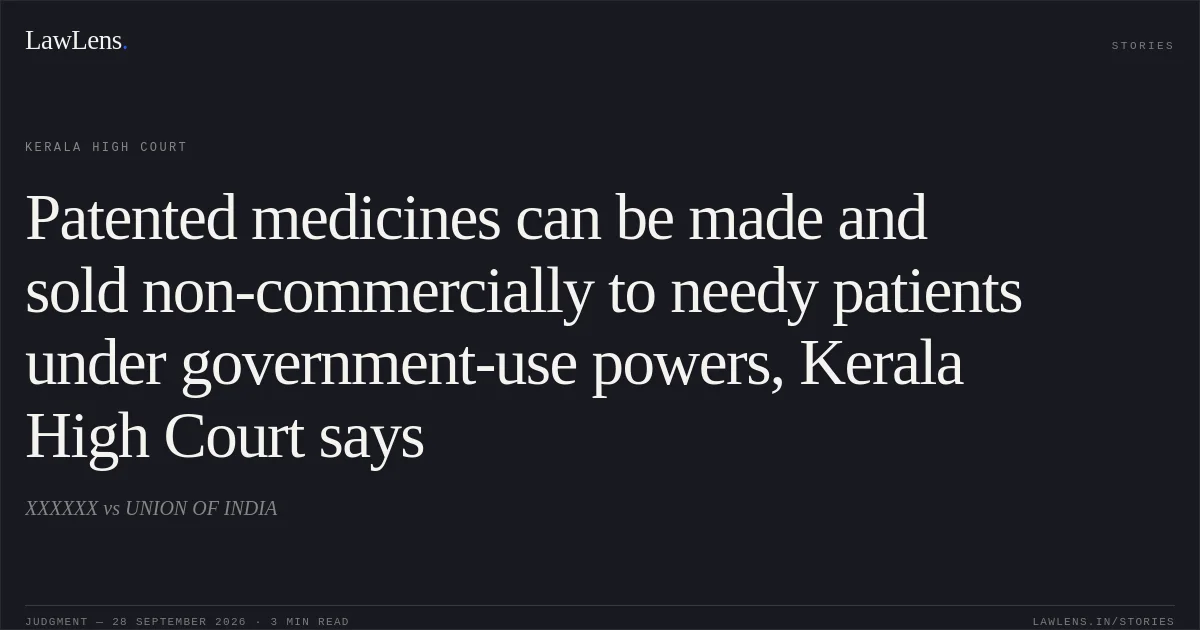
The Court read Sections 99 and 100 together and held that the authority to “vend” under Section 100, read with the express references to medicines and non-commercial sale, permits the Government to authorise manufacture of a patented drug and sell it to needy patients.
Source reference: pp. 26–30It considered this construction consistent with the State’s public-health duties under Articles 21 and 47 and the principles in Section 83.
Source reference: pp. 33–36, 44–45The Court rejected the contention that Palbociclib was an adequate substitute for Ribociclib, relying on the Drug Controller General’s affidavit and the Regional Cancer Centre’s report distinguishing their stated uses.
Source reference: pp. 21–22However, the Court declined to order the Government to invoke Section 100: affordability and the appropriate response required countrywide data on patients, medicine use, unmet need and the effectiveness of existing schemes.
Source reference: pp. 47–52The decision whether to exercise Section 100 remained a matter for the Central Government, informed by that data and subject to judicially stated legal principles.
Source reference: pp. 47–52Holding
The Court held that Section 100 can encompass government-authorised manufacture of a patented medicine and its non-commercial sale to needy patients, and that the power may be relevant where a patented medicine is sold at an exorbitant price.
It did not issue a mandamus requiring the Government to invoke Section 100.
Source reference: p. 56Instead, it disposed of the petition, holding that the Government should collect the necessary data, determine affordability and proceed under Section 100 if warranted.
Source reference: p. 56Acts & Sections Cited
16 provisions across 1 statute referred to in this judgment. Each provision opens on LawLens.
Original Court PDF
XXXXXXvsUNION OF INDIA
Click to open original judgment
Original judgment, available to read, download and summarize on LawLens.in