Facts
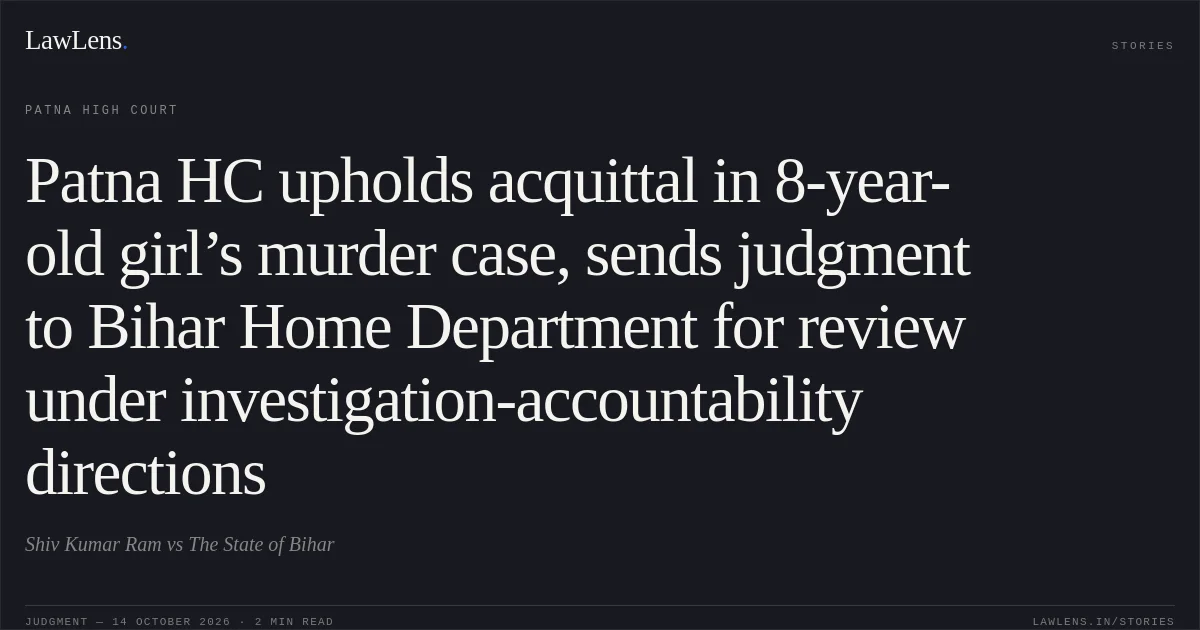
The appellant, father of an eight-year-old girl, challenged the acquittal of Guddu Manjhi by the Additional Sessions Judge-cum-Special Judge (POCSO), Patna, of charges under Sections 376 and 302 IPC, Section 4 of the POCSO Act, and Section 3(2)(v) of the SC/ST Act.
Source reference: para. 2, 7The prosecution alleged that the child went missing on the evening of 27 August 2015 and was found dead the next morning in an under-construction building; the post-mortem attributed death to asphyxia by smothering.
Source reference: para. 3–5, 31The trial court found that the prosecution had not established rape or linked the accused to the killing, and acquitted him.
Source reference: para. 11–15The father appealed, relying principally on alleged last-seen evidence and the medical evidence.
Source reference: para. 16–20Issues
1. Whether the trial court’s acquittal was contrary to the evidence or involved an error warranting appellate interference.
Source reference: para. 16–20, 37–382. Whether the prosecution evidence, including the alleged last-seen circumstance and forensic evidence, established the accused’s involvement in the victim’s death and the charged sexual offences.
Source reference: para. 24–37Law Applied
The charges were under Sections 376 and 302 of the IPC, Section 4 of the POCSO Act, and Section 3(2)(v) of the SC/ST Act.
Source reference: para. 2, 7The prosecution was required to establish the accused’s guilt beyond reasonable doubt; unexamined witnesses’ statements recorded under Section 161 CrPC could not, in the circumstances of this case, establish the alleged last-seen circumstance.
Source reference: para. 24–25The Court also relied on State of Gujarat v. Kishanbhai, (2014) 5 SCC 108, which calls for State-level review of acquittals, identification of investigative or prosecutorial lapses, and appropriate departmental action where warranted.
Source reference: para. 40–41Reasoning
The Court found no reliable trial evidence that the victim had been seen with the accused: the father’s account was not reflected in his fardbeyan, the mother had not witnessed the accused taking the child, the alleged supporting witnesses were not examined, and PW-9 denied knowing or identifying the accused.
Source reference: para. 24–30, 36The autopsy established death by smothering but did not establish rape; the forensic reports detected human blood on the exhibits but no semen, and no evidence connected the blood to the accused.
Source reference: para. 31–35In the absence of evidence connecting the accused to the occurrence, the Court held that the trial court had committed no error in extending the benefit of doubt.
Source reference: para. 37Holding
The High Court dismissed the appeal and upheld the acquittal, finding no merit in the challenge.
It directed that a copy of the judgment be sent to the Bihar Home Department to consider the directions in Kishanbhai and the Court’s subsequent decisions; copies were also directed to the Director General of Police, Bihar, and the Director, Directorate of Prosecution, Bihar, and the trial-court record was to be returned.
Source reference: para. 41–42Acts & Sections Cited
15 provisions across 4 statutes referred to in this judgment. Each provision opens on LawLens.
Indian Penal Code, 18604
Protection of Children from Sexual Offences Act, 20124
Scheduled Castes and the Scheduled Tribes (Prevention of Atrocities) Act, 19895
Code of Criminal Procedure, 19732
Original Court PDF
Shiv Kumar RamvsThe State of Bihar
Click to open original judgment
Original judgment, available to read, download and summarize on LawLens.in