Facts
The original appellant, a Panchayat Secretary at Jagdishpur Gram Panchayat, was allegedly caught accepting a bribe of ₹25,000 in a vigilance trap relating to disbursement of benefits under the Indira Awas Yojana. A criminal case under Sections 7 and 13(2) read with Section 13(1)(d) of the Prevention of Corruption Act, 1988, and departmental proceedings were initiated against him.
Source reference: pp. 2–3, paras 2(i)–(iii)The first departmental enquiry was not accepted by the Disciplinary Authority because no evidence had been led by the department; a fresh enquiry was ordered. In the second enquiry, the Enquiry Officer found the charges proved, and the appellant was dismissed from service on 15 July 2014.
Source reference: p. 3, para 2(iii)His writ petition was dismissed by the learned Single Judge, following which he filed the present Letters Patent Appeal.
Source reference: pp. 3–4, para 2(iv)The Division Bench referred the matter to a Larger Bench to determine whether a disciplinary proceeding involving a serious charge should be remanded when the punishment order is quashed for procedural defects such as non-examination of witnesses or non-furnishing of the list of documents.
Source reference: pp. 9–10, para 2(ix)During the pendency of the appeal, the original appellant died, and his legal heirs were substituted because the dismissal order affected monetary, pensionary and family-pension entitlements.
Source reference: pp. 10–12, paras 3–8Issues
Whether a disciplinary proceeding may be remanded to the disciplinary authority when the punishment order is quashed on technical or procedural grounds, such as non-examination of witnesses or non-furnishing of the list of documents, particularly where the alleged misconduct is serious?
Source reference: pp. 11–12, para 8; p. 12, para 9Whether remand is permissible where the defect amounts to a failure to adduce any valid evidence or constitutes a “no evidence” case, rather than a curable procedural irregularity?
Source reference: pp. 22–24, paras 13–14; pp. 33–36, para 17Whether the question of remand must be decided on the facts and circumstances of each case, including the lapse of time, availability of evidence, gravity of the charge and public interest?
Source reference: pp. 33–36, para 17Law Applied
The Court applied Article 311(2) of the Constitution, which requires that dismissal or removal be based on an enquiry in which the employee is informed of the charges and given a reasonable opportunity of being heard, and that punishment be based on evidence adduced during the enquiry.
Source reference: pp. 19–22, para 10It relied on the Bihar Government Servants (Classification, Control and Appeal) Rules, 2005, particularly the requirements concerning disclosure of witnesses and documents and proof of charges.
Source reference: pp. 13–14, para 10Under State Bank of Patiala v. S.K. Sharma, (1996) 3 SCC 364, procedural defects are distinguishable between fundamental defects and other curable irregularities.
Source reference: p. 22, para 12The principles in Union of India v. Mohd. Ramzan Khan, (1991) 1 SCC 588; Managing Director, ECIL v. B. Karunakar, (1993) 4 SCC 727; Chairman-cum-Managing Director, Coal India Ltd. v. Ananta Saha, (2011) 5 SCC 142; Anant R. Kulkarni v. Y.P. Education Society, (2013) 6 SCC 515; and State of U.P. v. Prabhat Kumar, 2022 LiveLaw (SC) 376 establish that, where punishment is set aside for a curable procedural or technical defect causing prejudice, the normal course is to reinstate or otherwise protect the employee and permit the disciplinary authority to resume the enquiry from the stage at which it became defective.
Source reference: pp. 29–31, paras 16(ix)–(xi)Conversely, Union of India v. P. Gunasekaran, (2015) 2 SCC 610, and the decisions in Srikant Singh and Vikash Kumar recognise that remand is impermissible where the finding is based on no evidence or no valid evidence, since remand cannot be used to cure the department’s negligence or fill an evidentiary lacuna.
Source reference: pp. 22–24, paras 13–14; pp. 27–29, paras 16(iv)–(vii)State of U.P. v. Ram Prakash Singh, 2025 SCC OnLine SC 891, further holds that repeated opportunities are not automatic and must be justified by overwhelming public interest, having regard to delay, availability of witnesses and the overall circumstances.
Source reference: pp. 33–35, para 17(ii)Reasoning
The Court distinguished between a curable procedural defect and a fundamental failure to prove the charge. Remand is justified where the enquiry was otherwise capable of adjudicating the charge but the employee suffered prejudice because a mandatory procedural safeguard—such as supply of the enquiry report, opportunity of cross-examination, or disclosure of relied-upon material—was denied.
Source reference: pp. 29–32, paras 16(ix)–(xiii)However, where the department led no evidence, relied merely on unproved documents, or failed to examine material witnesses, the defect may amount to “no evidence” or “no valid evidence”; remand in such circumstances would improperly permit the department to repair its case and reward negligent conduct.
Source reference: pp. 22–24, paras 13–14The seriousness of the allegation, including an allegation of accepting illegal gratification, is relevant but is not by itself decisive.
Source reference: pp. 33–36, para 17The Court held that the nature of the defect, the stage at which the enquiry became invalid, the lapse of time, the availability of witnesses, the employee’s position and the existence of overriding public interest must all be assessed on the facts of the particular case.
Source reference: pp. 33–36, para 17The Court particularly relied on Ram Prakash Singh to emphasise that even grave allegations do not justify endless or repeated departmental opportunities where a fresh enquiry would be unfair, impracticable or serve no useful purpose.
Source reference: pp. 33–35, para 17(ii)Holding
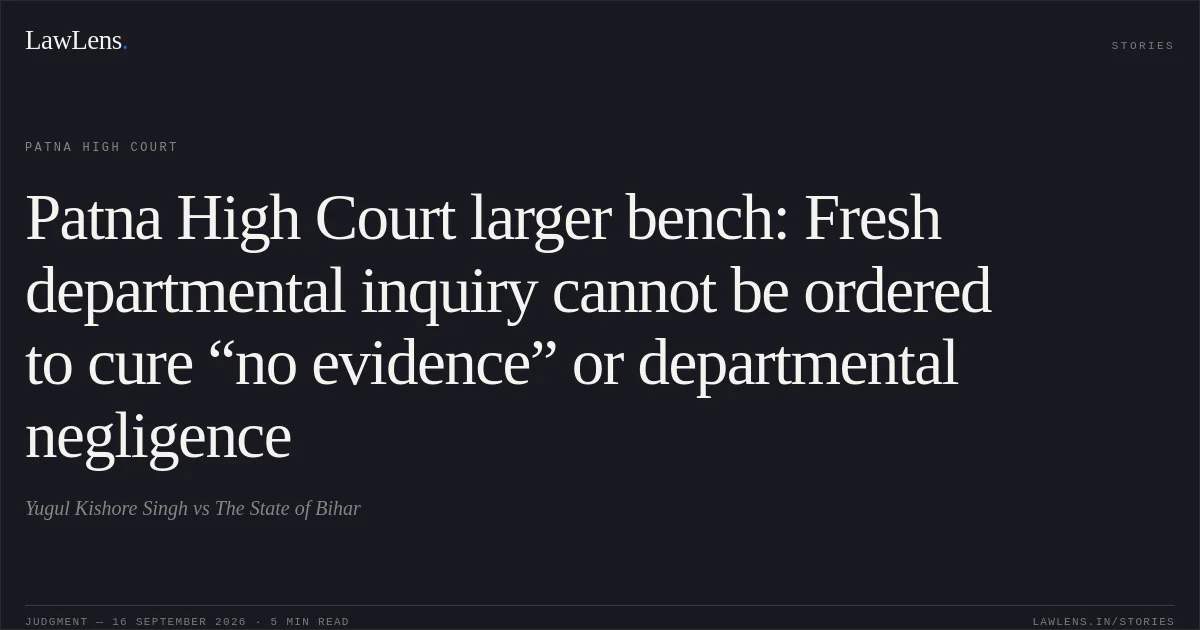
The Special Bench answered the reference by holding that remand of a departmental proceeding is permissible only where the punishment order is set aside for a curable technical or procedural defect, and the purpose of remand is to prevent prejudice to the delinquent by restoring a fair opportunity of defence.
Remand cannot be ordered to fill an evidentiary lacuna, cure the department’s negligence, or permit a fresh case to be built where the original finding rests on no evidence or no valid evidence.
Source reference: pp. 32–33, para 17(i)Whether a defect is technical and whether remand should follow must be decided case by case, considering the gravity of the charge, delay, availability of evidence, public interest and the practical utility of a fresh enquiry.
Source reference: pp. 33–36, paras 17(ii)–(v)The second limb of the reference concerning remand in the present appeal was rendered infructuous by the death of the original appellant; the legal heirs were nevertheless permitted to pursue the appeal because of the continuing monetary and pensionary consequences of the dismissal order.
Source reference: pp. 10–12, paras 3–8Acts & Sections Cited
2 provisions across 1 statute referred to in this judgment. Each provision opens on LawLens.
Prevention of Corruption Act, 19882
Original Court PDF
Yugul Kishore SinghvsThe State of Bihar
Click to open original judgment
Original judgment, available to read, download and summarize on LawLens.in