Facts
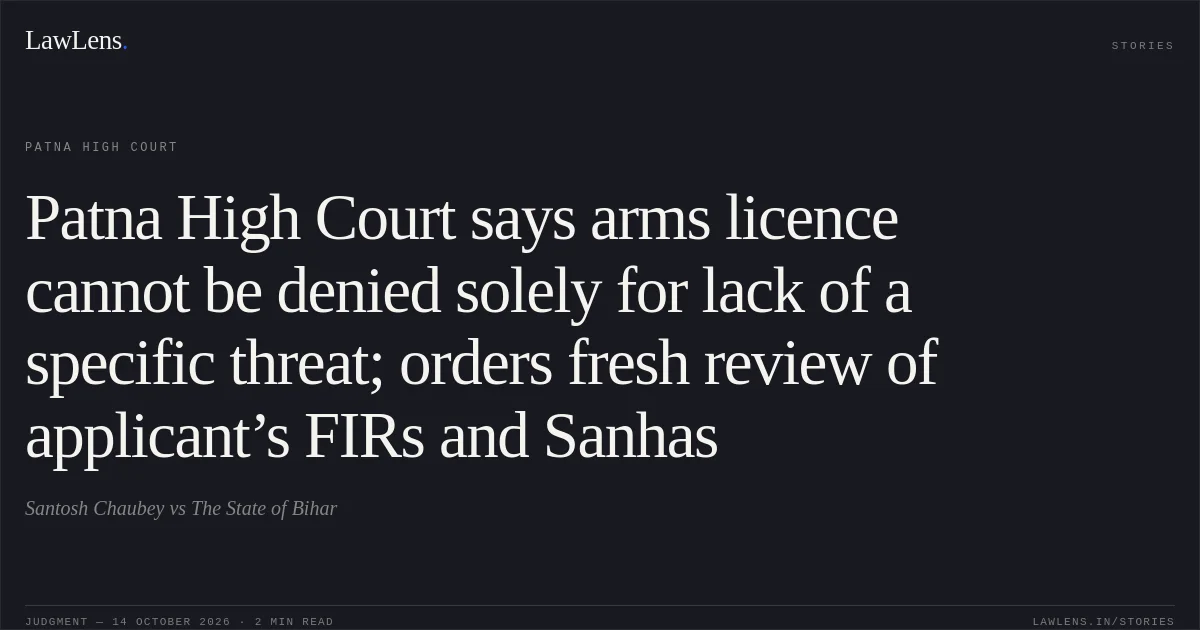
The petitioner applied for licences for a rifle and a handgun on 16 February 2019, relying on FIRs and Sanhas which, he submitted, evidenced threats to his life and property.
Source reference: p.3, para. 3Following a police inquiry, the District Magistrate, Vaishali rejected the application on 29 December 2023, citing the absence of supporting evidence; the petitioner’s appeal was dismissed by the Commissioner, Tirhut Division, on 30 May 2024.
Source reference: pp.4–5, paras. 4, 6The petitioner challenged both orders, contending that the authorities had not considered the FIRs and Sanhas and had relied on a police report not disclosed to him.
Source reference: pp.4–5, paras. 4–5Issues
1. Whether the District Magistrate’s rejection of the arms-licence application was sustainable when the order did not discuss the FIRs and Sanhas relied on by the petitioner and relied on a police report not made available to him.
Source reference: p.8, para. 82. Whether the appellate authority independently and adequately considered the relevant material before affirming the rejection.
Source reference: p.8, para. 83. Whether the petitioner was entitled to a direction for grant of the licences, or instead to reconsideration of his application in accordance with law.
Source reference: pp.8–9, paras. 9–11Law Applied
Under the Arms Act, 1959, including Sections 13, 14 and 17, and the Arms Rules, 2016, including Rules 12(3)(a) and 10(3), licensing decisions must be made on an objective assessment of relevant material and supported by recorded reasons; an application cannot be rejected on vague allegations, whim or caprice.
Source reference: pp.5–7, paras. 6–7The Court stated that an FIR, without more, is generally insufficient to refuse or cancel a licence, that police verification and threat assessments must be meaningfully weighed, and that denial cannot rest solely on the absence of a specific or imminent threat.
Source reference: pp.6–7, para. 7It also stated that a safety-training requirement under Rule 39 could not be insisted upon unless notified by the Central Government under Rule 10(3).
Source reference: p.7, para. 7Reasoning
The District Magistrate rejected the application for want of evidence of danger without discussing the FIRs and Sanhas the petitioner had placed on record, and relied on a Raghopur police report that had not been disclosed to him, although the cited incidents were registered at other locations.
Source reference: pp.7–8, para. 8The Commissioner affirmed the rejection without independently examining that material.
Source reference: p.8, para. 8Because the authorities had not objectively assessed the petitioner’s supporting materials, both orders were procedurally and substantively deficient.
Source reference: pp.8–9, paras. 9–11The Court did not, however, determine that the petitioner was entitled to a licence; it required a fresh consideration.
Source reference: pp.8–9, paras. 9–11Holding
The Court quashed the District Magistrate’s order dated 29 December 2023 and the Commissioner’s appellate order dated 30 May 2024.
It directed the District Magistrate to reconsider the application for a rifle and handgun, after giving the petitioner an opportunity of hearing, and to pass a reasoned order within three months of receiving or being produced with a copy of the judgment. The petitioner may submit further documents.
Source reference: p.9, para. 11The writ petition was allowed.
Source reference: p.9, para. 12Acts & Sections Cited
4 provisions across 2 statutes referred to in this judgment. Each provision opens on LawLens.
Indian Penal Code, 18601
Arms Act, 19593
Original Court PDF
Santosh ChaubeyvsThe State of Bihar
Click to open original judgment
Original judgment, available to read, download and summarize on LawLens.in