Facts
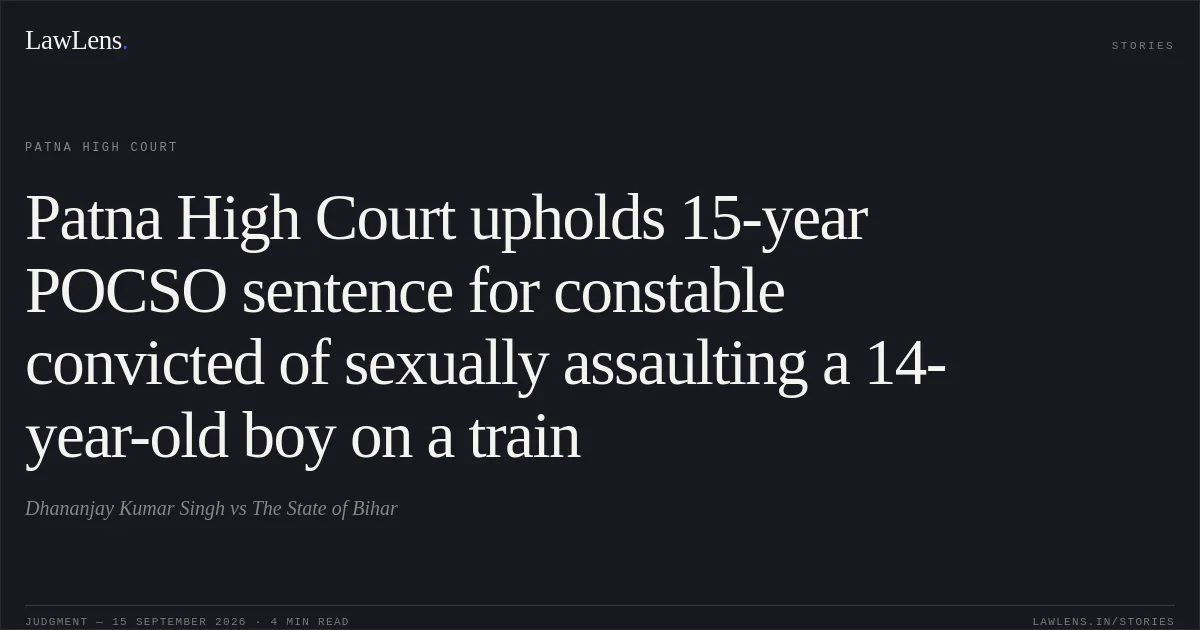
The appellant, a railway police constable, was prosecuted on the allegation that on 8 November 2015 he assaulted a 14-year-old boy inside the bathroom of the Mithila Express, forcibly removed his clothes, and committed penetrative sexual acts upon him.
Source reference: paras. 4–6; pp. 2–4The appellant was charged under Sections 323, 341 and 377 of the Indian Penal Code, and subsequently under Section 6 of the Protection of Children from Sexual Offences Act, 2012 (“POCSO Act”) after the victim’s minority became relevant during trial.
Source reference: paras. 7–9; pp. 4–5The trial court convicted the appellant under Sections 323, 341 and 377 IPC and Section 6 of the POCSO Act, sentencing him to fifteen years’ rigorous imprisonment and fine under Section 6 POCSO, with concurrent sentences for the IPC offences.
Source reference: para. 3; p. 2Issues
Whether the testimony of the victim was sufficiently credible and corroborated to sustain the appellant’s conviction under Sections 323, 341 and 377 IPC and Section 6 of the POCSO Act?
Source reference: paras. 25, 37–40, 44–45; pp. 11–12, 19–24Whether the prosecution case failed because of inconsistencies in the victim’s statements, hostile witnesses, absence of the victim’s medical examination report, and failure to conduct the appellant’s medical examination under Section 53-A CrPC?
Source reference: paras. 16–19, 34–36, 44; pp. 7–9, 16–19, 23–24Whether the FSL report could be relied upon when it was not properly exhibited and was not put to the appellant in his examination under Section 313 CrPC?
Source reference: paras. 42–43; pp. 22–23Whether the victim’s age and the statutory presumptions under Sections 29 and 30 of the POCSO Act supported the prosecution case?
Source reference: paras. 21, 39, 41; pp. 9–10, 21–22Law Applied
The Court applied Sections 323, 341 and 377 IPC concerning voluntarily causing hurt, wrongful restraint and unnatural offences, respectively, and Section 6 of the POCSO Act concerning aggravated penetrative sexual assault.
Source reference: paras. 3, 15; p. 2, 7It relied on the victim’s testimony as substantive evidence, holding that a credible and trustworthy victim’s evidence can sustain conviction when it inspires confidence and is supported by surrounding circumstances.
Source reference: paras. 13–15, 37–40, 44The Court also considered Sections 29 and 30 of the POCSO Act, under which presumptions arise regarding commission of specified POCSO offences and the existence of culpable mental state once the prosecution establishes the foundational facts.
Source reference: para. 41; pp. 21–22Under Section 293 CrPC, scientific reports may be received in evidence in the prescribed manner; however, a document not properly exhibited and not put to the accused under Section 313 CrPC cannot be relied upon against him.
Source reference: paras. 42–43; pp. 22–23Reasoning
The Court found the victim’s account to be natural, consistent and substantially corroborated by the surrounding circumstances.
Source reference: paras. 27–33, 36, 44; pp. 13–19, 23–24The evidence established that the appellant was part of the railway escort party, remained on the train when the escort party disembarked, was later found at Madhupur with his official rifle, and was taken into custody after the victim complained that a constable had sexually assaulted him.
Source reference: paras. 27–33, 36, 44; pp. 13–19, 23–24The victim’s age was adequately proved through the school records, and the defence did not materially challenge that evidence.
Source reference: para. 39; p. 21The Court held that the absence of the full medical examination report did not discredit the victim’s testimony; the doctor’s evidence regarding the anal swab was considered as part of the record, although it did not itself establish the occurrence.
Source reference: paras. 34–35, 44; pp. 16–17, 23–24The hostile testimony of some police witnesses was not treated as fatal because other evidence, particularly the victim’s testimony and the evidence regarding the appellant’s presence and apprehension, remained reliable.
Source reference: paras. 29–33, 44; pp. 14–19, 23–24However, the FSL report was expressly discarded because it had not been properly exhibited and had not been put to the appellant in his Section 313 CrPC examination.
Source reference: paras. 42–43; pp. 22–23Even without relying on the FSL report, the Court held that the remaining evidence proved the prosecution case beyond reasonable doubt and that the defence had failed to create a reasonable doubt.
Source reference: paras. 44–45; pp. 23–24Holding
The High Court held that the victim’s testimony was credible and sufficiently supported by the evidence concerning the appellant’s presence on the train, his failure to disembark with the escort party, his apprehension at Madhupur, the victim’s immediate complaint, and proof of the victim’s minority.
The Court further held that the improperly exhibited FSL report could not be relied upon, but its exclusion did not affect the outcome.
Source reference: paras. 42–43; pp. 22–23Finding no perversity or illegality in the trial court’s appreciation of evidence, the Court dismissed the appeal and affirmed the conviction and concurrent sentences imposed under Sections 323, 341 and 377 IPC and Section 6 of the POCSO Act.
Source reference: para. 46; p. 24A copy of the judgment and the trial court records was directed to be transmitted to the trial court.
Source reference: para. 47; p. 24Acts & Sections Cited
14 provisions across 3 statutes referred to in this judgment. Each provision opens on LawLens.
Indian Penal Code, 18603
Protection of Children from Sexual Offences Act, 20127
Code of Criminal Procedure, 19734
Original Court PDF
Dhananjay Kumar SinghvsThe State of Bihar
Click to open original judgment
Original judgment, available to read, download and summarize on LawLens.in