Facts
The petitioners sought, under Section 528 of the Bharatiya Nagarik Suraksha Sanhita, 2023 (erstwhile Section 482 Cr.P.C.), quashing of the JMIC, Gurugram’s order dated 05.09.2024 refusing their application to compound proceedings under Section 138 of the Negotiable Instruments Act, 1881, arising from complaint NACT/23750/2018.
Source reference: p.1, para.1The complaint arose from three cheques issued towards consideration for the petitioners’ purchase of four kanals of land; the cheques were dishonoured on 09.05.2018 for “Funds Insufficient”.
Source reference: p.2, para.2The petitioners claimed to have tendered the entire principal cheque amount of ₹24,00,000 through a demand draft and expressed willingness to pay interest, compensation and litigation costs.
Source reference: p.2, para.3Their earlier petition seeking the same relief had been dismissed as withdrawn on 01.07.2026.
Source reference: p.1, para.1.1The present petition was considered and dismissed in limine without notice to the respondent.
Source reference: p.3, para.4Issues
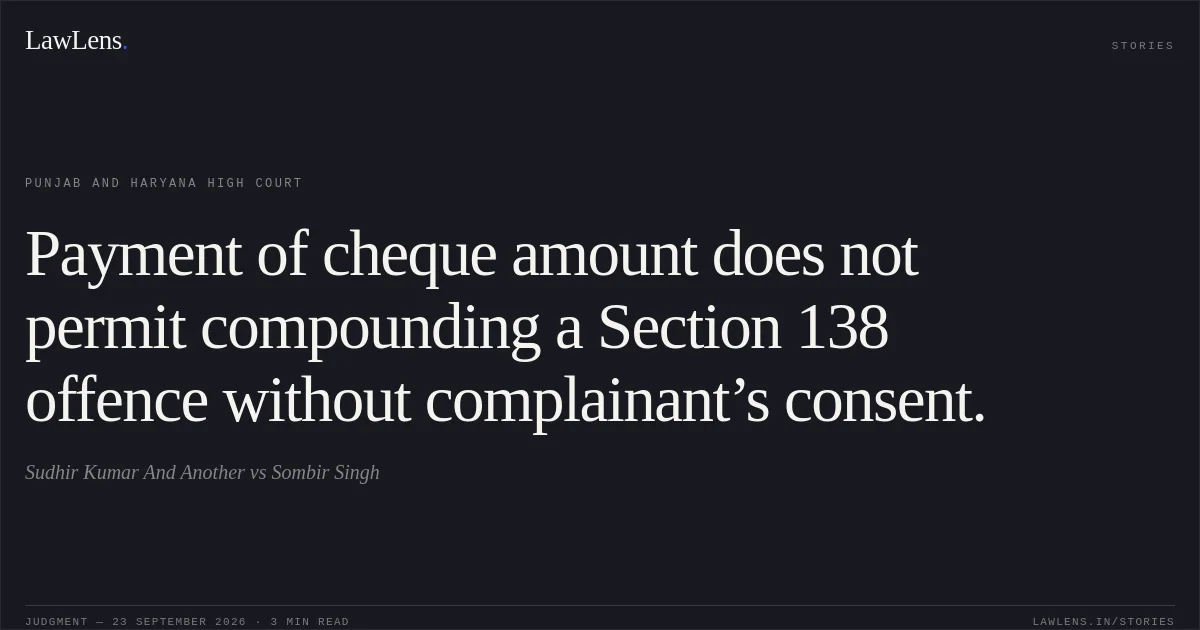
Whether an accused in proceedings under Section 138 of the Negotiable Instruments Act can claim compounding of the offence as a matter of right merely by tendering or paying the cheque amount, without the complainant’s consent?
Source reference: p.3, paras.5–5.2Whether the Trial Court’s refusal to permit compounding warranted interference under the High Court’s inherent jurisdiction under Section 528 BNSS, 2023?
Source reference: p.4, para.5.3Whether, despite dismissal of the compounding petition, the matter should be referred to mediation to explore an amicable settlement?
Source reference: p.4, para.5.3Law Applied
Section 147 of the Negotiable Instruments Act makes offences under the Act compoundable, but compounding requires the consent of the complainant.
Source reference: no citationSection 528 of the BNSS, 2023, corresponding to Section 482 Cr.P.C., preserves the High Court’s inherent jurisdiction to prevent abuse of process and secure the ends of justice.
Source reference: no citationDamodar S. Prabhu v. Sayed Babalal H., 2010 (5) SCC 663, provides guidelines encouraging and regulating compounding at different stages, including graded costs, but does not eliminate the requirement of complainant consent.
Source reference: p.3, para.5.1M/s Meters and Instruments Private Limited v. Kanchan Mehta, 2018 (1) SCC 560, recognises the predominantly compensatory object of Section 138 proceedings, but does not confer an absolute right to compounding upon payment of the cheque amount.
Source reference: p.3, para.5.1In A.S. Pharma Pvt. Ltd. v. Nayati Medical Pvt. Ltd., 2024 INSC 690, the Supreme Court reiterated that an offence under Section 138 can be compounded under Section 147 only with the complainant’s consent.
Source reference: p.3, para.5.2Reasoning
The Court held that the petitioners’ payment or tender of the cheque amount did not automatically extinguish the offence or create an indefeasible right to compounding.
Source reference: p.3, para.5Although the petitioners relied on the compensatory nature of Section 138 proceedings and their willingness to pay further amounts, the complainant had not consented to compounding.
Source reference: p.3, paras.5–5.2Accordingly, the principles in Damodar S. Prabhu and Meters and Instruments could not override the consent requirement reaffirmed in A.S. Pharma.
Source reference: p.3, paras.5.1–5.2Since the Trial Court had correctly declined compounding and its order disclosed no jurisdictional error, perversity or material infirmity, interference under Section 528 BNSS was unwarranted.
Source reference: p.4, para.5.3Nevertheless, in view of the payment of the cheque amount and the petitioners’ willingness to pay interest and compensation, the Court considered mediation appropriate.
Source reference: p.4, para.5.3Holding
The High Court dismissed the petition, holding that the petitioners could not compel compounding of the Section 138 offence without the complainant’s consent merely because the cheque amount had been paid or tendered.
No opinion was expressed on the merits of the complaint.
Source reference: p.4, para.5.3The Trial Magistrate was directed to refer the matter to the mediation centre to explore the possibility of an amicable settlement.
Source reference: p.4, para.5.3All pending interlocutory and ancillary applications were disposed of as having become infructuous.
Source reference: p.5, para.6Acts & Sections Cited
4 provisions across 3 statutes referred to in this judgment. Each provision opens on LawLens.
Bharatiya Nagarik Suraksha Sanhita, 20231
Code of Criminal Procedure, 19731
Negotiable Instruments Act, 18812
Original Court PDF
Sudhir Kumar And AnothervsSombir Singh
Click to open original judgment
Original judgment, available to read, download and summarize on LawLens.in