Facts
The petitioner, a legal heir of the original tenant, challenged concurrent eviction decrees for non-payment of rent.
Source reference: p.1-4The tenant was required to pay monthly rent of Rs. 150, in addition to municipal taxes and education cess.
Source reference: p.1-4The landlord issued a statutory demand notice for arrears; the tenant’s son, who resided at the rented premises, received it. The tenant did not pay the arrears within one month of service.
Source reference: p.1-4The Trial Court decreed eviction, and the Appellate Court affirmed, holding that Section 12(3)(a), rather than Section 12(3)(b), of the Gujarat Rents, Hotel and Lodging House Rates Control Act, 1947 (“Rent Act”) applied. The High Court considered the tenant’s revision under Section 29(2) of the Rent Act
Source reference: p.1-4Issues
1. Whether the tenant’s obligation to pay municipal taxes and education cess, in addition to monthly rent, brought the tenancy within Section 12(3)(b) rather than Section 12(3)(a) of the Rent Act
Source reference: p.4-102. Whether service of the statutory notice on the tenant’s son at the rented premises, and the tenant’s failure to pay within one month, supported eviction under Section 12(3)(a)
Source reference: p.11-143. Whether the alleged non-determination of standard rent, the tenant’s later payment of arrears, or the subsequent purchaser’s status warranted interference with the eviction decree
Source reference: p.4-5, 14-15Law Applied
Section 12(3)(a) of the Rent Act requires an eviction decree where rent is payable monthly, there is no timely dispute as to standard rent or permitted increases, arrears have continued for at least six months, and the tenant fails to pay within one month after the statutory notice; later payment does not avoid the decree where that provision applies
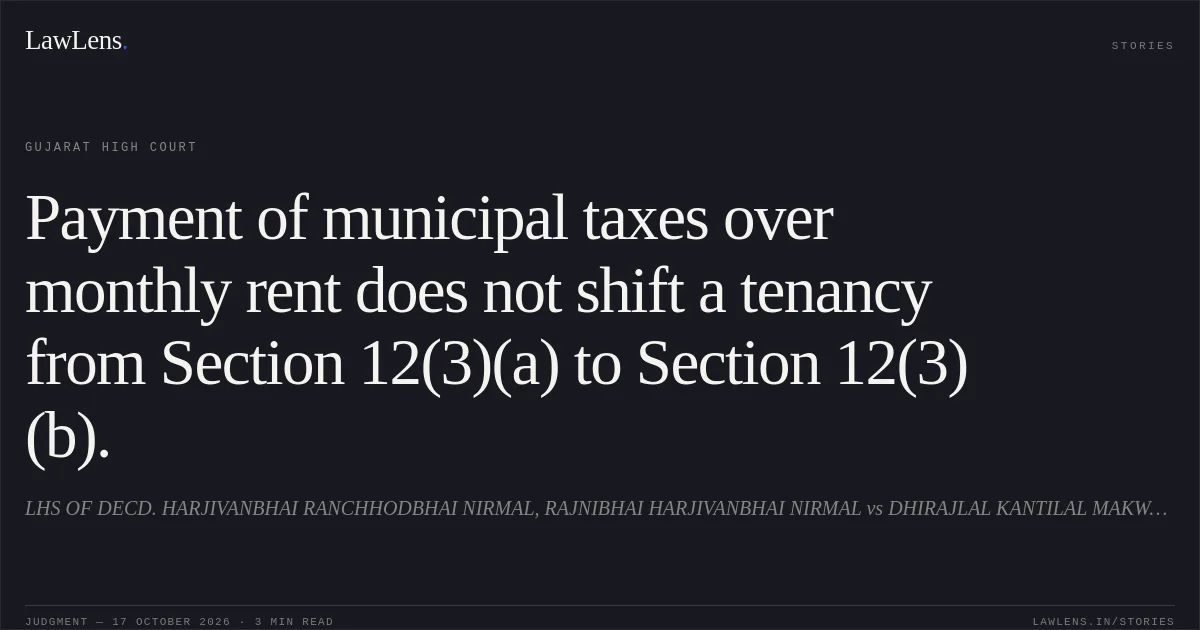
Source reference: p.8-10Under Hotel Kings v. Sara Farhan Lukmani, (2007) 1 SCC 202, a tenant’s separate liability for rates and taxes does not convert monthly rent into rent payable at longer intervals or make Section 12(3)(b) applicable
Source reference: p.7-10Arjun Khiamal Makhijani v. Jamnadas C. Tuliani, (1989) 4 SCC 612, requires a dispute as to standard rent to be raised within one month of the statutory notice for purposes of Section 12
Source reference: p.12-14Under Section 29(2), revision does not permit interference with concurrent factual findings absent perversity or gross error; the Court relied on Hindustan Petroleum Corp. Ltd. v. Dilbahar Singh, (2014) 9 SCC 78
Source reference: p.15A registered purchaser of the premises succeeds to the predecessor landlord’s interest in the pending litigation
Source reference: p.14Reasoning
The Court held that the rent was expressly payable monthly and that the additional liability for municipal taxes and education cess did not alter that arrangement; accordingly, Section 12(3)(a) governed
Source reference: p.6-10The tenant neither paid within one month of the notice nor demonstrated that a standard-rent dispute had been raised within the prescribed period.
Source reference: p.11-14The notice was received by the tenant’s son, who lived at the rented premises, and the concurrent finding of valid service was not perverse
Source reference: p.11-14Because Section 12(3)(a) applied, later payment of arrears did not defeat the eviction claim. The registered subsequent purchaser was entitled to the benefit of the predecessor landlord’s litigation, and no basis for revisional interference was shown
Source reference: p.14-15Holding
The High Court found no perversity or gross irregularity in the concurrent findings that the tenant was in default, had failed to comply with the statutory notice, and was governed by Section 12(3)(a) of the Rent Act.
It dismissed the revision application in limine and made no order as to costs
Source reference: p.15-16Acts & Sections Cited
4 provisions across 2 statutes referred to in this judgment. Each provision opens on LawLens.
Gujarat Rents, Hotel and Lodging House Rates Control Act, 19473
Transfer of Property Act, 18821
Original Court PDF
LHS OF DECD. HARJIVANBHAI RANCHHODBHAI NIRMAL, RAJNIBHAI HARJIVANBHAI NIRMALvsDHIRAJLAL KANTILAL MAKWANA
Click to open original judgment
Original judgment, available to read, download and summarize on LawLens.in