Facts
The assessee engaged bus, car and truck operators under contracts to transport employees and goods and deducted tax at source (TDS) under Section 194C of the Income Tax Act, 1961.
Source reference: p. 3–8The Assessing Officer treated the payments as rent subject to Section 194-I, raised a demand under Sections 201(1) and 201(1A), and later reduced it to Rs. 9,04,800.
Source reference: p. 3–8The CIT(A) allowed the assessee’s appeal, but the Tribunal reversed that decision. The assessee appealed to the High Court
Source reference: p. 3–8Issues
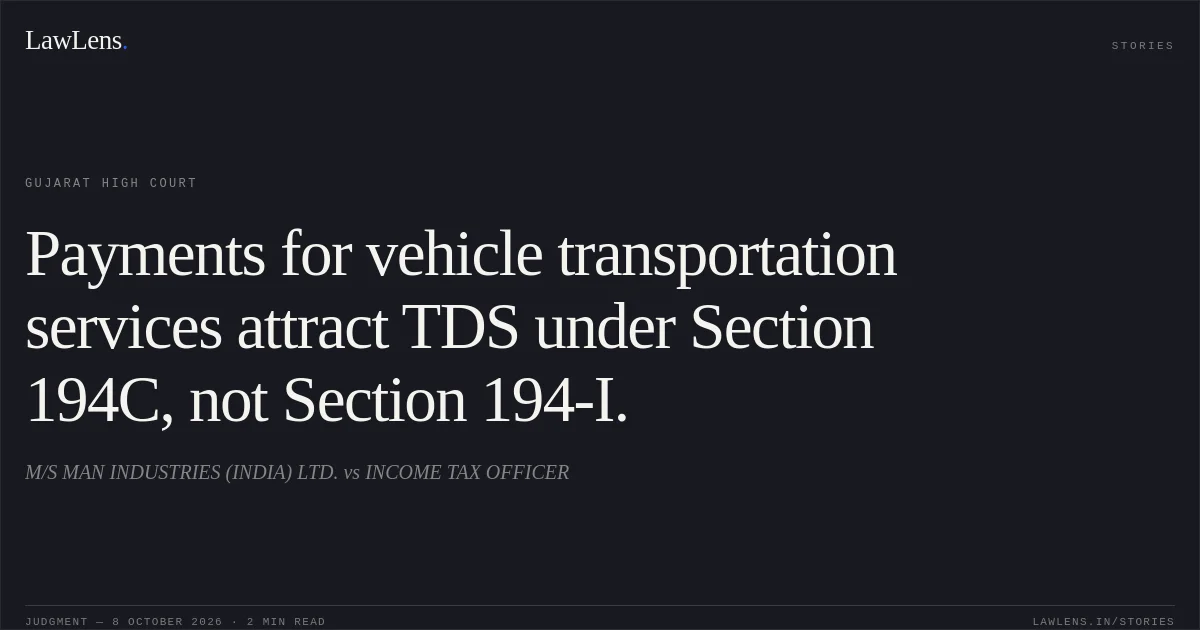
Whether the payments for hiring vehicles and related services were subject to TDS under Section 194C or Section 194-I of the Act
Source reference: p. 2; paras. 10–12Whether the assessee was liable to be treated as an assessee in default under Sections 201(1) and 201(1A) for deducting TDS under Section 194C
Source reference: p. 2; paras. 12, 14Law Applied
Section 194C requires TDS on payments to a contractor for carrying out work under a contract; the definition of “work” includes carriage of goods and passengers by any mode of transport.
Source reference: p. 14–20Section 194-I applies to payments constituting rent for the use of machinery, plant or equipment.
Source reference: p. 14–20The distinction turns on the substance of the arrangement: a contract for transportation or the provision of transport services falls under Section 194C, whereas an arrangement for use of the equipment itself may attract Section 194-I.
Source reference: p. 14–20Under Sections 201(1) and 201(1A), the payer’s liability as an assessee in default depends on a failure to deduct the tax required by the applicable provision.
Source reference: p. 14–20The Court relied on *CIT (TDS) v. Swayam Shipping Services Pvt. Ltd.*, (2011) 339 ITR 647, which treated contracts for transportation of goods as falling within Section 194C rather than Section 194-I
Source reference: p. 14–20Reasoning
The Court found that the contracts and invoices showed that the assessee had engaged operators to provide transport services, not taken vehicles into its possession for its own use.
Source reference: p. 17–18The operators owned and maintained the vehicles and bore operating expenses; the vehicles were deployed to transport employees or goods as directed by the assessee.
Source reference: p. 17–18The Tribunal focused on the vehicles’ character as plant or machinery and the monthly payments, but failed to account for the evidence establishing the service-based nature of the contracts
Source reference: p. 17–18Applying Section 194C and *Swayam Shipping*, the Court held that the payments were for carrying out contracted work, not rent for use of machinery under Section 194-I
Source reference: p. 18–20Holding
The Court answered both substantial questions in favour of the assessee and against the Revenue.
It held that Section 194C applied, that the assessee had correctly deducted TDS under that provision, and that the assessee could not be treated as in default under Sections 201(1) and 201(1A).
Source reference: p. 20The appeal was allowed, and the Tribunal’s reversal of the CIT(A)’s order was held unjustified
Source reference: p. 20Acts & Sections Cited
23 provisions across 1 statute referred to in this judgment. Linked provisions open on LawLens.
Income Tax Act, 1961
Original Court PDF
M/S MAN INDUSTRIES (INDIA) LTD.vsINCOME TAX OFFICER
Click to open original judgment
Original judgment, available to read, download and summarize on LawLens.in