Facts
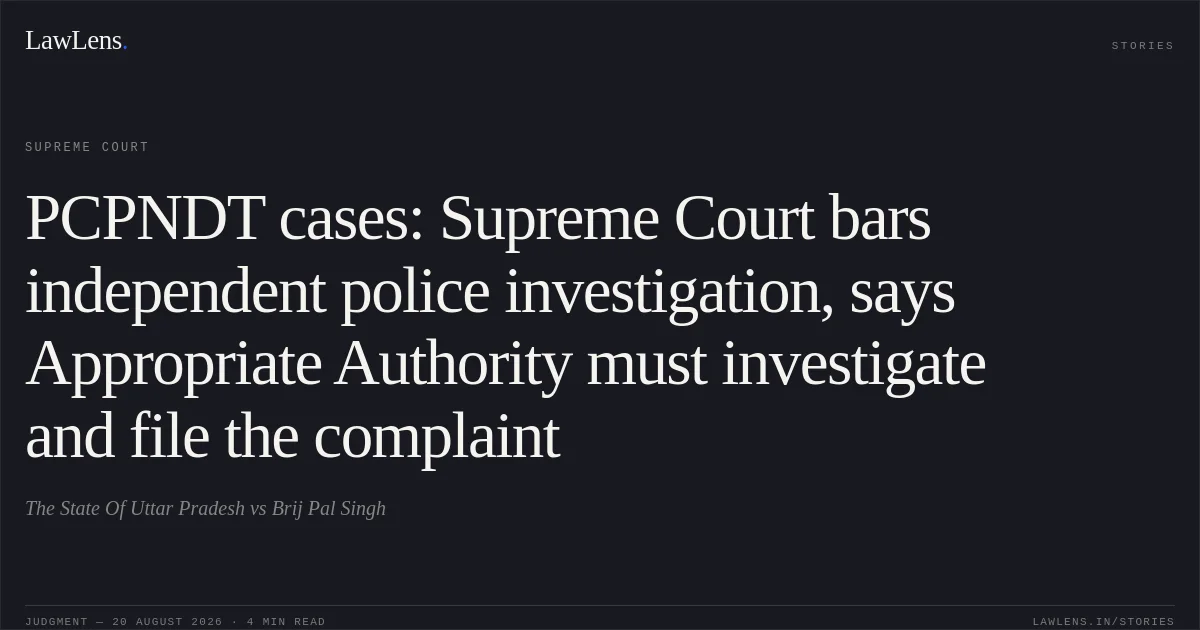
Secret information was received by the District Magistrate, Bulandshahar, the Appropriate Authority under the Pre-Conception and Pre-Natal Diagnostic Techniques (Prohibition of Sex Selection) Act, 1994 (“PCPNDT Act”), regarding alleged illegal sex determination of a foetus by Respondent No. 1 and others.
Source reference: pp. 3–4; paras 1–3A decoy operation and subsequent raid were conducted at the concerned hospital. An FIR was registered, followed by a police chargesheet alleging offences under Sections 315 and 511 of the IPC and Sections 4, 5(2), 6(a), 23 and 25 of the PCPNDT Act.
Source reference: pp. 3–4; paras 1–3The respondent sought quashing of the proceedings under Section 482 CrPC. The Allahabad High Court allowed the petition and, noting conflicting High Court decisions, issued a certificate under Articles 134-A and 134(1)(c) of the Constitution of India for determination of the legal questions concerning police registration of FIRs, investigation, and cognizance under the PCPNDT Act.
Source reference: pp. 3–4; paras 1–3Issues
1. Whether the police may register an FIR for offences under the PCPNDT Act merely because such offences are classified as cognizable and non-bailable under Section 27 of the Act?
Source reference: p. 4; para 22. Whether the police may investigate offences under the PCPNDT Act, and which authority is competent to investigate complaints alleging violations of the Act?
Source reference: p. 4; para 23. Whether a Magistrate may take cognizance of PCPNDT Act offences on the basis of a police chargesheet?
Source reference: p. 4; para 24. Where the same transaction discloses both PCPNDT Act offences and distinct offences under the IPC/BNS or another general penal law, whether the Appropriate Authority and the police may exercise separate investigative jurisdiction over their respective offences?
Source reference: concurrence, pp. 1–2; paras 1–2Law Applied
The Court applied Sections 17(4)(c) and (e) of the PCPNDT Act, which entrust investigation of complaints and initiation of legal action to the Appropriate Authority; Section 17A, which confers powers relating to summons, production of material and search warrants; Section 27, which classifies offences under the Act as cognizable, non-bailable and non-compoundable; Section 28, which creates a mandatory and exclusive bar against cognizance except upon a complaint by the Appropriate Authority, an authorised officer, or a person complying with the statutory notice requirement; and Section 30, which empowers the Appropriate Authority to search and seize with necessary assistance.
Source reference: pp. 17–21Rule 18A(3)(iv) of the PCPNDT Rules, 1996, requiring that the police not be involved “as far as possible” in investigating Act offences, was held to have statutory force and to permit police involvement only in a supplemental or assisting capacity.
Source reference: pp. 50–52; para 10.4Applying the special-law-over-general-law principle under Sections 4 and 5 CrPC, and the reasoning in Jeewan Kumar Raut v. CBI, Union of India v. Ashok Kumar Sharma, State (NCT of Delhi) v. Sanjay, State of Bihar v. Murad Ali Khan and Rajendra Bihari Lal v. State of U.P., the Court held that the PCPNDT Act’s specialised procedure prevails over the general police-investigation procedure, while police jurisdiction remains intact for genuinely distinct offences under general penal law.
Source reference: pp. 37–44; pp. 45–49The Court also relied on Lalita Kumari v. Government of Uttar Pradesh, but held that the mandatory FIR rule cannot override a special statute that excludes police investigation of the special offence.
Source reference: pp. 52–54; para 10.5Reasoning
The Court harmonised Sections 27 and 28 rather than allowing the word “cognizable” in Section 27 to override the specialised statutory scheme. Sections 17(4) and 17A expressly place investigation, technical assessment and legal action in the hands of the Appropriate Authority, while Section 28 makes a complaint—not a police report—the exclusive route for judicial cognizance.
Source reference: pp. 46–50; paras 10.1–10.3A police chargesheet would therefore have no legally effective endpoint because the Magistrate could not take cognizance of it under Section 28.
Source reference: pp. 46–50; paras 10.1–10.3Rule 18A(3)(iv), read with the Act’s medical and technical framework, reinforces that police involvement is to be avoided and, where necessary, can only be authorised by and remain subordinate to the Appropriate Authority.
Source reference: pp. 50–52; para 10.4The Court nevertheless distinguished independent IPC/BNS offences arising from the same transaction. The physical overlap of facts does not confer jurisdiction on the police over the PCPNDT component; the police may investigate only the distinct general-law offence, while transmitting the PCPNDT material to the Appropriate Authority.
Source reference: concurrence, pp. 6–11; paras 6–11Conversely, the Appropriate Authority must refer any independently disclosed IPC/BNS offence to the police.
Source reference: concurrence, pp. 11–14; paras 12–13.4Holding
(i) the police cannot register and independently investigate PCPNDT Act offences merely because they are cognizable and non-bailable;
(ii) the Appropriate Authority is the principal and competent investigating authority, while the police may provide only supplemental assistance when specifically required by the Appropriate Authority;
Source reference: pp. 58–60; para 11(iii) a Magistrate cannot take cognizance of PCPNDT Act offences on the basis of a police chargesheet, since Section 28 requires a competent statutory complaint.
Source reference: pp. 58–60; para 11However, the police retain jurisdiction to investigate distinct IPC/BNS or other general penal offences arising from the same transaction, without taking over the PCPNDT investigation.
Source reference: concurrence, pp. 10–16; paras 11–13.7The matter was remanded to the Allahabad High Court for decision in accordance with the judgment, and the appeal was disposed of along with pending applications.
Source reference: p. 60; paras 12–13Acts & Sections Cited
42 provisions across 9 statutes referred to in this judgment. Each provision opens on LawLens.
Pre-conception and Pre-natal Diagnostic Techniques (Prohibition of Sex Selection) Act, 1994
Code of Criminal Procedure, 1973
Indian Penal Code, 18604
Bharatiya Nagarik Suraksha Sanhita, 20236
Transplantation of Human Organs and Tissues Act, 19942
Drugs and Cosmetics Act, 19401
Mines and Minerals (Development and Regulation) Act, 19573
Wild Life (Protection) Act, 19721
Prevention of Money-Laundering Act, 20021
Original Court PDF
The State Of Uttar PradeshvsBrij Pal Singh
Click to open original judgment
Original judgment, available to read, download and summarize on LawLens.in