Facts
The applicant, a Postal Assistant, was issued a charge sheet on January 9, 2017, alleging negligence for failing to tally the Makhu SO 1-TD List of Transactions (LOT) with vouchers on February 5, 2014
Source reference: para. 2The department alleged this lapse allowed a fraudulent misappropriation of ₹15,45,426/- by a Sub-Postmaster (SPM) to go undetected
Source reference: para. 2The applicant denied the charges, asserting that vouchers were duly processed and that the department failed to provide crucial records like "will follow registers" for her defense
Source reference: para. 3Following a de novo consideration ordered by the Appellate Authority, the Disciplinary Authority re-imposed a penalty of recovery of ₹1,80,000/- in 60 installments on April 23, 2018
Source reference: para. 4The applicant’s subsequent appeal was rejected on October 29, 2018
Source reference: para. 4She approached the Tribunal arguing that the recovery was based on conjectures, lacked direct proof of negligence, and violated principles of natural justice
Source reference: para. 5-7Issues
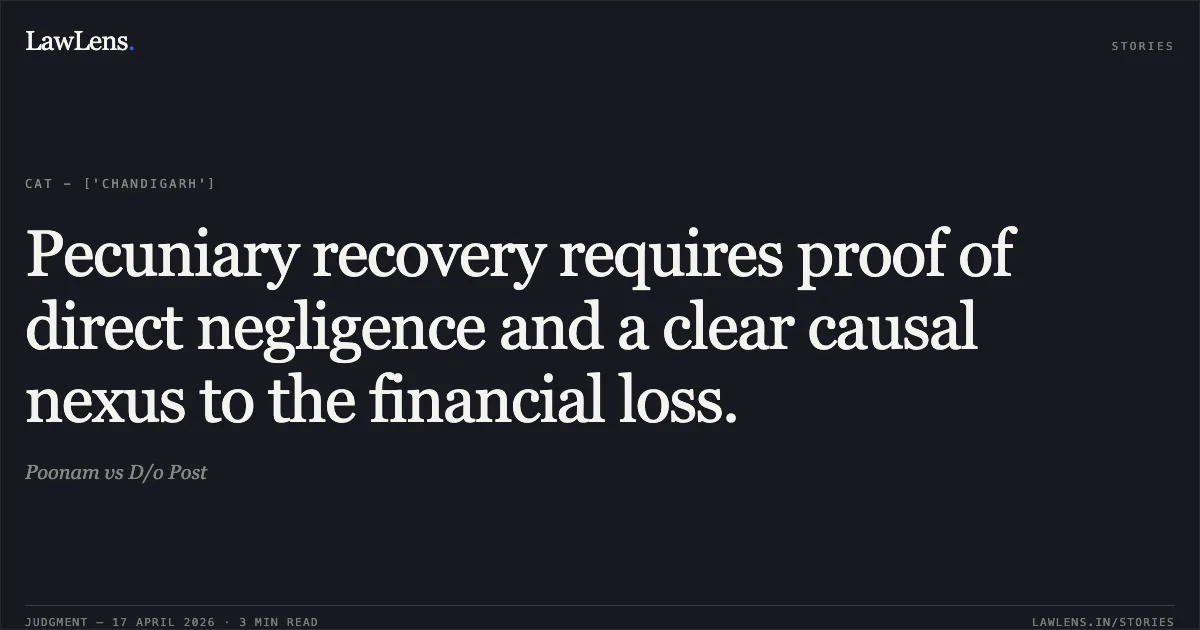
1. Whether the penalty of recovery is sustainable in the absence of direct evidence establishing a nexus between the applicant's alleged negligence and the financial loss incurred by the department.
Source reference: para. 15, 192. Whether the disciplinary proceedings were vitiated due to the non-supply of relevant documents and reliance on material not included in the charge sheet, thereby violating principles of natural justice.
Source reference: para. 5, 18Law Applied
Rule 16 of the CCS (CCA) Rules, 1965, regarding the procedure for imposing minor penalties, and Rule 3(1)(ii) and 3(1)(iii) of the CCS (Conduct) Rules, 1964
Source reference: para. 2, 13Departmental Instructions dated February 10, 1975, and February 13, 1981, which stipulate that recovery can only be effected when an employee’s lapse is directly responsible for the loss
Source reference: para. 6Principle from Kuldip Singh v. Commissioner of Police Ors. (1999) that suspicion or presumption cannot substitute for proof in departmental proceedings
Source reference: para. 10Precedent set in Amrita v. Union of India Others (CWP No. 15808 of 2017), which held that recovery for "contributory negligence" is impermissible without proved direct negligence
Source reference: para. 14, 20Reasoning
The Tribunal observed that the primary fraud was admittedly committed by the late SPM Nirmal Singh, and the department failed to produce direct evidence that the applicant had actually missed the closure vouchers
Source reference: para. 16The Tribunal found that the Disciplinary Authority’s findings were based on presumptions rather than concrete evidence, especially since crucial records like the SB-104 and "will follow registers" were unavailable, yet adverse inferences were drawn solely against the applicant
Source reference: para. 17It was determined that the department failed to establish a direct nexus between the applicant’s alleged procedural lapse and the actual loss, as required by the 1975 and 1981 instructions
Source reference: para. 19The Tribunal also noted a significant procedural flaw: the applicant was denied access to relevant documents while the authority relied on extraneous material (preliminary inquiry reports) not part of the charge sheet, constituting a violation of natural justice
Source reference: para. 18Following the parity established in Amrita’s case, the Tribunal concluded that the charge of negligence remained unsubstantiated by reliable evidence
Source reference: para. 20Holding
The Tribunal answered the issues in the negative, holding that the impugned orders were unsustainable in law.
The Tribunal quashed the Disciplinary Authority’s order dated April 23, 2018, and the Appellate Authority’s order dated October 29, 2018; the respondents were directed to refund any amount already recovered from the applicant within two months of receiving the order
Source reference: para. 21Acts & Sections Cited
1 provisions across 1 statute referred to in this judgment. Each provision opens on LawLens.
Administrative Tribunals Act, 19851
Original Court PDF
PoonamvsD/o Post
Click to open original judgment
Original judgment, available to read, download and summarize on LawLens.in