Facts
Atul Limited filed its return for Assessment Year 2001–02 declaring nil income. In assessment under Section 143(3) of the Income-tax Act, 1961, the Assessing Officer determined total income at ₹8,49,15,110 by, inter alia, allowing depreciation of ₹26,70,38,995 that had not been claimed by the assessee, disallowing deductions under Sections 80HHC, 80-IA and 80-IB, and disallowing a deduction under Section 80G.
Source reference: p.2–3The Assessing Officer initiated penalty proceedings under Section 271(1)(c), alleging that the depreciation claim was made to enhance deductions under Sections 80HHC, 80-IA and 80-IB and that the assessee had wrongly claimed deductions under Sections 80-IA and 80-IB; a penalty of ₹10,26,28,624 was imposed. The CIT(A) confirmed the penalty. On further appeal, the Tribunal held that the assessee had rebutted the presumption under Explanation 1 to Section 271(1)(c), that the depreciation issue was debatable, and that the explanation furnished by the assessee was bona fide; it accordingly deleted the penalty.
Source reference: p.4, p.6–12Issues
1. Whether the Tribunal was correct in law and on facts in reversing the CIT(A)’s order and deleting the penalty of ₹10,26,28,624 imposed under Section 271(1)(c) of the Income-tax Act on the allegation that the assessee had concealed particulars of income.
Source reference: p.22. Whether mere disallowance of deductions under Sections 80HHC, 80-IA and 80-IB, including the depreciation-related computation, justified levy of penalty under Section 271(1)(c).
Source reference: p.13–14Law Applied
Section 271(1)(c) authorises penalty where an assessee conceals particulars of income or furnishes inaccurate particulars of income. Explanation 1 to Section 271(1)(c) creates a rebuttable presumption in respect of additions or disallowances, but does not make the assessment order conclusive or automatically establish concealment.
Source reference: p.6–7In National Textiles v. CIT, 249 ITR 125 (Guj), the Court held that penalty requires material supporting the conclusion that the amount represents the assessee’s income and circumstances indicating conscious concealment or furnishing of inaccurate particulars; an explanation that is unproved but not disproved, in the absence of a positive inference of falsity, cannot by itself justify penalty. Under CIT v. Reliance Petroproducts Pvt. Ltd., 322 ITR 158/159 (SC), a mere incorrect or unsustainable claim does not amount to furnishing inaccurate particulars where the particulars furnished are not false. The Court also relied on Associated Power Structure v. CIT, 55 taxmann.com 310 (Guj), concerning the non-leviability of penalty merely on account of disallowance of a deduction.
Source reference: p.8–11, p.14Reasoning
The Tribunal found that the assessee had disclosed the relevant depreciation and deduction computations through a detailed note accompanying the return and had furnished a plausible explanation for its treatment of depreciation.
Source reference: p.11–12The legal position regarding depreciation and its effect on deductions under Sections 80-IA and 80-IB was regarded as highly debatable, with different Tribunal Benches having taken divergent views before the issue was settled by a Special Bench. Consequently, the assessee’s position could not be characterised as mala fide or as involving conscious concealment. The Revenue did not produce cogent material demonstrating that the assessee’s explanation was false or that the particulars furnished were inaccurate.
Source reference: p.6–8, p.11Further, the relevant quantum additions were not ultimately sustained: the Revenue’s appeal concerning the captive/PAA plant was dismissed, and the assessee’s appeal concerning depreciation and deductions relating to the new plant was decided in its favour. Applying Explanation 1, National Textiles, Reliance Petroproducts and Associated Power Structure, the Court held that the mere disallowance of deductions, without concealment or inaccurate particulars, could not sustain the penalty.
Source reference: p.13–14Holding
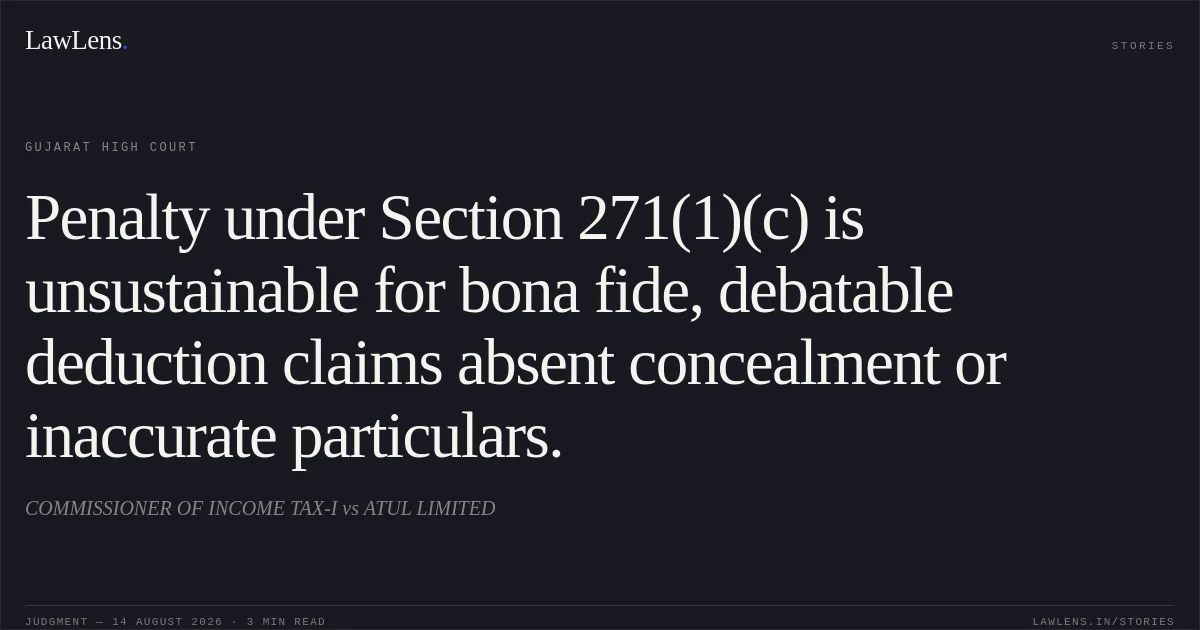
The substantial question of law was answered in favour of Atul Limited and against the Revenue. The High Court held that the Tribunal had rightly deleted the penalty under Section 271(1)(c), as the assessee had neither concealed particulars of income nor furnished inaccurate particulars merely by making debatable claims for depreciation and deductions under Sections 80HHC, 80-IA and 80-IB.
The tax appeal was dismissed.
Source reference: p.14Acts & Sections Cited
8 provisions across 1 statute referred to in this judgment. Linked provisions open on LawLens.
Income Tax Act, 19618
Original Court PDF
COMMISSIONER OF INCOME TAX-IvsATUL LIMITED
Click to open original judgment
Original judgment, available to read, download and summarize on LawLens.in