01Facts
The petitioners and private respondents belonged to branches of the same family and disputed possession and revenue entries concerning the subject property.
¶ 2After alleging deletion of their names from the revenue records and attempted dispossession, the petitioners instituted Civil Suit No. 104/2024 (RCSA) seeking declaration, injunction, and partition, along with an application under Order XXXIX Rules 1 and 2 CPC, which remained pending.
¶ 2During pendency of the civil suit, Respondent Nos. 1–3 initiated proceedings before the Sub-Divisional Magistrate under Sections 164–165 of the Bharatiya Nagarik Suraksha Sanhita, 2023, asserting apprehension of breach of peace.
¶ 3Despite the petitioners’ objection that possession was already in issue before the Civil Court, the SDM, by order dated 7 July 2026, held Respondent Nos. 1–3 to be in possession and directed the petitioners not to interfere with such possession.
¶ 4The petitioners challenged that order under Article 226 of the Constitution.
¶ 102Issues
i.Whether the pendency of a civil suit concerning title and possession ousted or restricted the jurisdiction of the Executive Magistrate to initiate proceedings under Sections 164–165 of the BNSS.
¶ 5–6, 9–11ii.Whether the SDM’s order holding Respondent Nos. 1–3 to be in possession and restraining the petitioners from interfering was illegal, perverse, or without jurisdiction merely because the civil suit and an interim injunction application were pending.
¶ 4, 9–1203Law Applied
The Court considered Sections 164–165 of the BNSS, which empower the Executive Magistrate to take preventive measures in cases involving disputes concerning possession and apprehension of breach of peace; such proceedings are preventive and do not finally adjudicate title or civil rights.
¶ 6, 9, 11It applied the principle in Amresh Tiwari v. Lalta Prasad Dubey , AIR 2000 SC 1504, that parallel proceedings under Section 145 CrPC—or the corresponding preventive provisions—should ordinarily not continue where a civil suit concerning possession or declaration of title is pending and the Civil Court is able to grant adequate protection, particularly where an interim order protecting possession has been passed.
¶ 5, 9–10However, Amresh Tiwari does not establish that every pending civil suit automatically bars preventive proceedings; the Magistrate may exercise jurisdiction where possession has not been prima facie adjudicated and a likelihood of breach of peace exists.
¶ 9–10The Court also noted the persuasive reasoning in Brijender Singh Jhakhar @ Brijender Jakhar & Ors. v. State of Haryana & Ors. , CRM-M-3662-2023 (O&M), decided on 29 July 2026, that mere pendency of a civil suit, absent interim protection, does not completely exclude the Executive Magistrate’s jurisdiction.
¶ 6Provisions in the judgment · 3 · Linked ones open on LawLens
Bharatiya Nagarik Suraksha Sanhita, 2023 Section 164Section 165
Code of Criminal Procedure, 1973 Section 145
04Reasoning
Although the petitioners’ civil suit had been filed before the BNSS proceedings, the Civil Court had neither adjudicated possession nor granted any interim relief in their favour.
¶ 11Consequently, the factual basis underlying Amresh Tiwari —namely, an operative status quo or protective order of the Civil Court—was absent.
¶ 11Since possession remained disputed and there was an apprehension of breach of peace, the SDM retained jurisdiction to invoke Sections 164–165 of the BNSS and pass preventive directions.
¶ 9–11The petitioners’ reliance on the pendency of their injunction application was therefore insufficient to invalidate the proceedings.
¶ 11The Court further rejected the contention that the SDM’s order was inherently without jurisdiction, holding that the absence of a prima facie civil adjudication of possession justified preventive intervention.
¶ 1105Holding
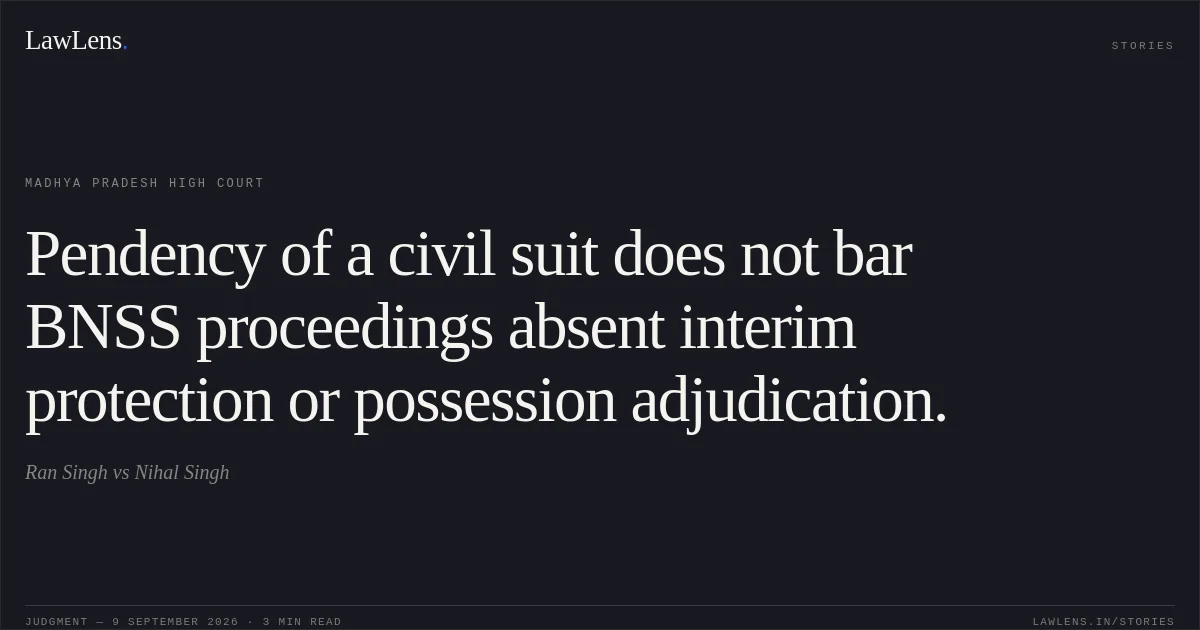
The Court held that the mere pendency of the civil suit did not bar proceedings under Sections 164–165 of the BNSS because no interim protection or prima facie determination of possession had been granted by the Civil Court and a likelihood of breach of peace existed.
¶ 11The SDM acted within jurisdiction in holding Respondent Nos. 1–3 to be in possession and restraining the petitioners from interfering.
¶ 11Finding no illegality, perversity, or jurisdictional error in the order dated 7 July 2026, the High Court dismissed the writ petition for want of merit.
¶ 12Original Court PDF
Ran SinghvsNihal Singh
Click to open original judgment
Original judgment, available to read, download and summarize on LawLens.in