Facts
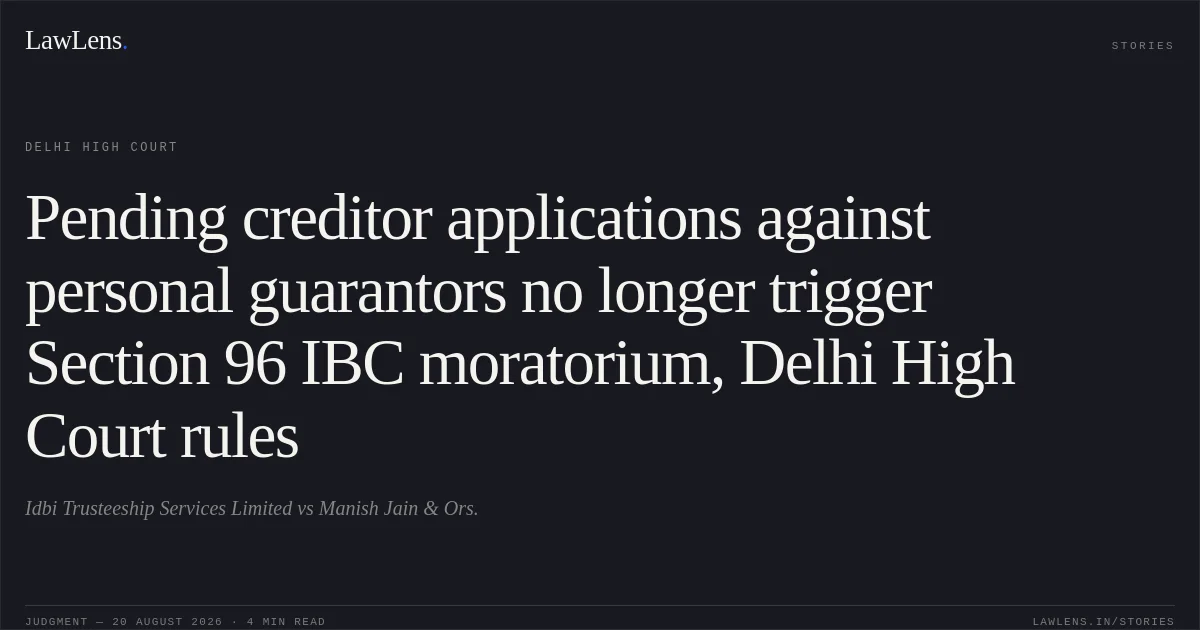
The plaintiff, IDBI Trusteeship Services Limited, instituted the commercial suit against, inter alia, Defendant Nos. 1 and 2, who were personal guarantors to Defendant No. 3, the principal borrower/corporate debtor.
Source reference: pp. 1–4, paras 1–3The plaintiff had initiated insolvency proceedings under Section 95 of the Insolvency and Bankruptcy Code, 2016 (“IBC”) against Defendant No. 2 on 10 August 2024, and the application remained pending before the NCLT.
Source reference: pp. 1–4, paras 1–3Defendant No. 2 consequently claimed the benefit of the interim moratorium under Section 96 IBC.
Source reference: pp. 1–4, paras 1–3The suit was filed on 28 July 2025.
Source reference: pp. 1–4, paras 1–3Defendant No. 2 sought rejection of the plaint under Order VII Rule 11(a) and (d), CPC, contending that the suit was barred by the interim moratorium under Section 96 IBC and disclosed no cause of action.
Source reference: pp. 1–4, paras 1–3During the pendency of the suit, Section 96 was amended by insertion of sub-section (4), effective from 26 May 2026, excluding personal guarantors to corporate debtors from the operation of the interim moratorium where an insolvency-resolution application was filed by the creditor or debtor.
Source reference: pp. 3–4, para 4.2; pp. 13–16, para 15Issues
Whether the insertion of Section 96(4) IBC operates retroactively or quasi-retroactively so as to apply to a pending Section 95 application filed before the amendment came into force.
Source reference: pp. 9–12, paras 8–14Whether, after the amendment, the suit against Defendant No. 2 was barred by the interim moratorium under Section 96 IBC and liable to be rejected under Order VII Rule 11(a) or (d), CPC.
Source reference: pp. 18–20, paras 20–27Whether the objection that Section 96 was brought into force only in relation to personal guarantors to corporate debtors, and not personal guarantors generally, rendered the provision otiose or defeated the plaintiff’s interpretation.
Source reference: pp. 19–20, paras 23–25Law Applied
The Court applied Order VII Rule 11(a) and (d), CPC, under which a plaint may be rejected where it does not disclose a cause of action or is barred by law.
Source reference: no citationSection 96(1) IBC provides for an interim moratorium upon filing an application under Section 94 or 95, during which pending legal proceedings concerning the debt are stayed and creditors cannot initiate such proceedings.
Source reference: pp. 13–14, para 15Section 96(4), inserted by the 2026 amendment, provides that Section 96 does not apply where an application to initiate insolvency resolution proceedings in respect of a personal guarantor to a corporate debtor is filed by the creditor or debtor.
Source reference: pp. 13–16, paras 15–18Relying on Vineeta Sharma v. Rakesh Sharma, (2020) 9 SCC 1, State Bank’s Staff Union (Madras Circle) v. Union of India, (2005) 7 SCC 584, and SEBI v. Rajkumar Nagpal, (2023) 8 SCC 274, the Court distinguished true retrospectivity from retroactivity or quasi-retroactivity: a provision may operate prospectively on an existing and continuing state of affairs or pending proceeding without impairing a completed transaction.
Source reference: pp. 9–12, paras 8–14The Court also relied on Dilip B. Jiwrajka v. Union of India, (2024) 5 SCC 435, and the Bombay High Court’s decision in Tata Capital Financial Services Ltd. v. Neel Motors LLP, Commercial Arbitration Petition No. 620/2021, decided on 24 July 2026.
Source reference: pp. 7–8, para 5.3; pp. 10–11, para 10Reasoning
The Court held that Section 96(4) was enacted to remedy the misuse of the interim moratorium by personal guarantors who filed insolvency applications to obstruct or delay recovery proceedings.
Source reference: pp. 16–18, paras 16–18The legislative materials demonstrated that the amendment was intended to remove the pre-admission shield for personal guarantors to corporate debtors and create a level playing field for creditors.
Source reference: pp. 16–18, paras 16–18Applying the doctrine of retroactivity/quasi-retroactivity, the Court construed the expression “where an application is filed” in Section 96(4) as encompassing applications already filed but still pending on 26 May 2026.
Source reference: pp. 10–12, paras 10–14; pp. 18–19, paras 19–22The amendment therefore operated prospectively from its effective date upon the continuing pendency of the Section 95 proceedings, rather than retrospectively upon a completed transaction.
Source reference: pp. 10–12, paras 10–14; pp. 18–19, paras 19–22Since Defendant No. 2 was admittedly a personal guarantor to the corporate debtor and the plaintiff’s Section 95 application remained pending, the interim moratorium ceased to operate from 26 May 2026.
Source reference: pp. 18–19, paras 19–22Consequently, the suit was no longer barred by Section 96 IBC.
Source reference: pp. 18–19, paras 20–22The Court further held that the partial applicability of Section 96 did not render the provision otiose, as the provision could operate in futuro in relation to personal guarantors generally if the relevant statutory provisions were brought into force.
Source reference: pp. 19–20, paras 23–25The Court declined to examine the separate factual objection concerning absence of cause of action at that stage.
Source reference: p. 20, para 26Holding
The Court answered the principal legal question in favour of the plaintiff, holding that Section 96(4) IBC applied retroactively/quasi-retroactively to the pending Section 95 application filed against Defendant No. 2.
The interim moratorium and the corresponding bar against instituting proceedings against Defendant No. 2 were deemed vacated from 26 May 2026.
Source reference: pp. 18–19, paras 20–22The application under Order VII Rule 11 CPC was accordingly held to be legally unmerited and was rejected.
Source reference: p. 20, paras 27–29The suit and connected applications were directed to be listed on 2 November 2026.
Source reference: p. 20, paras 27–29Acts & Sections Cited
9 provisions across 3 statutes referred to in this judgment. Each provision opens on LawLens.
Insolvency and Bankruptcy Code, 2016.7
Arbitration and Conciliation Act, 19961
Hindu Succession Act, 19561
Original Court PDF
Idbi Trusteeship Services LimitedvsManish Jain & Ors.
Click to open original judgment
Original judgment, available to read, download and summarize on LawLens.in