01Facts
The Respondent was provisionally selected for appointment as a Public Notary pursuant to an appointment notice dated 15 March 2024, subject to verification of eligibility, documents and payment of the prescribed fee.
pp. 3, paras 10–12She submitted an affidavit dated 12 April 2024 disclosing that Criminal Case No. 53797/2016 had resulted in her discharge by the Trial Court on 18 August 2022 and that a revision petition was pending for orders.
p. 3 · ¶ 13However, before the affidavit was submitted, the Revisional Court had, on 6 April 2024, set aside the discharge order and remanded the matter to the Trial Court for fresh consideration on framing of charge.
p. 4 · ¶ 15The Appellants alleged that the Respondent had suppressed this material development and declined to issue her Certificate of Practice (CoP) or enter her name in the Register of Notaries.
pp. 4–5, paras 16–19The learned Single Judge directed the Appellants to consider the Respondent’s application and observed that pendency of a criminal case should not, by itself, be a reason to deny the CoP.
p. 2 · ¶ 8The Union of India challenged that order in the present appeal.
02Issues
i.1. Whether the Respondent was entitled to issuance of a CoP and entry of her name in the Register of Notaries merely because she had received a provisional appointment and an Interview Board recommendation.
pp. 13, paras 39–43ii.2. Whether pendency of the criminal proceedings, having regard to the nature of the allegations, could be considered by the Government while deciding the Respondent’s appointment and issuance of the CoP.
pp. 15–16, paras 47–51iii.3. Whether the Respondent had suppressed the Revisional Court’s order dated 6 April 2024 while submitting her affidavit.
pp. 14–15, paras 45–4603Law Applied
Under Sections 3 and 4 of the Notaries Act, 1952, the appropriate Government has the power to appoint Notaries and maintain the Register of Notaries.
p. 8 · ¶ 31Section 5 governs entry in the Register and issuance or renewal of the CoP, while Section 9 prohibits a person from practising as a Notary without a valid CoP.
p. 8 · ¶ 32Section 10 concerns removal of an already registered Notary and therefore does not govern the initial appointment or issuance of a CoP in the present case.
pp. 13–14, paras 41–42Rule 3 of the Notaries Rules, 1956 prescribes the qualifications for appointment and does not expressly list pendency of criminal proceedings as an automatic disqualification.
pp. 9–10, paras 35–36However, under Rules 6, 7, 7A and 8, the competent authority and the appropriate Government may scrutinise the application, consider the Interview Board’s recommendation, conduct further inquiry, and allow or reject the application; an Interview Board recommendation does not create an automatic right to appointment.
pp. 10–12, paras 36–40The Government may therefore consider the applicant’s antecedents and the nature and seriousness of pending criminal allegations, provided its decision is supported by plausible reasons.
pp. 15–16, paras 48–51Provisions in the judgment · 14
Indian Penal Code, 1860 Section 419Section 420Section 467Section 471Section 34
Notaries Act, 1952 Section 3Section 4Section 5Section 7Section 9Section 10Section 12Section 15
Rights of Persons with Disabilities Act, 2016 Section 2
04Reasoning
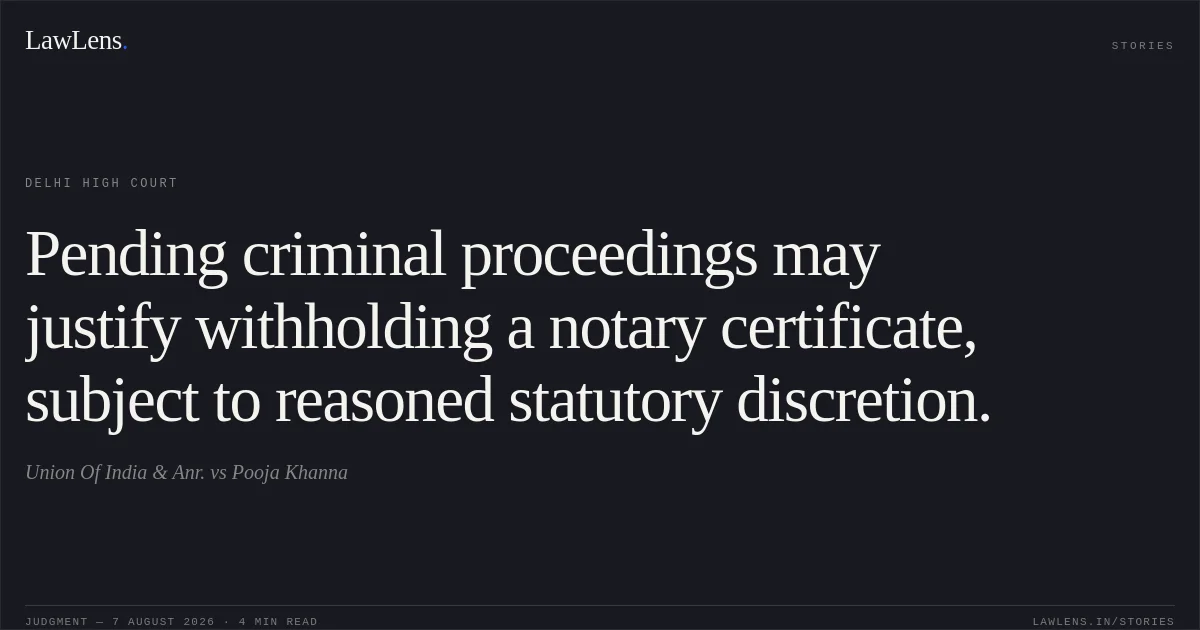
The Court held that the Respondent’s provisional appointment did not crystallise into a vested right to issuance of the CoP or entry in the Register because Rule 8 expressly preserves the Government’s discretion to reject an application even after receiving the Interview Board’s recommendation.
pp. 12–13, paras 38–40Section 10 could not assist the Respondent since she had not yet been entered in the Register; that provision applies to removal of an existing Notary, not to initial appointment.
pp. 13–14, paras 41–43, 52–53Although pendency of a criminal case is not an automatic statutory disqualification, the nature of the allegations—particularly allegations that the Respondent performed notarial functions without appointment or a valid CoP—could legitimately be relevant to the Government’s assessment of her antecedents, integrity and suitability.
pp. 5–6, paras 19–21 · pp. 15–16, paras 48–51The Court declined to decide whether the Respondent had suppressed the Revisional Court’s order because the Appellants had not yet taken a conscious decision on that issue, and the Respondent had subsequently furnished further documents disclosing the relevant developments.
pp. 14–15, paras 45–46The Single Judge’s observation that pendency of a criminal case should not be a ground for denying the CoP improperly constrained the statutory discretion vested in the Government.
pp. 15, paras 47–4905Holding
The Appeal was disposed of with modification of the Single Judge’s order.
p. 17 · ¶ 54(i)The Appellants were directed to consider the Respondent’s request for issuance of the CoP and entry of her name in the Register of Notaries and to take a final decision within six weeks.
p. 17 · ¶ 54(i)The Respondent was granted ten days to submit a written representation.
p. 17 · ¶ 54(ii)The competent authority was required to pass an informed and reasoned order after considering the representation.
p. 17 · ¶ 54(iii)The decision was to be taken independently and without being influenced by the Single Judge’s observation that pendency of the criminal case should not be a reason to deny the CoP.
p. 17 · ¶ 54(iv)–(v)The Court made no final finding on the alleged suppression of facts, and there was no order as to costs.
p. 18 · ¶ 55Original Court PDF
Union Of India & Anr.vsPooja Khanna
Click to open original judgment
Original judgment, available to read, download and summarize on LawLens.in