Facts
The petitioner instituted a suit seeking a declaration of ownership, possession and consequential reliefs concerning the suit property.
Source reference: pp. 4–6Along with the suit, he filed applications under Order XXXIX Rules 1 and 2 of the Code of Civil Procedure, 1908 (CPC), seeking to restrain alienation or creation of third-party interests and alteration of the property’s nature.
Source reference: pp. 4–6The Trial Court issued summons but did not grant ex parte interim relief. The petitioner challenged that order, contending that the caveat had been lodged only against defendant No. 7.
Source reference: pp. 4–5On 27 April 2026, the High Court directed the parties to maintain status quo pending further hearing.
Source reference: p. 6The matter came before the Court with defendant No. 7 served and the pleadings complete.
Source reference: p. 7Issues
1. Whether the Trial Court’s issuance of summons and deferral of consideration of the interim applications, in light of the caveat, required interference by the High Court.
Source reference: pp. 4–62. Whether the High Court should determine the challenge to its interim status quo order at that stage, or instead direct the Trial Court to decide the pending applications.
Source reference: pp. 6–7Law Applied
The petitioner’s interim applications were under Order XXXIX Rules 1 and 2 CPC, which provide for temporary injunctions in appropriate cases.
Source reference: pp. 4–6The petition invoked the High Court’s jurisdiction under Article 226 of the Constitution.
Source reference: p. 3Although the parties relied on the effect of the caveat, the Court did not state or apply a substantive rule determining the caveat’s scope; it left that issue unexamined at this stage.
Source reference: p. 7Reasoning
The Court noted that the suit summons had been issued and that defendant No. 7 had been served, with pleadings complete. It therefore found no impediment to the Trial Court considering and deciding the pending injunction applications.
Source reference: p. 7Rather than deciding whether the caveat justified the Trial Court’s course or examining the challenge concerning the High Court’s status quo order, the Court considered it sufficient to require a prompt decision on the applications.
Source reference: pp. 7–8It directed that the Trial Court decide them independently, without being influenced by the High Court’s interim order or the order’s findings.
Source reference: pp. 7–8Holding
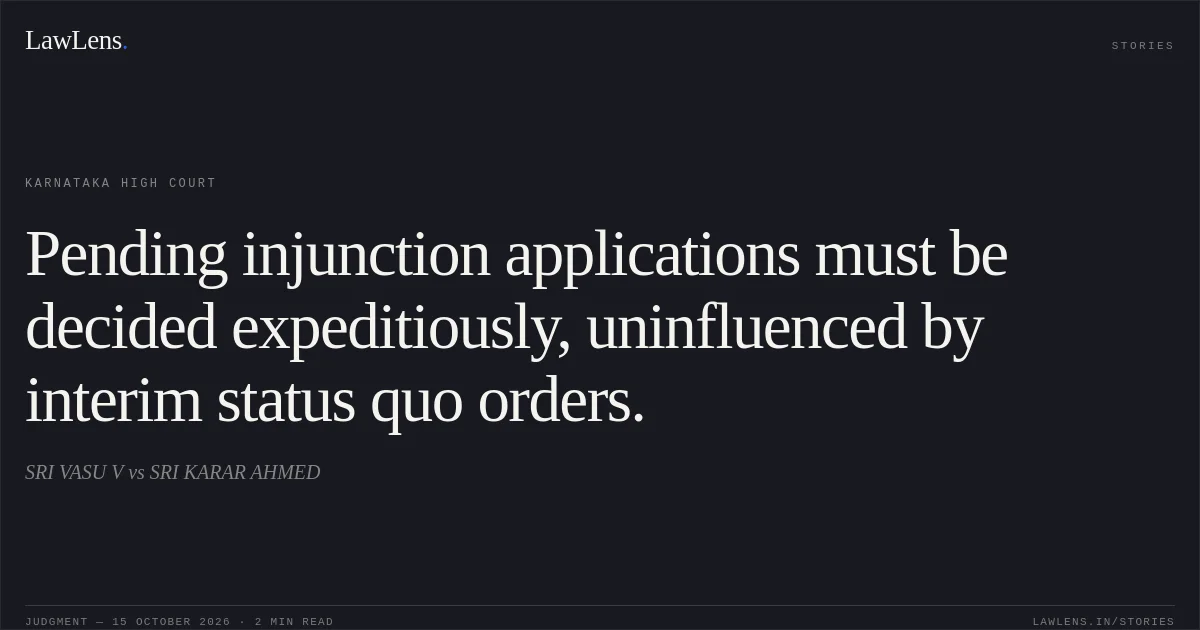
The writ petition was disposed of. The Trial Court was directed to decide the applications under Order XXXIX Rules 1 and 2 CPC within three weeks; either party could seek advancement of the matter.
The High Court’s status quo order dated 27 April 2026 was to continue until the applications were considered, but the Trial Court was not to be influenced by that order or by any findings in the High Court’s order.
Source reference: p. 8Original Court PDF
SRI VASU VvsSRI KARAR AHMED
Click to open original judgment
Original judgment, available to read, download and summarize on LawLens.in


