Facts
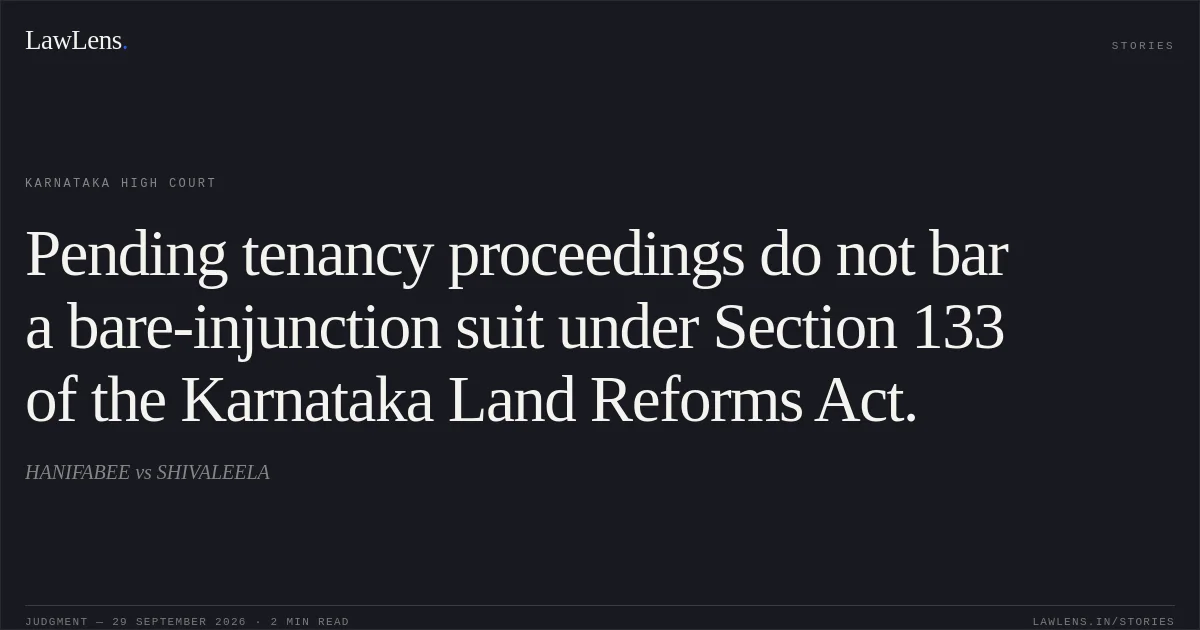
The petitioners, defendants in two suits for bare injunction before the Principal Civil Judge, Chincholi, sought a stay of the suits under Section 133(2) of the Karnataka Land Reforms Act, 1961, contending that tenancy proceedings concerning the suit lands were pending before the Land Tribunal.
Source reference: paras. 3, 6–7; pp. 8–11The Trial Court rejected the stay applications and granted temporary injunctions in favour of the plaintiffs.
Source reference: paras. 3, 6–7; pp. 8–11The defendants challenged both orders under Articles 226 and 227 of the Constitution, asserting that the civil court lacked jurisdiction.
Source reference: paras. 3, 6–7; pp. 8–11Issues
Whether the pending tenancy proceedings before the Land Tribunal barred the civil court from proceeding with the suits for bare injunction under Section 133 of the Karnataka Land Reforms Act, 1961.
Source reference: paras. 3, 8–9; pp. 8–12Whether the High Court should interfere under Article 227 with the Trial Court’s refusal to stay the suits and its grant of temporary injunction, particularly when an appellate remedy was available against the injunction orders.
Source reference: paras. 4, 10–12; pp. 9–14Law Applied
Section 133 of the Karnataka Land Reforms Act, 1961 bars civil-court jurisdiction in matters requiring determination by the Land Tribunal, including questions concerning the nature of land or tenancy, but its application depends on the subject matter and pleadings in the suit.
Source reference: paras. 8–9; pp. 11–13The Court relied on V. R. Shivakumaraswamy v. Sri Subramanya, W.P. No. 193/2024, decided 20 January 2026, for the proposition that Section 133 does not apply to a suit for permanent injunction simpliciter where the dispute, on its pleadings and circumstances, is not a matter for determination by the Land Tribunal.
Source reference: para. 8; pp. 11–12It also relied on Radhey Shyam v. Chhabi Nath, (2015) 5 SCC 423; K.P. Natarajan v. Muthalammal, AIR 2021 SC 3443; and Mohamed Ali v. V. Jaya, (2022) 10 SCC 477, concerning the limits of supervisory interference under Article 227.
Source reference: para. 8; p. 12An order granting temporary injunction is appealable, and the Court referred to Whirlpool Corporation v. Registrar of Trade Marks, (1998) 8 SCC 1, on the recognised exceptions to the rule that a writ may be declined where an alternative remedy is available.
Source reference: paras. 10, 12; pp. 13–14Reasoning
The Court considered the suits to be for bare injunction and, applying the reasoning in V. R. Shivakumaraswamy, held that the Trial Court was justified in rejecting the applications to stay them; the mere pendency of tenancy proceedings did not warrant the requested stay in these suits.
Source reference: paras. 8–9; pp. 11–13As to the temporary injunctions, the petitioners had an appellate remedy, and the Court found no basis to entertain the challenge under Article 227. It therefore left the merits of the injunction orders open for determination by the appellate court.
Source reference: paras. 10–12; pp. 13–14Holding
Both writ petitions were rejected as devoid of merit.
The Court upheld the Trial Court’s refusal to stay the suits and declined to review the temporary injunction orders under Article 227, reserving liberty to the petitioners to challenge those orders before the appellate court.
Source reference: paras. 9–14; pp. 13–15Acts & Sections Cited
1 provisions across 1 statute referred to in this judgment. Each provision opens on LawLens.
KARNATAKA LAND REFORMS ACT, 19611
Original Court PDF
HANIFABEEvsSHIVALEELA
Click to open original judgment
Original judgment, available to read, download and summarize on LawLens.in