Facts
Arjun Prasad Tripathi submitted a complaint to the Lokayukt alleging that Kunjan Lal Raikwar, an employee of the MPEB, demanded ₹200 as illegal gratification for processing his leave, travelling allowance and leave-encashment claims.
Source reference: para. 2, p. 1A trap was arranged, and phenolphthalein-treated currency notes were allegedly recovered in connection with Raikwar.
Source reference: para. 2, p. 1The Special Judge convicted Raikwar under Section 161 of the IPC and Section 5(1)(d) read with Section 5(2) of the Prevention of Corruption Act, 1947, but recorded that Tripathi had given false evidence and directed initiation of proceedings under Section 340 of the CrPC.
Source reference: para. 3, p. 2Raikwar was subsequently acquitted by the High Court, which nevertheless directed that action concerning Tripathi’s alleged false evidence be taken in accordance with law.
Source reference: para. 4, p. 2In MJC No. 15/1993, the First Additional Sessions Judge, Rewa, directed prosecution of Tripathi under Section 193 of the IPC. Tripathi challenged that order under Section 341 of the CrPC.
Source reference: paras. 1, 4–6, pp. 1–3Issues
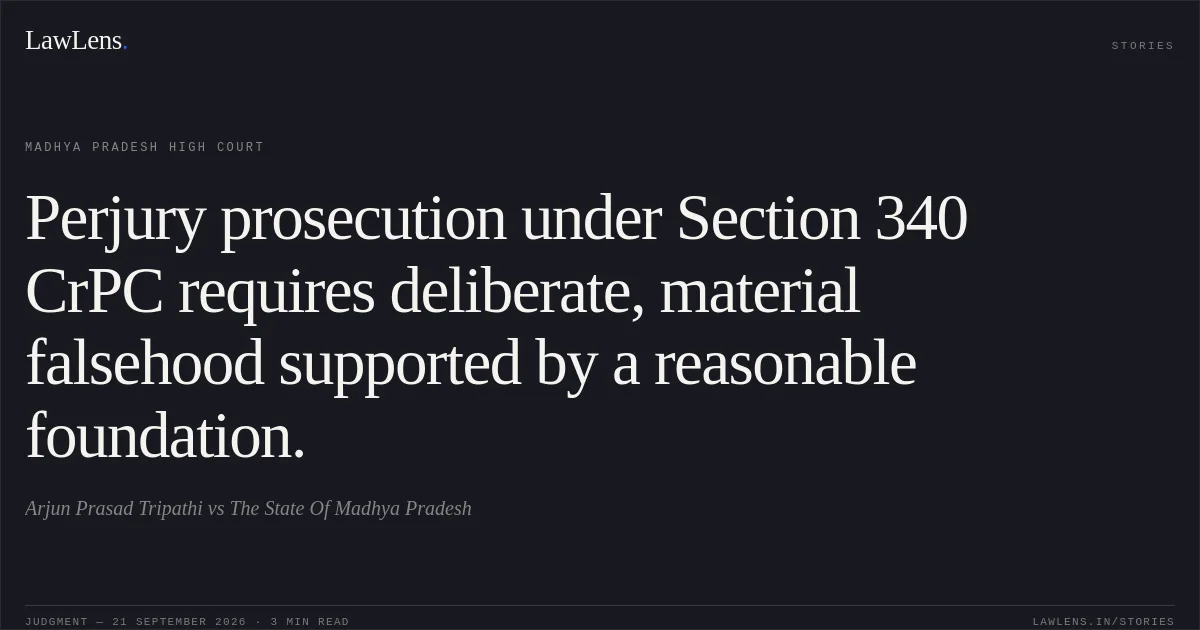
Whether the First Additional Sessions Judge committed an error in directing prosecution of Arjun Prasad Tripathi for an offence punishable under Section 193 of the IPC under Section 340 of the CrPC?
Source reference: para. 9, p. 4Whether the material on record disclosed a deliberate and intentional false statement on a material matter, making prosecution expedient in the interests of justice?
Source reference: paras. 10–11, pp. 4–5Law Applied
The Court applied Section 193 of the IPC, concerning giving or fabricating false evidence, together with Section 340 of the CrPC, which empowers a court to initiate a complaint where an offence affecting the administration of justice appears to have been committed.
Source reference: para. 10, pp. 4–5These authorities establish that perjury proceedings should not be initiated for every discrepancy or innocent inaccuracy; there must be a prima facie case of deliberate and intentional falsehood on a material matter, supported by a reasonable foundation or unimpeachable material, and prosecution must be expedient in the interests of justice.
Source reference: para. 10, pp. 4–5The Court summarised the requirements as: intentional and deliberate false evidence, materiality of the false evidence, and expediency of prosecution in the interests of justice.
Source reference: para. 11, p. 5Reasoning
The Court found that Tripathi had substantially resiled from his complaint and the prosecution version regarding the handing over of the phenolphthalein-treated currency notes to Raikwar and Raikwar’s receipt and possession of those notes.
Source reference: para. 12, p. 5In his deposition, Tripathi denied handing over the tainted currency or Raikwar’s keeping it in his trouser pocket, despite phenolphthalein traces having been detected on Raikwar’s hands and trouser pocket and despite other material supporting the prosecution case.
Source reference: para. 14, p. 6His explanation that he had signed the police statement and other documents hurriedly, without reading or understanding them, was considered unconvincing.
Source reference: para. 14, p. 6Since the contradictory testimony concerned the central facts of the trap and had a direct bearing on the criminal case against Raikwar, the Court held that the alleged falsehood was material.
Source reference: paras. 13–15, pp. 5–6The findings of the trial court and the appellate court provided a sufficient prima facie foundation for concluding that the testimony was deliberate and intentional, and that prosecution was expedient in the interests of justice.
Source reference: paras. 13–15, pp. 5–6Holding
The High Court held that the First Additional Sessions Judge correctly exercised jurisdiction under Section 340 of the CrPC and properly directed prosecution of Tripathi under Section 193 of the IPC.
The appeal was found to be meritless and was dismissed; the impugned order dated 28 July 2009 was not interfered with.
Source reference: paras. 14–16, pp. 6–7Acts & Sections Cited
5 provisions across 2 statutes referred to in this judgment. Each provision opens on LawLens.
Code of Criminal Procedure, 19733
Indian Penal Code, 18602
Original Court PDF
Arjun Prasad TripathivsThe State Of Madhya Pradesh
Click to open original judgment
Original judgment, available to read, download and summarize on LawLens.in