Facts
The parties married on 6 February 2013 and had a son.
Source reference: no citationThe husband obtained a decree for restitution of conjugal rights under Section 9 of the Hindu Marriage Act, 1955 (HMA), dated 20 February 2017; the decree was not set aside, but the parties did not resume cohabitation.
Source reference: p. 2–4, p. 8He later sought divorce under Section 13(1-A)(ii) HMA, and the Family Court granted a decree on 23 May 2022.
Source reference: p. 2–4, p. 8The wife appealed under Section 19(1) of the Family Courts Act, 1984.
Source reference: no citationDuring the appeal, she accepted that restitution was no longer possible because the husband had contracted a second marriage and confined her principal request to permanent alimony.
Source reference: p. 5–6, p. 8–10The High Court had directed the husband to file a financial affidavit in accordance with Rajnesh v. Neha, but found his disclosure inadequate.
Source reference: p. 5–6, p. 8–10Issues
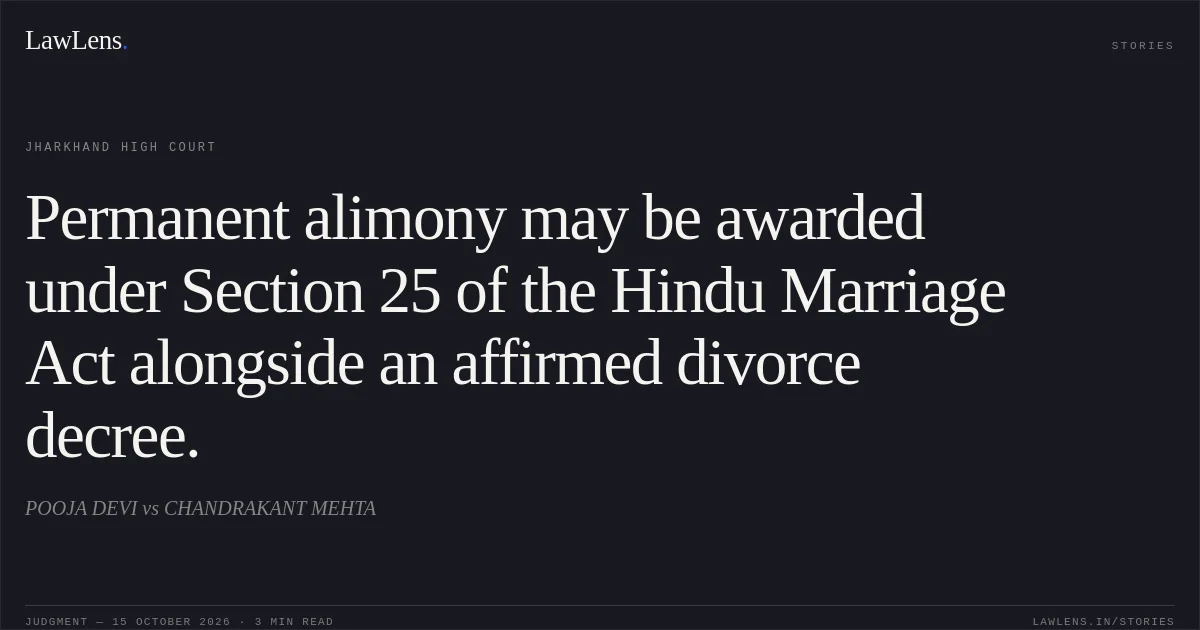
Whether the wife was entitled to permanent alimony under Section 25 HMA following the decree of divorce.
Source reference: p. 8, para. 16Whether the Family Court’s decree of divorce was in accordance with law, including whether the decree could stand despite the improper framing of an issue concerning cruelty by the wife.
Source reference: p. 8, p. 10–11, paras. 17, 22–23Law Applied
Section 13(1-A)(ii) HMA permits either spouse to seek divorce where there has been no restitution of conjugal rights for at least one year after a decree for restitution in proceedings to which both were parties.
Source reference: p. 1–2, para. 2Under Section 25(1) HMA, the court may award permanent alimony at the time of, or after, a decree, having regard to the parties’ income and property, conduct, and other circumstances.
Source reference: p. 9, para. 19The court also relied on Rajnesh v. Neha, (2021) 2 SCC 324, as the authority for financial disclosure by affidavit in maintenance proceedings.
Source reference: p. 5–6, p. 8, paras. 11, 18Issues and findings should not extend beyond the pleadings; the court held that the cruelty issue against the wife should not have been framed without amendment of the pleadings.
Source reference: p. 4–5, p. 10–11, paras. 9, 22Reasoning
The decree for restitution remained operative and had not been set aside, and the parties had not resumed conjugal life.
Source reference: p. 11, paras. 23–24The High Court therefore found no basis to interfere with the divorce decree under Section 13(1-A)(ii), particularly as the wife did not press that challenge during argument.
Source reference: p. 11, paras. 23–24It nevertheless held that the Family Court had improperly framed the issue alleging cruelty by the wife beyond the pleadings; that error did not displace the independent ground of non-restitution supporting the decree.
Source reference: p. 10–11, paras. 22–23On alimony, the wife earned an honorarium of Rs. 2,000 per month, had no immovable property, and supported the parties’ minor son; the husband’s affidavit inadequately disclosed his financial position despite the court’s direction.
Source reference: p. 8–10, paras. 18–20Considering the parties’ circumstances, the court found an award of Rs. 10,000 per month each for the wife and son just and reasonable.
Source reference: p. 11, para. 21Holding
The High Court dismissed the appeal insofar as it challenged the divorce decree and affirmed the dissolution of marriage.
It modified the relief by directing the husband to pay permanent alimony of Rs. 10,000 per month to the wife and Rs. 10,000 per month for the minor son until he attains majority, effective from 15 October 2026.
Source reference: p. 11–12, paras. 23–28The order does not prejudice recovery of any maintenance arrears already ordered by a competent court.
Source reference: p. 12, para. 27Acts & Sections Cited
5 provisions across 3 statutes referred to in this judgment. Each provision opens on LawLens.
Family Courts Act, 19841
Hindu Marriage Act, 19553
Code of Criminal Procedure, 19731
Original Court PDF
POOJA DEVIvsCHANDRAKANT MEHTA
Click to open original judgment
Original judgment, available to read, download and summarize on LawLens.in


