Facts
The appellant-wife challenged a Family Court decree dissolving her marriage under Section 13(1)(i-a) of the Hindu Marriage Act, 1955, on the ground of cruelty.
Source reference: para. 1, 9During the appeal, the parties stated that reconciliation was not possible and that the husband had remarried; the wife agreed to the divorce subject to permanent alimony and did not press the appeal on the merits of the divorce decree.
Source reference: para. 22, 39–46, 72–73The husband’s July 2026 salary records showed gross monthly salary of approximately ₹47,498 and net pay of ₹34,372; he also disclosed responsibilities for his elderly mother and his second family.
Source reference: para. 32–37, 74–75The wife had no independent source of income, and the Court recorded her age as approximately 47.
Source reference: para. 41–42, 85The Court therefore considered the quantum of permanent alimony without re-examining the merits of the divorce decree.
Source reference: para. 38Issues
1. Whether, in light of the parties’ positions and the husband’s remarriage, the wife was entitled to permanent alimony and, if so, what amount would be just and reasonable under Section 25 of the Hindu Marriage Act.
Source reference: para. 47–482. Whether the Family Court’s divorce decree required interference in the appeal, given that the wife did not press the appeal on its merits.
Source reference: para. 38, 41, 95Law Applied
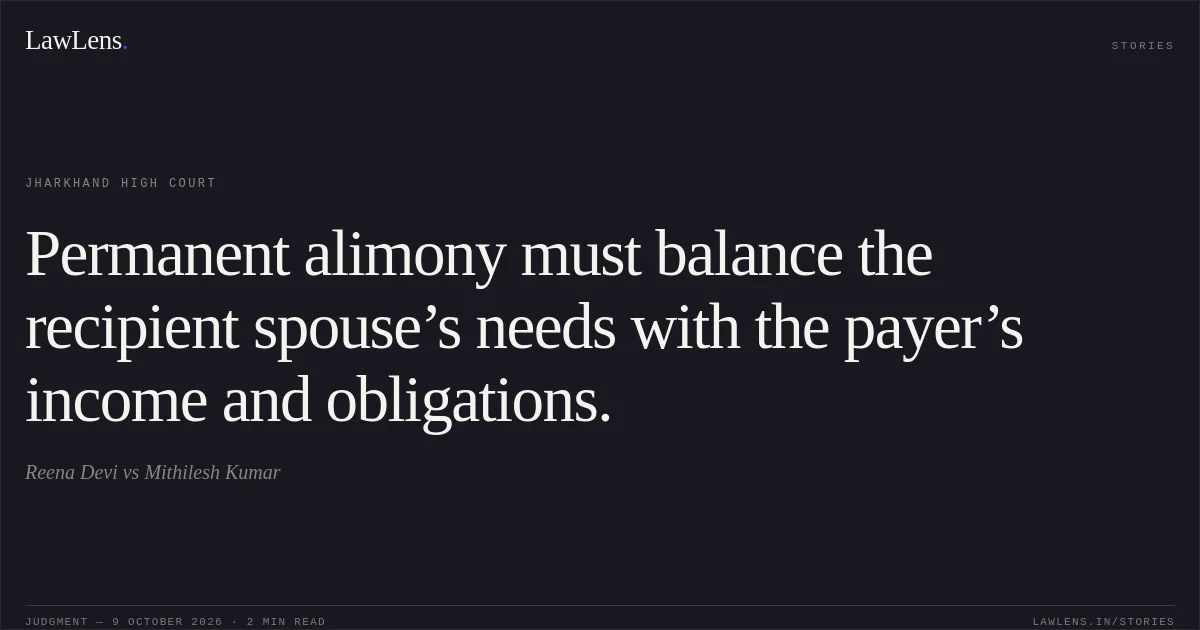
Section 25 of the Hindu Marriage Act, 1955 empowers a matrimonial court to award permanent alimony, having regard to the parties’ incomes and property, their conduct, and the circumstances of the case; an order may be varied where circumstances change.
Source reference: para. 48, 51–53Under Vinny Parmvir Parmar v. Parmvir Parmar, U. Sree v. U. Srinivas and Rajnesh v. Neha, there is no fixed formula for maintenance: the court considers, among other matters, the parties’ status and needs, the applicant’s independent income, the respondent’s actual income and obligations, and the standard of living the applicant enjoyed during the marriage.
Source reference: para. 54–56Rajnesh further requires a fair balance so that maintenance is neither excessive nor inadequate.
Source reference: para. 56The Court also referred to Kalyan Dey Chowdhury v. Rita Dey Chowdhury, observing that approximately 25% of the husband’s net salary may be a reasonable benchmark, but not a universal rule.
Source reference: para. 90Reasoning
The Court assessed the husband’s disclosed salary and obligations against the wife’s lack of independent income and need for financial security.
Source reference: para. 75–76, 85, 87–89It considered her age and future needs, while also recognising that the husband had to meet his own living expenses and support other dependants.
Source reference: para. 75–76, 85, 87–89Although the Court discussed a one-fourth salary-based calculation, it ultimately applied no rigid formula and concluded that a lump sum of ₹20,00,000 fairly balanced the husband’s capacity to pay with the wife’s need for support and future security.
Source reference: para. 86, 90–91Holding
The Court affirmed the divorce decree and modified the outcome by directing the husband to pay the wife ₹20,00,000 as permanent alimony.
The sum is payable in four equal instalments within 12 months of the order, with the first instalment due within two months; the wife may pursue legal remedies if payment is not made as directed.
Source reference: para. 92–93The appeal was disposed of and decreed in those terms.
Source reference: para. 96Acts & Sections Cited
6 provisions across 4 statutes referred to in this judgment. Each provision opens on LawLens.
Family Courts Act, 19841
Hindu Marriage Act, 19553
Code of Criminal Procedure, 19731
Special Marriage Act, 19541
Original Court PDF
Reena DevivsMithilesh Kumar
Click to open original judgment
Original judgment, available to read, download and summarize on LawLens.in